Question
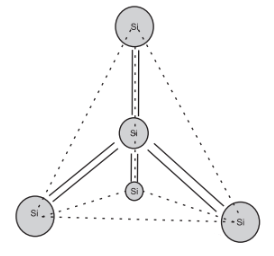
Explain characteristics and structure of silicon using a neat labelled diagram.

Answer

$1.$ Silicon $(Si)$ has atomic number $14$ and its electronic configuration is $1s^2 2s^2 2p^6 3s^2 3p^2.$
$2.$ Its valence is $4.$
$3.$ Each atom of $Si$ forms four covalent bonds with its neighbouring atoms. One $Si$ atom is surrounded by four $Si$ atoms at the comers of a regular tetrahedron as shown in the figure.
Image

Need a full question paper?

Generate a complete, print-ready paper with questions like this in minutes — across 16+ boards, with answer keys.
Start Generating Free

Similar questions

One of the effects of a force is to change the momentum. Define the quantity related to this and explain it for a variable
force. Usually when do we define it instead of using the force?
To understand the process of change of state:
Take some cubes of ice in a beaker. Note the temperature of ice (0 °C). Start heating it slowly on a constant heat source. Note the temperature after every minute. Continuously stir the mixture of water and ice. Observe the change in temperature. Continue heating even after the whole of ice gets converted into water. Observe the change in temperature as before till vapours start coming out. Plot the graph of temperature (along Y-axis) versus time (along X-axis). Obtain a graph of temperature versus time
Explain the concept of relative velocity along a straight line with the help of an example.
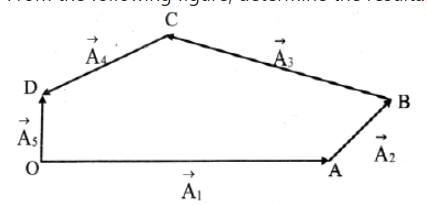
From the following figure, determine the resultant of four forces $\overrightarrow{ A }_1, \overrightarrow{ A }_2, \overrightarrow{ A }_3, \overrightarrow{ A }_4$
Image
What are some commonly known facts about magnetism?
Explain the use of dimensional analysis to check the correctness of a physical equation.
What are some features of $n-$type semiconductor?
Write short note on visible light.
A spring ball of mass 0.5 kg is dropped from some height. On falling freely for 10 s, it explodes into two fragments of
mass ratio 1:2. The lighter fragment continues to travel downwards with speed of 60 m/s. Calculate the kinetic energy supplied during explosion. [Ans: 200 J]
Explain space wave propagation.