Question
Explain Competition as a population Interaction with suitable examples.

Answer

→ It is a process in which fitness of one species ('r'value) is significantly lower in presence of another species.
→ Interspecific competition is a potent force in organic evolution.
→ Competition occurs when closely related species compete for the same limited resources.
→ Unrelated species can also compete for the resource. E.g. Flamingoes & fishes in some shallow South American lakes compete for zooplankton.
→ Competition occurs in abundant resources also. E.g. In interference competition, the feeding efficiency of one species is reduced due to the interfering and inhibitory presence of other species, even if resources are abundant.
Evidences for competition :
→ The Abingdon tortoise in Galapagos Islands became extinct within a decade after goats were introduced on the island, due to greater browsing efficiency of the goats.
→ Competitive release : It is the expansion of distributional range of a species when the competing species is removed.
→ Connell's field experiments : On the rocky sea coasts of Scotland, there are 2 barnacle species: Balanus (lager & competitively superior) & Chthamalus (smaller). Balanus dominates intertidal area and excludes Chthamalus. When Connell experimentally removed Balanus, Chthamalus colonized the intertidal zone.
→ Gause's 'Competitive Exclusion Principle' :
→ It states that two closely related species competing for the same resources cannot co- exist indefinitely and the competitively inferior one will be eliminated eventually. This may be true in limited resources, but not otherwise.
→ Species facing competition may evolve mechanisms for co-existence rather than exclusion. E.g. resource partitioning.
→ Resource partitioning : It is the division of limited resources by species to avoid competition. For this, they choose different feeding times or different foraging patterns. E.g. MacArthur showed that five closely related species of warblers living on a tree could avoid competition and co-exist due to behavioural differences in their foraging activities.
Need a full question paper?

Generate a complete, print-ready paper with questions like this in minutes — across 16+ boards, with answer keys.

Start Generating Free

Similar questions

Read the following and answer any four questions from (i) to (v) given below:

Ginkgo tree has been saved from extinction by selective breeding followed by channeling into trade of nature lovers. This is an ex-situ conservation, where endangered species are protected from all adverse factors. Offspring produced in captive breeding are released in natural habitat for acclimatisation.

  1. What is the significance of offsite collections?
  1. Restock depleted populations.
  2. Protection of endangered species.
  3. Reintroduce species in wild.
  4. All of these.
  1. Which of the following is not an ex-situ conservation?
  1. Wetlands
  2. Orchards
  3. Aquaria
  4. Botanical gardens.
  1. Select the incorrect statements for ex-situ conservation.
  1. It is conservation of species outside their natural habitats.
  2. Endangered species are kept under human supervision and provided all the essentials.
  3. The species population recovers in natural environment.
  4. Both (b) and (c).
  1. Conditions maintained in seed banks for orthodox seeds are:
  1. Low moisture content.
  2. Anaerobic conditions.
  3. Low temperature.
  4. All of these.
  1. Assertion: Animal species which have become extinct in wild continue to be maintained in zoological parks.

Reason: Captive breeding is the conservation of those cases where these is no realistic chance of in-situ survival.

  1. Both assertion and reason are true and reason is the correct explanation of assertion.
  2. Both assertion and reason are true but reason is not the correct explanation of assertion.
  3. Assertion is true but reason is false.
  4. Both assertion and reason are false.
Read the following and answer any four questions from (i) to (v) given below:

Cleavage is the series of rapid mitotic divisions in zygote and forms blastula. The 2, 4, 8, 16 daughter cells are called blastomeres. Embryo with 64 blastomeres is known as blastocyst and has blastocoel cavity. Blastocyst gets implanted in uterine wall and leads to pregnancy.

  1. Solid mass of cells with 16 blastomeres is called:
  1. Morula.
  2. Blastula.
  3. Gastrula.
  4. Zygote.
  1. At which stage of embryonic development, trophoectoderm develops?
  1. Zygote.
  2. Morula.
  3. Blastula.
  4. Gastrula.
  1. Site of implantation is:
  1. Endometrium of uterus.
  2. Cervix.
  3. Uterine fundus.
  4. Infundibulum of oviduct.
  1. Correct sequence of various structures formed during embryonic development is:
  1. Morula → Embryo → Gastrula → Blastula.
  2. Zygote → Embryo → Morula → Blastula.
  3. Blastula → Morula → Gastrula → Embryo.
  4. Zygote → Morula → Blastula → Gastrula.
  1. Assertion: Side of blastocyst with inner cell mass is called animal pole.

Reason: Inner cell mass gives rise to embryo.

  1. Both assertion and reason are true, and reason is the correct explanation of assertion.
  2. Both assertion and reason are true, but reason is not the correct explanation of assertion.
  3. Assertion is true, but reason is false.
  4. Both assertion and reason are false.
Read the following text carefully and answer the questions that follow:
Malaria and dengue fever are major mosquito-borne public health problems in tropical countries. The authors report a malaria and dengue co-infection in an 11-year-old boy who presented with sustained fever for 10 days. The physical examination revealed a flushed face, injected conjunctivae and left submandibular lymphadenopathy. His peripheral blood smear showed few ring-form trophozoites of Plasmodium falciparum. His blood tests were positive for dengue NS-1 antigen and IgM antibody, and negative for IgG antibody. After the initiation of antimalarial treatment with artesunate and mefloquine, his clinical condition gradually improved. However, he still had low-grade fever that persisted for 6 days. Finally, he recovered well without fluid leakage, shock or severe bleeding.
i. Name the fish that help in eradication of mosquito larvae.
ii. What is the reason of symptoms of malaria?
iii. Name the body parts and host in which following events takes place in life cycle of plasmodium.
a. asexual reproduction
b. sexual reproduction.
OR
Name some vector borne diseases and their vector.
Describe the process of DNA Fingerprinting in detail.
What is chromosomal disorder? Explain any two aneuploidy with characters in humans.###Mention any two autosomal genetic disorders with their symptoms.
Read the following and answer any four questions from (i) to (v) given below:

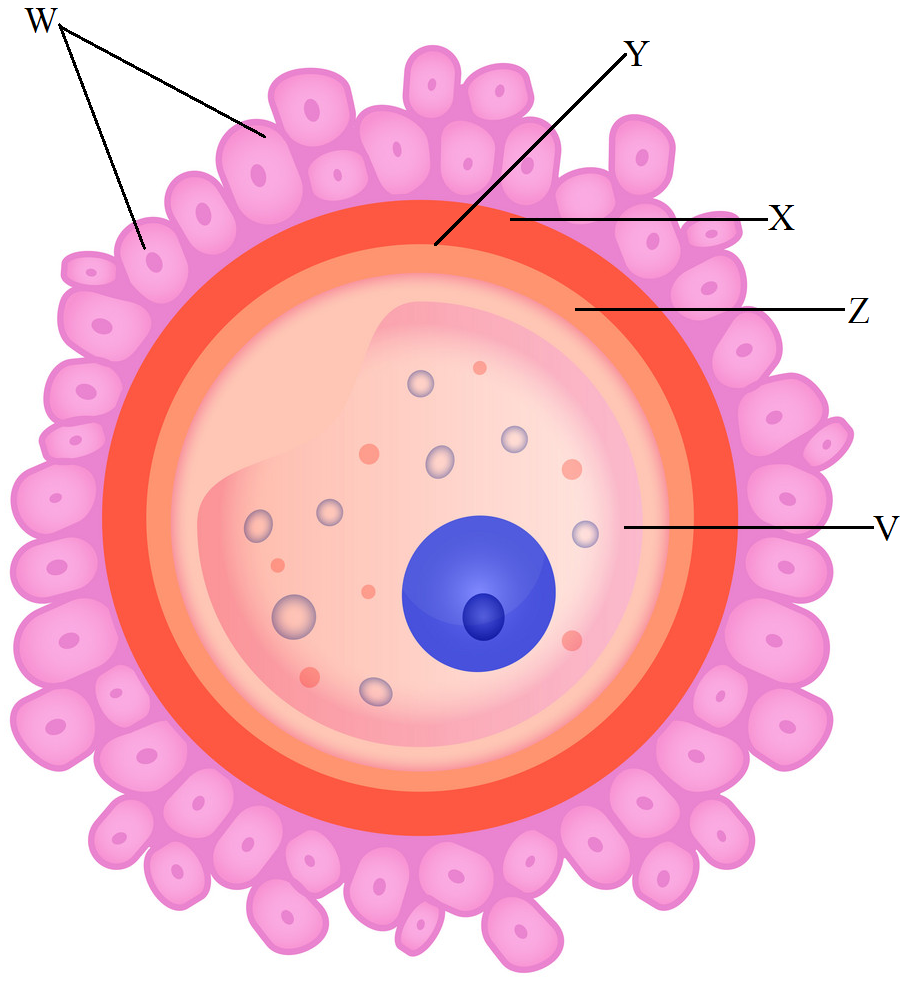
The mature ovum or a female gamete is spherical in shape. The human ovum is almost free of yolk and is said to be alecithal. Human ovum loses its ability to be fertilised about 24 hours after ovulation. Refer to the given structure of ovum and answer the following questions.

  1. Thick cellular layer formed of radially elongated follicular cells is:
  1. Zona pellucida.
  2. Plasma membrane.
  3. Perivitelline membrane.
  4. Corona radiata.
  1. In humans, at which stage does ovum get released from ovary?
  1. Secondary oocyte.
  2. Oogonium.
  3. Primary oocyte.
  4. First polar body.
  1. Cytoplasm of an ovum is enveloped by _____.
  1. Zona pellucida.
  2. Corona radiata.
  3. Cell membrane.
  4. Perivitelline space.
  1. Select the correct option:
S. No
V
W
X
(a)
Cytoplasm
Zona pellucida
Plasma membrane
(b)
Cortical granules
Corona radiata
Zona pellucida
(c)
Cortical granules
Plasma membrane
Corona radiata
(d)
Cytoplasm
Corona radiata
Zona pellucida
  1. Which of the following is not a characteristic of an ovum?
  1. Nucleus of an ovum has prominent nucleolus.
  2. Only one ovum formed from one oogonium.
  3. It lacks centrioles.
  4. It has very small amount of ooplasm.
Read the following and answer any four questions from (i) to (v) given below:

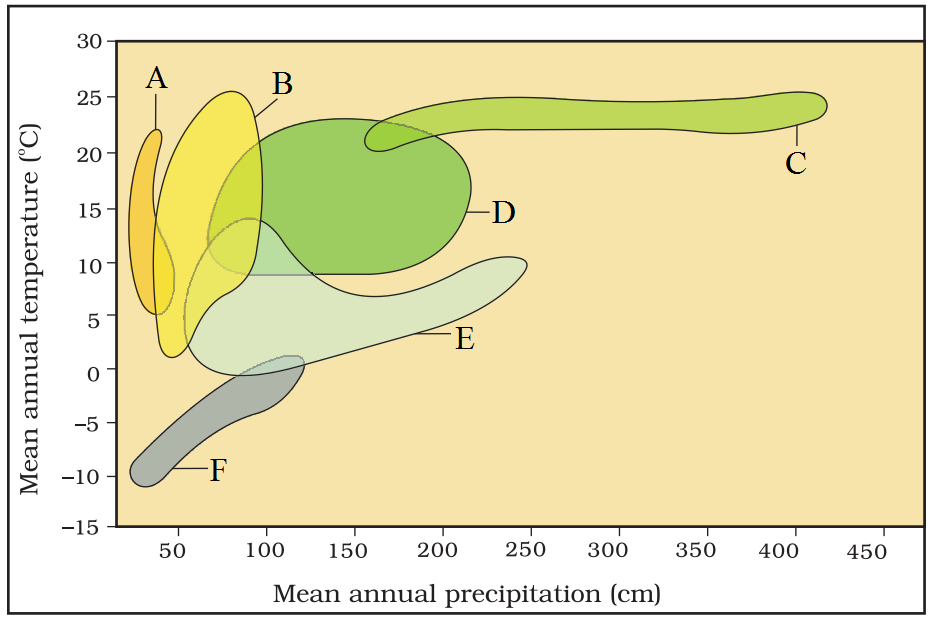
Organism P has thick lips and tongue so that it can easily feed on the commonly available spiny plants. Organism Q has thick layer of insulating fat under the skin. It was strong hooves to walk steadily on steep surfaces and lives in burrows during winters. Organism R has bright colours and sticky pads on its fingers and toes. It lives on trees.

  1. Which of the following is correct habitat for organisms P regarding its adaptation?
  1. Grassland biome.
  2. Desert biome.
  3. Tropical rainforest.
  4. Tropical deciduous forest.
  1. Which of the following is correct match regarding organism Q and its habitat?
  1. Tundra - Polar bear.
  2. Tropical rain forest - Deer.
  3. Grassland - Bighorn sheep.
  4. Desert - Camel.
  1. Which of the following is incorrect regarding organisms R's habitat?
  1. The vegetation shows stratification.
  2. Epiphytic growth is rich.
  3. Standing crop is highest.
  4. Deep rooted shrubs are common due to abundant sunlight.
  1. The dominant plants in habitat where P lives could be:
  1. Opuntia
  2. Nymphaea
  3. Deodar
  4. both (a) and (c).
  1. Organisms P, Q and R respectively most likely occur in:

  1. F, B and A.
  2. C, A, E.
  3. A, F and C.
  4. B, D and A.
Read the following and answer any four questions from (i) to (v) given below:
A group of teenagers was involved in drug abuse. 'They used syringes and needles to inject drugs. 'They indulged in this habit when they became adults. Administration of drug through needles became a piece of cake for them. Raj was the most active drug abuser amongst them and used to take drugs in high profile parties. In a span of time he started losing weight and suffered persistent diarrhoea. He developed constant low grade fever and used to catch opportunistic infection. When he consulted a doctor, he got himself tested for HIV in his blood and finally diagnosed with AIDS.
Based on the above information, answer the following questions.
  1. Select the incorrect statement.
  1. AIDS is a disorder of cell mediated immune system of the body.
  2. AIDS is caused by Human Immunodeficiency virus.
  3. AIDS infections were detected in India for the first time in prostitutes of Chennai, Tamil Nadu in 1986.
  4. December 10 is recalled as World AIDS Day.
  1. How do you think Raj got AIDS infection?
  1. Through transfusion of HIV infected blood
  2. Sexual intercourse with an infected partner
  3. Sharing towel with infected friend
  4. Use of contaminated needles and syringes to inject drugs
  1. How AIDS can be diagnosed?
  1. ELISA test
  2. Ames test
  3. Pap's test
  4. Wida! test
  1. How can AIDS be prevented?
  1. Blood tests of blood donor before transfusion to check for the presence of AIDS virus.
  2. Use of disposable needles and syringes for injecting medicines and vaccination
  3. Having protected sex by use of condoms
  4. All of these
  1. Select the correct statement for AIDS virus.
  1. It is rhomboid in shape with a diameter of 10-15 cm.
  2. Its genome consists of ds DNA.
  3. It consists of reverse transcriptase enzyme.
  4. Its envelope consists of lipid bilayer and three protein coats.
  1. What are the three options that can be thought of, to increase food production?
  2. Mention the reasons for the success of Green Revolution in increasing food production.
  3. Why do we still search for other alternatives to increase food production?
Explain Species-Area relationships graph.