Question
Explain elastic and inelastic collision. For head on elastic collision, obtained expressions for the velocities of the colliding particles after the collision. Also mention the special conditions of collision.

Answer

self

Need a full question paper?

Generate a complete, print-ready paper with questions like this in minutes — across 16+ boards, with answer keys.
Start Generating Free

Similar questions

A projectile shot at an angle of 60° above the horizontal ground strikes a vertical wall 30m away at a point 15m above the ground. Find the speed with which the projectile was launched and the speed with which it strikes the wall.
What do you understand by a driven simple harmonic oscillator? Derive the differential equation of its motion and explain it.
A circular coil of radius 2.00cm has 50 turns. A uniform magnetic field B - 0.200T exists in the space in a direction parallel to the axis of the loop. The coil is now rotated about a diameter through an angle of 60.0°. The operation takes 0.100s.
  1. Find the average emf induced in the coil.
  2. If the coil is a closed one (with the two ends joined together) and has a resistance of $4.00\Omega.$ calculate the net charge crossing a cross-section of the wire of the coil.
When a body slides down from rest along a smooth inclined plane making an angle of 45° with the horizontal, it takes time T. When the same body slides down from rest along a rough inclined plane making the same angle and through the same distance, it is seen to take time pT, where p is some number greater than 1. Calculate the co-efficient of friction between the body and the rough plane.
The temperature and pressure at Simla are 15.0°C and 72.0cm of mercury and at Kalka these are 35.0°C and 76.0cm of mercury. Find the ratio of air density at Kalka to the air density at Simla.
Derive an expression for velocity of a car on a banked circular road having coefficient of friction $\mu$ and $\text{v}>\text{v}_0.$ Write the expression for optimum velocity of the car. (v: speed of car, vo: optimum speed)
You are riding in an automobile of mass 3000kg. Assuming that you are examining the oscillation characteristics of its suspension system. The suspension sags 15cm when the entire automobile is placed on it. Also, the amplitude of oscillation decreases by 50% during one complete oscillation. Estimate the values of (a) the spring constant k and (b) the damping constant b for the spring and shock absorber system of one wheel, assuming that each wheel supports 750kg.
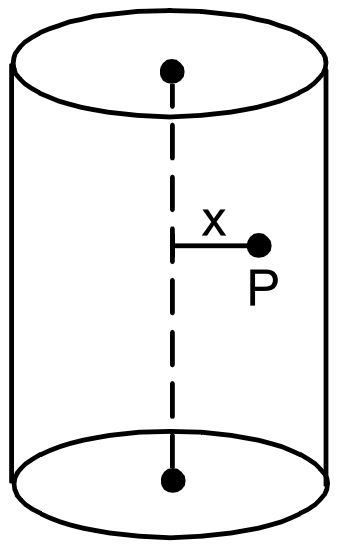
A long cylindrical volume contains a uniformly distributed charge of density $\rho.$ Find the electric field at a point P inside the cylindrical volume at a distance x from its axis (figure).

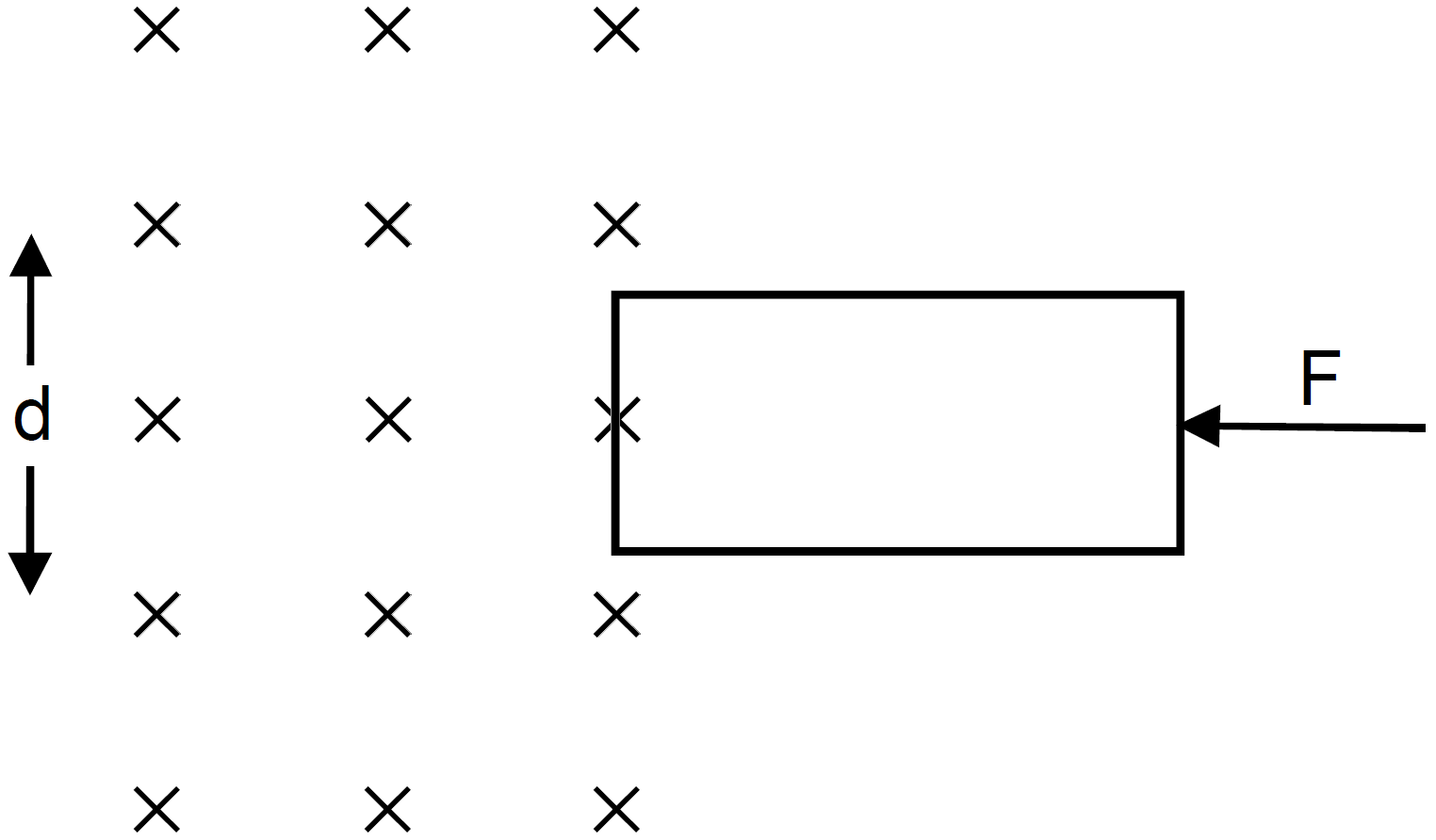
The rectangular wire-frame, shown in figure, has a width d, mass m, resistance R and a large length. A uniform magnetic field B exists to the left of the frame. A constant force F starts pushing the frame into the magnetic field at t = 0.

  1. Find the acceleration of the frame when its speed has increased to v.
  2. Show that after some time the frame will move with a constant velocity till the whole frame enters into the magnetic field. Find this velocity v0.
  3. Show that the velocity at time t is given by $\text{v}=\text{v}_0\Big(1-\text{e}^{-\frac{\text{ft}}{\text{mv}_0}}\Big)$

A satellite of mass 1000kg is supposed to orbit the earth at a height of 2000km above the earth's surface. Find
  1. Its speed in the orbit.
  2. Its kinetic energy.
  3. The potential energy of the earth-satellite system.
  4. Its time period. Mass of the earth = 6 × 1024kg.