Question
Explain electrostatic potential.
Answer

The work done in taking the test charge from one point to the other point in the electric field created by an electric charge distribution is stored in the form of potential energy and is proportional to charge $q$.
If this work is divided by $q$, then the resulting quantity does not depend on $q$. In this way, work done per unit charge is the characteristic of electric field, which can be defined as static electric potential.
The work done by external force in taking unit positive charge from $R$ to P ,
$\frac{ W _{ RP }}{q}=\frac{ U _{ P }- U _{ R }}{q}= V _{ P }- V _{ R }=\Delta V$ Where, $V _{ P }$ and $V _{ R }$ are electrostatic potential at points $P$ and $R$ respectively.
There is no importance of absolute value of electric potential. It is only the difference of electric potential between two points, which is important.
If electric potential at infinite distance is taken zero then,
"Work done in bringing unit positive charge from infinity to the given point in the electric field, against the electric field is called electro static potential (V) at that point".
OR
→"In the region of static electric field, electric potential at any point, means work done by external force in bringing unit positive charge from infinity to that point, without acceleration."
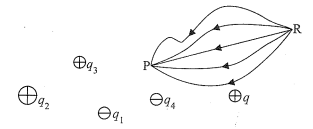
The work done in taking the test charge $q$ in the given electric field, does not depend on path. It depends only on the initial position and final position.

Image

As shown in the fig., in the resultant (net) electric field of electric charges $q_1, q_2, q_3$, $q_4$, the work done in taking the test charge $q$ from point R to P , on different paths, is found same which indicates that the work done is independent of path.

Need a full question paper?

Generate a complete, print-ready paper with questions like this in minutes — across 16+ boards, with answer keys.

Start Generating Free

Similar questions

What are the advantages of using soft iron as a core, instead of steel, in the coils of galvanometers?
The equation of a wave travelling on a string is:

$\text{y}=(0.10\text{mm})\sin\big[(31.4\text{m}^{-1})\text{x}+(314\text{s}^{-1})\text{t}\big].$
  1. In which direction does the wave travel?
  2. Find the wave speed, the wavelength and the frequency of the wave.
  3. What is the maximum displacement and the maximum speed of a portion of the string?
In a pure semiconductor, the number of conduction electrons is 6 × 10¹⁹ per cubic metre. How many holes are there in a sample of size 1cm × 1cm × 1mm?
In a Quincke's experiment, the sound intensity has a minimum value I at a particular position. As the sliding tube is pulled out by a distance of 16.5mm, the intensity increases to a maximum of 9I. Take the speed of sound in air to be 330m/s.
  1. Find the frequency of the sound source.
  2. Find the ratio of the amplitudes of the two waves arriving at the detector assuming that it does not change much between the positions of minimum intensity and maximum intensity.
A cubical box of volume 216cm3 is made up of 0.1cm thick wood. The inside is heated electrically by a 100W heater. It is found that the temperature difference between the inside and the outside surface is 5°C in steady state. Assuming that the entire electrical energy spent appears as heat, find the thermal conductivity of the material of the box.
The current through a wire depends on time as $\text{i}=\text{i}_0+\alpha\text{t},$
Where $\text{i}_0=10\text{A}$ and $\alpha=4\text{A/ s}.$ Find the charge that crosses through a section of the wire in 10 seconds.
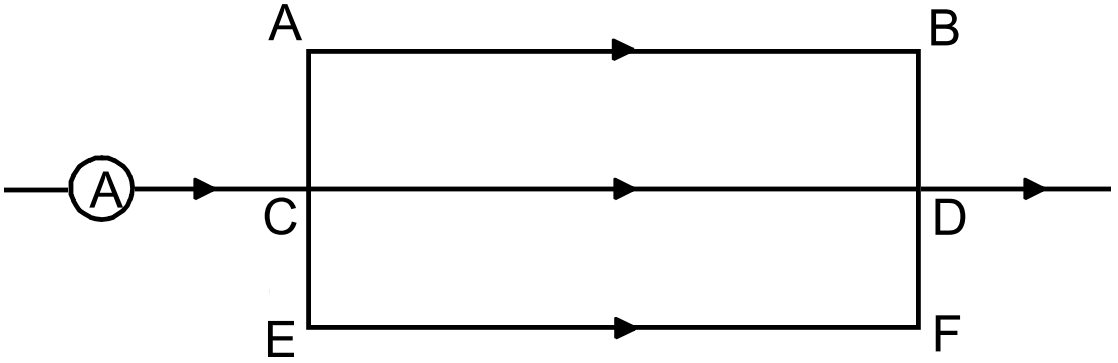
Figure shows a part of an electric circuit. The wires AB, CD and EF are long and have identical resistances. The separation between the neighbouring wires is 1.0cm. The wires AE and BF have negligible resistance and the ammeter reads 30A. Calculate the magnetic force per unit length of AB and CD.

At what temperature the mean speed of the molecules of hydrogen gas equals the escape epeed from the earth?
In a p-n junction, the depletion region is 400nm wide and an electric field of 5 × 10⁵V/m exists in it.
  1. Find the height of the potential barrier.
  2. What should be the minimum kinetic energy of a conduction electron which can diffuse from the n-side to the p-side?
Compute the typical de Broglie wavelength of an electron in a metal at 27ºC and compare it with the mean separation between two electrons in a metal which is given to be about 2 × 10–10 m.