Question
In a Quincke's experiment, the sound intensity has a minimum value I at a particular position. As the sliding tube is pulled out by a distance of 16.5mm, the intensity increases to a maximum of 9I. Take the speed of sound in air to be 330m/s.
  1. Find the frequency of the sound source.
  2. Find the ratio of the amplitudes of the two waves arriving at the detector assuming that it does not change much between the positions of minimum intensity and maximum intensity.
Answer

  1. According to the data

$\frac{\lambda}{4}=16.5\text{mm}$

$\Rightarrow\lambda=66\text{mm}=66\times10^{-3}\text{m}$

$\Rightarrow\text{n}=\frac{\text{V}}{\lambda}=\frac{330}{66\times10^{-3}}=5\text{KHz}$

  1. $\text{I}_\text{minimum}=\text{K}(\text{A}_1-\text{A}_2)^2=\text{I}\Rightarrow\text{A}_1-\text{A}_2=11$

$\text{I}_\text{minimum}=\text{K}(\text{A}_1+\text{A}_2)^2=9\Rightarrow\text{A}_1+\text{A}_2=31$

So, $\frac{\text{A}_1+\text{A}_2}{\text{A}_1+\text{A}_2}=\frac{\text{3}}{4}$

$\Rightarrow\frac{\text{A}_1}{\text{A}_2}=\frac{2}{1}$

So, the ratio amplitudes is 2.

Need a full question paper?

Generate a complete, print-ready paper with questions like this in minutes — across 16+ boards, with answer keys.

Start Generating Free

Similar questions

  1. Define the term ‘intensity of radiation’ in terms of photon picture of light.
  2. Two monochromatic beams, one red and the other blue, have the same intensity. In which case (i) The number of photons per unit area per second is larger, (ii) The maximum kinetic energy of the photoelectrons is more? Justify your answer.
Given a uniformly charged plane/sheet of surface charge density, $\sigma=2\times10^{17}\text{C/m}^2.$

Image

  1. Find the electric field intensity at a point A, 5mm away from the sheet on the left side.
  2. Given a straight line with three points X, Y and Z placed 50cm away from the charged sheet on the right side. At which of these points, the field due to the sheet remain the same as that of point A and why?
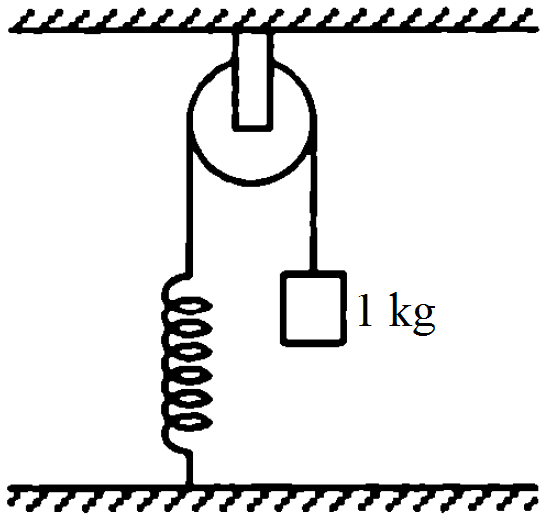
The pulley shown in figure has a radius of 20cm and moment of inertia 0.2kg-m2. The string going over it is attached at one end to a vertical spring of spring constant 50N/m fixed from below, and supports a 1kg mass at the other end. The system is released from rest with the spring at its natural length. Find the speed of the block when it has descended through 10cm. Take g = 10m/s2.

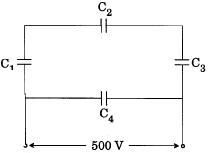
A network of four capacitors each of 12 μF capacitance is connected to a 500 V supply as shown in the figure. Determine (a) equivalent capacitance of the network and (b) charge on each capacitor. 

Sketch a graph showing the variation of fringe width versus the distance of the screen from the plane of the slits (keeping other parameters same) in Young’s double slit experiment. What information can one obtain from the slope of this graph?
A small piece of wood is floating on the surface of a 2.5m deep lake. Where does the shadow form on the bottom when the sun is just setting? Refractive index of water $=\frac{4}{3}.$
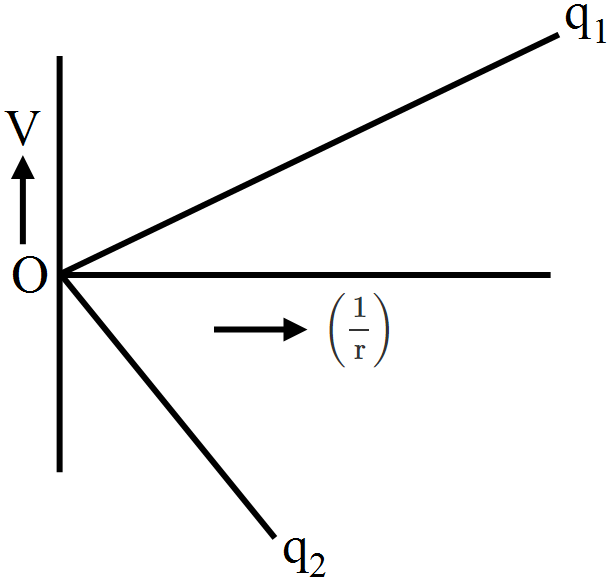
The two graphs are drawn below, show the variations of electrostatic potential (V) $\frac{1}{\text{r}}$ (r being the distance of field point from the point charge) for two point charges q1 and q2.
  1. What are the signs of the two charges?
  2. Which of the two charges has the larger magnitude and why?
​​​​​​​​​​​​​​
A square plate of mass 120g and edge 5.0cm rotates about one of the edges. If it has a uniform angular acceleration of 0.2rad/s2, what torque acts on the plate?
  1. Draw the energy level diagram showing the emission of b-particles followed by γ-rays by a $\text{ }^{60}_{27}\text{Co}$ nucleus.
  2. Plot of distribution of KE of b-particles is shown in fig. (b).


The condition of air in a cloeed room is described as follows. Temperature = 25°C, relative humidity = 60%, pressure = 104kPa. lf all the water vapour is removed from the room without changing the temperature, what will be the new pressure? The saturation vapour pressure at 25°C = 3.2kPa.