MAGNETISM AND MATTER — Physics STD 12 Science — Question
Bihar BoardEnglish MediumSTD 12 SciencePhysicsMAGNETISM AND MATTER2 Marks
Question
Explain ferromagnetism and ferromagnetic substances.
✓
Answer
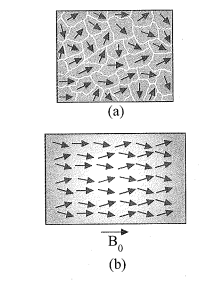
→Ferromagnetic substances are those which get strongly magnetised when placed in an external magnetic field. →The individual atoms in a ferromagnetic material possess a dipole moment as in a paramagnetic material. →The neighbouring atoms are bound by strong attraction force. This bonding however, is limited to a small region. The atoms (molecules) in such small regions (small microscopic volumes) interact in such a way that their dipole moments are aligned in a common direction. Such regions (macroscopic volumes) are called domain(s). →Each domain has some net magnetisation. But the magnetisation varies randomly from domain to domain, and there is no bulk magnetisation. →Typical domain size is 1 mm and the domain contains about $10^{11}$ atoms.
→When external magnetic field $\left(\overrightarrow{ B _0}\right)$ is applied, the domains orient themselves in the direction of $\vec{B}_0$. →Simultaneously the domain oriented in the direction of $\overrightarrow{B_0}$ grow in size. As shown in fig. (b) all domains merge gradually and make a larger/'giant' domain. →Thus, in a ferromagnetic material, field lines are highly concentrated. →When such materials are placed in non-uniform magnetic field, they are attracted towards strong magnetic field. →Examples : Some Ferromagnetic materials such as iron, cobalt, nickel, gadolinium etc. have relative magnetic permeability $>1000$.
Need a full question paper?
Generate a complete, print-ready paper with questions like this in minutes — across 16+ boards, with answer keys.