Question
Explain gravitational potential at a point in gravitational field. Give relation between gravitational field intensity and gravitational potential.

Answer

Gravitational potential at a point in a gravitational field of a body is defined as the amount of work done in bringing a body of unit mass from infinity to that point without acceleration.
Consider two points A and B, distance dr apart in a uniform gravitational field of intensity $\vec{\text{I}}$ Let the direction of $\vec{\text{I}}$ be along AB.
Gravitational force on the particle of mass m placed at B will be, $\vec{\text{F}}=\text{m}\vec{\text{I}}.$
Work done by gravitational force for the displacement of the particle from B to A (i.e. a displacement $\overrightarrow{\text{dr}})$ will be
$\text{dW}=\vec{\text{F}}.\overrightarrow{\text{dr}}=\text{m}\vec{\text{I}}.\ \overrightarrow{\text{dr}}=\text{mI}\text{ dr }\cos180^\circ$
Change in gravitational potential,
$\text{dV}=\frac{\text{dW}}{\text{m}}=-\text{Idr}$
$\Rightarrow\text{I}=-\frac{\text{dV}}{\text{dr}}$
$\text{Here,}\frac{\text{dV}}{\text{dr}}$ is called gravitational potential gradient.

Need a full question paper?

Generate a complete, print-ready paper with questions like this in minutes — across 16+ boards, with answer keys.
Start Generating Free

Similar questions

Three samples A, B and C of the same gas $(\gamma=1.5)$ have equal volumes and temperatures. The volume of each sample is doubled, the process being isothermal for A, adiabatic for B and isobaric for C. If the final pressures are equal for the three samples, find the ratio of the initial pressures.
When a body slides down from rest along a smooth inclined plane making an angle of 45° with the horizontal, it takes time T. When the same body slides down from rest along a rough inclined plane making the same angle and through the same distance, it is seen to take time pT, where p is some number greater than 1. Calculate the co-efficient of friction between the body and the rough plane.
The speed of a motor launch w.r.t still water is 7ms-1 and the speed of the stream is 3ms-1. When the launch began travelling upstream, a float was dropped from it. The launch travelled 4.2km upstream, turned about and caught up with the float. How long is it, before the launch reached the float?
An electron and a proton are detected in a cosmic ray experiment, the first with kinetic energy 10keV, and the second with 100keV. Which is faster, the electron or the proton? Obtain the ratio of their speeds. (electron mass = 9.11 × 10⁻³¹kg, proton mass = 1.67 × 10⁻²⁷kg, 1eV = 1.60 × 10⁻¹⁹J).
Two cylindrical hollow drums of radii R and 2R, and of a common height h, are rotating with angular velocities $\omega$ (anti-clockwise) and $\omega$ (clockwise), respectively. Their axes, fixed are parallel and in a horizontal plane separated by $(3\text{R}+\delta).$ They are now brought in contact $(\delta\rightarrow0){:}$
  1. Show the frictional forces just after contact.
  2. Identify forces and torques external to the system just after contact.
  3. What would be the ratio of final angular velocities when friction ceases?
One end of a 10cm long silk thread is fixed to a large vertical surface of a charged nonconducting plate and the other end is fastened to a small ball having a mass of 10g and a charge of 4.0 × 10⁻⁵C. In equilibrium, the thread makes an angle of 60° with the vertical. Find the surface charge density on the plate.
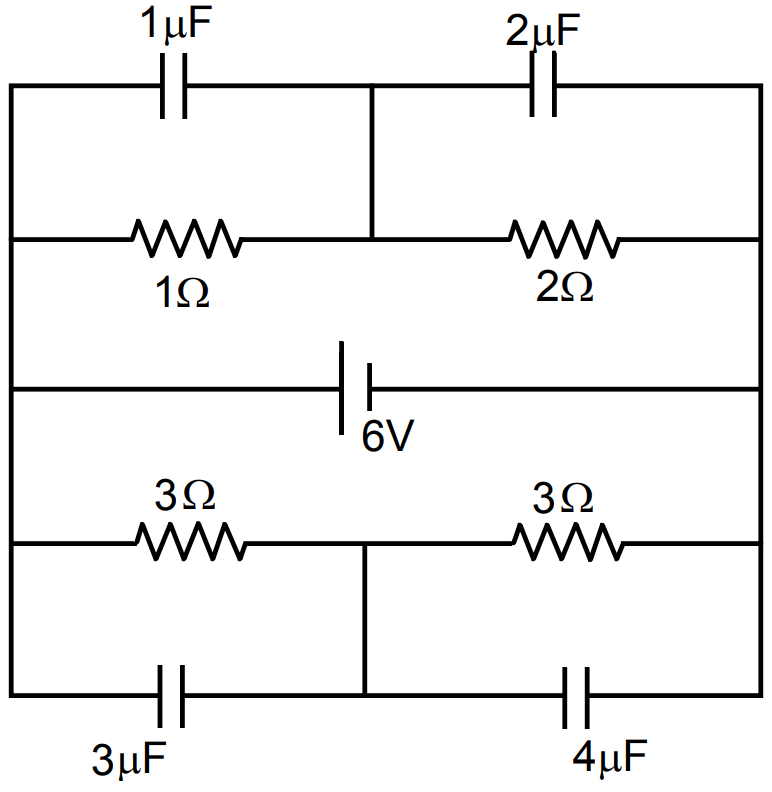
Find the charges on the four capacitors of capacitances $1\mu\text{F},2\mu\text{F},3\mu\text{F}$ and $4\mu\text{F}$ shown in the figure.

A bullet of mass 20g moving horizontally at a speed of 300m/s is fired into a wooden block of mass 500g suspended by a long string. The bullet crosses the block and emerges on the other side. If the centre of mass of the block rises through a height of 20.0cm, find the speed of the bullet as it emerges from the block.
The difference in the frequencies of series limit of Lyman series and Balmer series is equal to the frequency of the first line of the Lyman series. Explain.
Two blocks of masses 400g and 200g are connected through a light string going over a pulley which is free to rotate about its axis. The pulley has a moment of inertia 1.6 x 10⁻⁴kg-m2 and a radius 2.0cm. Find:
  1. The kinetic energy of the system as the 400g block falls through 50cm.
  2. The speed of the blocks at this instant.