Question
Explain how Carnot's cycle works with the heat flow diagram. Using the same, explain the working of a refrigerator. Also, give its coefficient of performance.
Answer

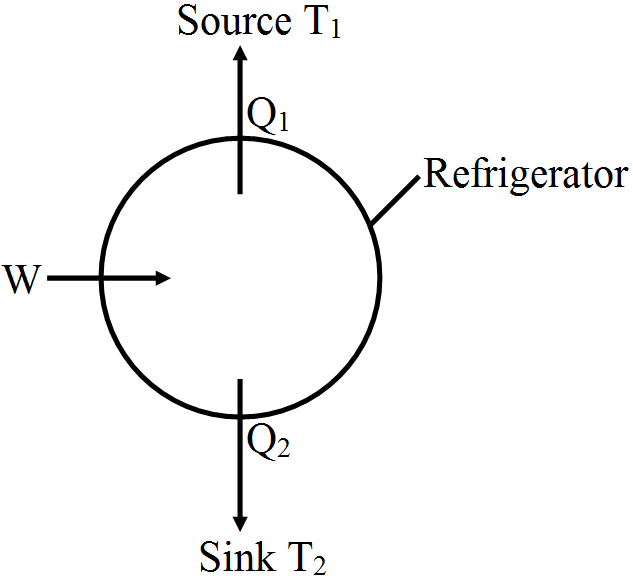
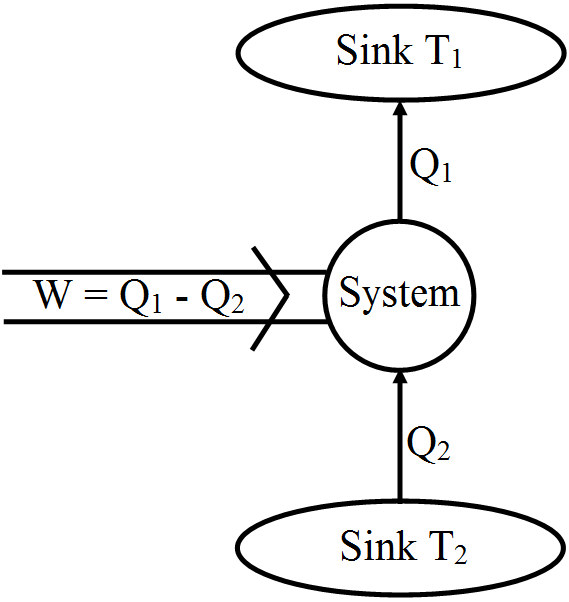
Refrigerator absorbs heat from the body at a low temperature and liberates it to a body at a high temperature by doing work. It can be shown by the given diagram.
Q2→ Energy absorbed from sink.
Q1 → Energy liberated to source.
W → Work done on the system.

Coefficient of performance $=\frac{\text{Q}_2}{\text{Q}_1-\text{Q}_2}$
Q1 – Q2 refers to the work done on the system/refrigerator.
Coefficient of performance (COP) $=\frac{\text{Q}_2}{\text{Q}_1-\text{Q}_2}=\frac{\text{T}_2}{\text{T}_1-\text{T}_2}$
Refrigerator: It works in the reverse Carnot's cycle. Heat is absorbed from sink at low temperature T2 and given to the source at higher temperature T1 with the help of an external agency doing work on the system. (W = Q1 - Q2).

The compressor in the refrigerator uses electrical energy and does work on the system. The coefficient of performance is defined as the heat energy absorbed from low temperature sink Q2 to the amount of work done.
$\text{W}=\text{Q}_1-\text{Q}_2$
$\text{COP}=\frac{\text{Q}_2}{\text{Q}_1-\text{T}_2}=\frac{\text{T}_2}{\text{T}_1-\text{T}_2}$

Need a full question paper?

Generate a complete, print-ready paper with questions like this in minutes — across 16+ boards, with answer keys.
Start Generating Free

Similar questions

A glass vessel measures exactly 10cm × 10cm × 10cm at 0°C. It is filled completely with mercury at this temperature. When the temperature is raised to 10°C, 1.6cm3 of mercury overflows. Calculate the coefficient of volume expansion of mercury. Coefficient of linear expansion of glass = 6.5 × 10⁻⁶ °C.
In the previous problem, if 15.0cm of water and spirit each are further poured into the respective arms of the tube, what is the difference in the levels of mercury in the two arms? (Specific gravity of mercury = 13.6)
A wire of length L and radius r is clamped rigidly at one end. When the other end of the wire is pulled by a force f, its length increases by l. Another wire of the same material of length 2L and radius 2r, is pulled by a force 2f. Find the increase in length of this wire.
A compound microscope consists of an objective of focal length 1cm and an eyepiece of focal length 5cm. An object is placed at a distance of 0.5cm from the objective. What should be the separation between the lenses so that the microscope projects an inverted real image of the object on a screen 30cm behind the eyepiece?
A disc of radius R is cut out from a larger disc of radius 2R in such a way that the edge of the hole touches the edge of the disc. Locate the centre of mass of the residual disc.
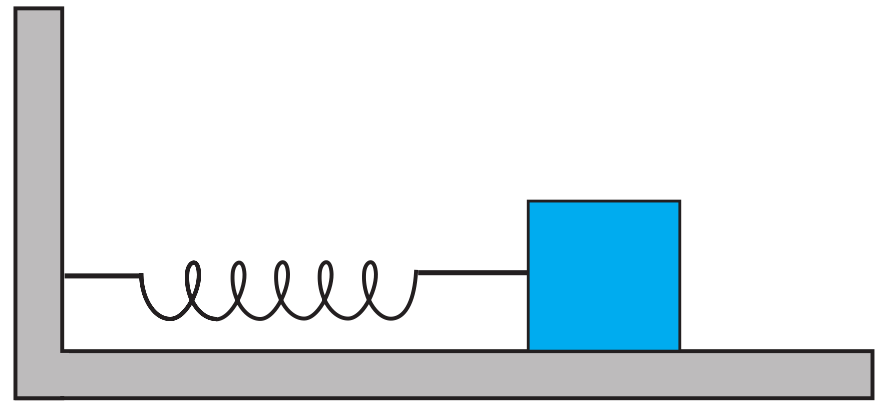
A spring having with a spring constant 1200N m-1 is mounted on a horizontal table as shown in Fig. A mass of 3kg is attached to the free end of the spring. The mass is then pulled sideways to a distance of 2.0cm and released.

Determine (i) the frequency of oscillations, (ii) maximum acceleration of the mass, and (iii) the maximum speed of the mass.

A metre long narrow bore held horizontally (and closed at one end) contains a 76cm long mercury thread, which traps a 15cm column of air. What happens if the tube is held vertically with the open end at the bottom?
In an experiment with Foucault's apparatus, the various distances used are as follows:
Distance between the rotating and the fixed mirror = 16m
Distance between the lens and the rotating mirror = 6m
Distance between the source and the lens = 2m
When the mirror is rotated at a speed of 356 revolutions per second, the image shifts by 0.7mm. Calculate the speed of light from these data.
A circular disc of mass 10kg is suspended by a wire attached to its centre. The wire is twisted by rotating the disc and released. The period of torsional oscillations is found to be 1.5s. The radius of the disc is 15cm. Determine the torsional spring constant of the wire. (Torsional spring constant $\alpha$ is defined by the relation $\text{J}=-\alpha\theta,$ where J is the restoring couple and $\theta$ the angle of twist).
Refer to the graphs in Fig. Match the following.
Graph
 
Characteristic
a.
i.
has v > 0 and a < 0 throughout.
b.
ii.
has x > 0 throughout and has a point with v = 0 and a point with a = 0.
c.
iii.
has a point with zero displacement for t > 0.
d.
iv.
has v < 0 and a > 0.