Question
Explain how does the polarized dielectric modify the original external field inside it ?
Answer

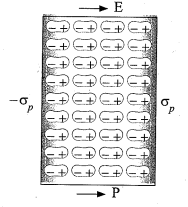
As shown in the figure, consider a rectangular (/ cuboid) dielectric slab placed in a uniform external field $\overrightarrow{ E _0}$.
Due to this, the dipole moments are aligned almost parallel to $\overrightarrow{ E _0}$.

Image
The situation shown in the figure is an ideal situation, at 0K (zero kelvin) temperature, The external field causes almost uniform polarization $\overrightarrow{ P }$ of the dielectric, Thus every volume element $\Delta V$ of the slab has a dipole moment $\overrightarrow{ P } \Delta V$.
Inside the dielectric, the net charge inside the volume element $\Delta V$ is zero. This is because the positive charge of one dipole sits close to and hence cancels out the effect of the negative charge of the neighbouring dipole. However, at the surface of the dielectric net, surface density is not zero because as shown in the figure, the positive ends of the dipoles remain unneutralized at the right surface and the negative ends at the left surface. These unbalanced charges are the induced charges due to the external electric field. Therefore, there is some net surface charge density on the surface of the dielectric.
The induced electric charge is also known as bound charge.
Thus the polarized dielectric is equivalent to two charged surfaces with induced surface charge densities, say $\sigma_p$ and $-\sigma_p$.
The field produced by these surface charges opposes the external electric field. The total field in the dielectric is, there by, reduced.

Need a full question paper?

Generate a complete, print-ready paper with questions like this in minutes — across 16+ boards, with answer keys.
Start Generating Free

Similar questions

You are facing a circular wire carrying an electric current. The current is clockwise as seen by you. Is the field at the centre coming towards you or going away from you?
Find the maximum angle of refraction when a light ray is refracted from glass $(\mu=1.50)$ to air.
Write down the expression (equation) to find the distance of $n^{\text {th }}$ bright fringe and $n^{\text {th }}$ dark fringe from the central maximum.
Write the definition of self inductance. What is depends on and state its unit and dimensional formula.
Write two differences between charge and mass.
Draw the circuit diagram of an illuminated photodiode in reverse bias. How is photodiode used to measure light intensity?
Draw the energy band diagram of (i) n-type, and (ii) p-type semiconductors at temperature T > 0 K. In the case of n-type Si-semiconductor, the donor energy level is slightly below the bottom of conduction band whereas in p-type semiconductor, the acceptor energy level is slightly above the top of valence band. Explain, giving examples, what role do these energy levels play in conduction and valence bands.
Explain with example why matter particle acquires electric charge.
When an ideal capacitor is charged by a dc battery, no current flows. However, when an ac source is used, the current flows continuously. How does one explain this, based on the concept of displacement current?