Question
Explain how electric conduction becomes possible in metallic conductor and in electrolytic conductors.

Answer

Conductors possess mobile charge carriers. In metallic conductors, there are free electrons as electric charge carriers.
In metal electrons in the outer most orbit Valence electrons part away from their atoms and they are free to move. These electrons are free to move within metal, but they are not free to leave metal.
These free electrons collide with each other and with other ions, and move randomly in different directions.
The positive ions made of bound electrons and nuclei remain held in their fixed positions.
In electrolytic conductors, the charge carriers are both positive and negative ions, but the movement of the charge carriers is affected by both the external field as well as the chemical forces.
Need a full question paper?

Generate a complete, print-ready paper with questions like this in minutes — across 16+ boards, with answer keys.

Start Generating Free

Similar questions

State types of commercial generators.
It is proposed to move a particle in simple harmonic motion on a rough horizontal surface by applying an external force along the line of motion. Sketch the graph of the applied force against the position of the particle. Note that the applied force has two values for a given position depending on whether the particle is moving in positive or negative direction.
A cylindrical capacitor is constructed using two coaxial cylinders of the same length 10cm and of radii 2mm and 4mm:
  1. Calculate the capacitance.
  2. Another capacitor of the same length is constructed with cylinders of radii 4mm and 8mm. Calculate the capacitance.
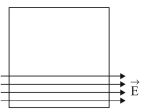
A square surface of side L meter is kept in the plane of the paper. A uniform elecrtric field $\overrightarrow{ E }$ is also present in the plane of the paper and it is limited to the lower half of the page as shown in the figure. What will be the electric flux bound to the surface?Image
The magnetic field in a plane electromagnetic wave is given by $B_y=\left(2 \times 10^{-7}\right) T \sin \left(0.5 \times 10^3 x+1.5 \times 10^{11} t\right)$.
(a) What is the wavelength and frequency of the wave?
(b) Write an expression for the electric field.
Calculate the radius of curvature of an equi$-$concave lens of refractive index $1.5,$ when it is kept in a medium of refractive index $1.4,$ to have a power of $-5D?$
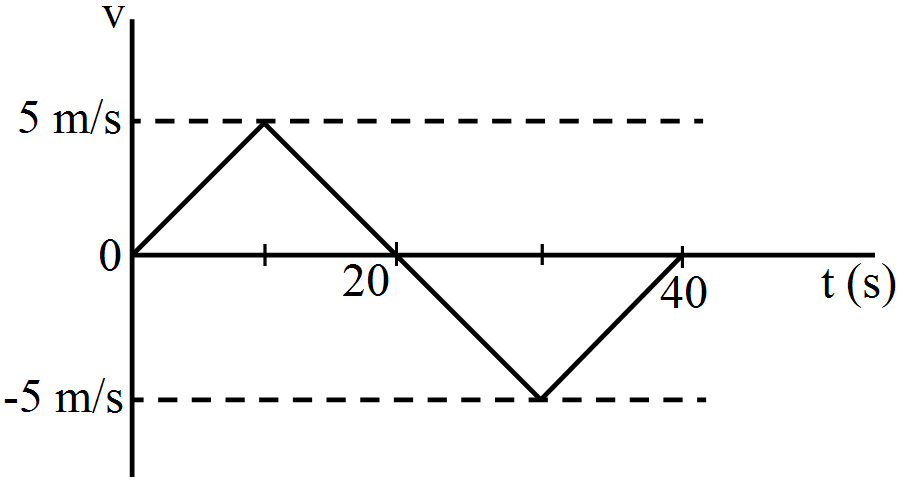
From the velocity-time plot shown in figure, find the distance travelled by the particle during the first 40 seconds. Also find the average velocity during this period.
Answer the following question:
The energy and momentum of an electron are related to the frequency and wavelength of the associated matter wave by the relations:
$\text{E}=\text{h v, p}=\frac{\text{h}}{\lambda}$
But while the value of λ is physically significant, the value of ν (and therefore, the value of the phase speed ν λ) has no physical significance. Why?
Find the maximum angle of refraction when a light ray is refracted from glass $(\mu=1.50)$ to air.
A conducting circular loop of radius a is connected to two Iong, straight wires. The straight wires carry current I as shown in figure. Find the magnetic field B at the centre of the loop.