Question
Explain how the scattering experiment can be analyzed in detail from Rutherford's nuclear model.

Answer

Image

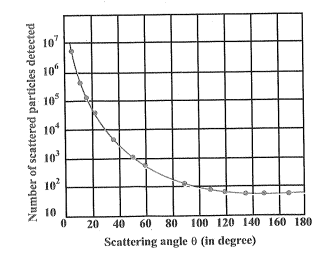
The figure shows a graph of the number of $\alpha$-particles scatterd versus the angle of scattering.
The scattering experiment can be analysed in detail from Rutherford's nuclear model. Since the gold foil is very thin, it can be assumed that $\alpha$-particles will suffer not more than one scattering during their passage through it. Hence it is sufficient to calculate the path (trajectory) of an $\alpha$-particle scattered by a single nucleus.
$\alpha$-particles are nuclei of helium atoms, so they have two units mass of positive charge $2 e$ and mass equal to that of a helium atom. The charge of the gold nucleus is Ze , where Z is the atomic number of the atom; for gold $Z =79$.
Since the nucleus of gold is about 50 times heavier than an $\alpha$-particle, it remains stationary throughout the scattering process.
The trajectory of an $\alpha$-particle can be calculated using newton's second law of motion and the coulomb's law for electrostatic force of repulsion between the $\alpha$-particle and the positively charged nucleus.
The magnitude of this force is
$F =\frac{1}{4 \pi \varepsilon_0} \frac{(2 e)( Ze )}{r^2}$
Where, $r$ is the distance between the $\alpha$-particle and the nucleus.
The force is directed along the line joining the $\alpha$-particle and the nucleus.
The magnitude and direction of the force on an $\alpha$-particle changes continuously as it moves towards and away from the nucleus.

Need a full question paper?

Generate a complete, print-ready paper with questions like this in minutes — across 16+ boards, with answer keys.
Start Generating Free

Similar questions

Explain the behaviour of non polar molecule and polar molecule in uniform electric field.
Explain barrier potential of $p-n$ junction.
An ammeter and a milliammeter are converted from the same galvanometer. Out of the two, which current measuring instrument has a higher resistance?
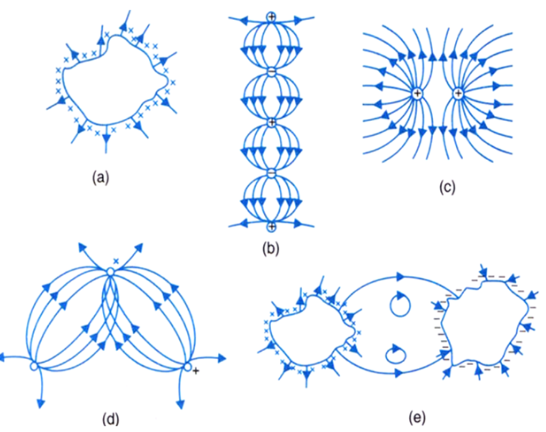
Which among the curves shown in Fig. 1.35 cannot possibly represent electrostatic field lines?
What are the advantages of the null$-$point method in a Wheatstone bridge? What additional measurements would be required to calculate $R_{unknown}$ by any other method?
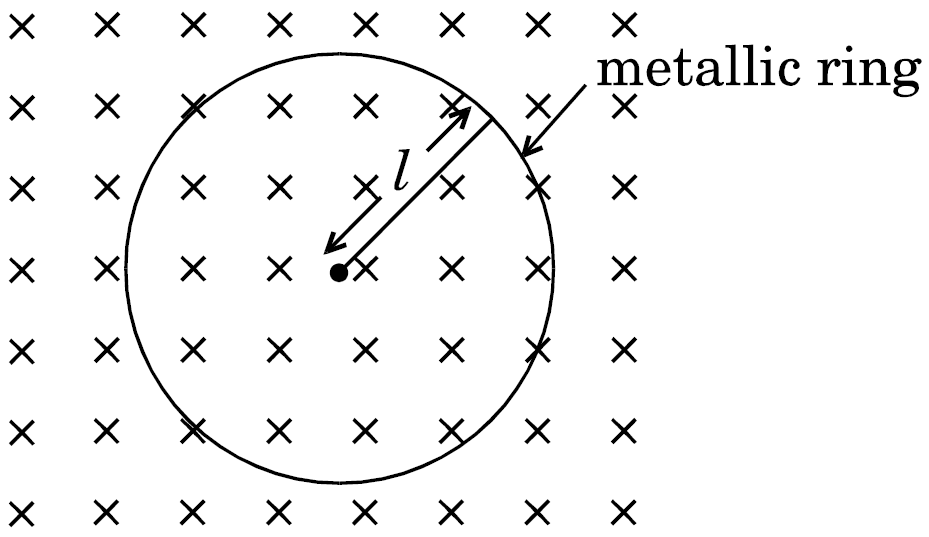
A metallic rod of length ‘l’ is rotated with a frequency ‘v’, with one end hinged at the centre and the other end at the circumference of a circular metallic ring, about an axis passing through the centre and perpendicular to the plane of the ring. A constant and uniform magnetic field B parallel to the axis is present everywhere.
  1. Obtain the expression for the emf induced between the centre and the ring.
  2. Given that the rod has resistance ‘R’, then how much power will be generated?
For a given position of an object, an equiconvex lens forms its real image at a distance of 60cm from the lens. A convex mirror is now kept in between this image position and the convex lens. The final image formed by this combination coincides with the object when the distance between the convex lens and the convex mirror equals 25cm. Calculate the radius of curvature of the convex mirror.
In a pure semiconductor, the number of conduction electrons is $6 \times 10^{19}$ per cubic metre. How many holes are there in a sample of size $1\ cm \times 1\ cm \times 1mm$?
A cell of emf E and internal resistance r is connected across an external resistance R. Plot a graph showing the variation of P.D. across R, verses R.
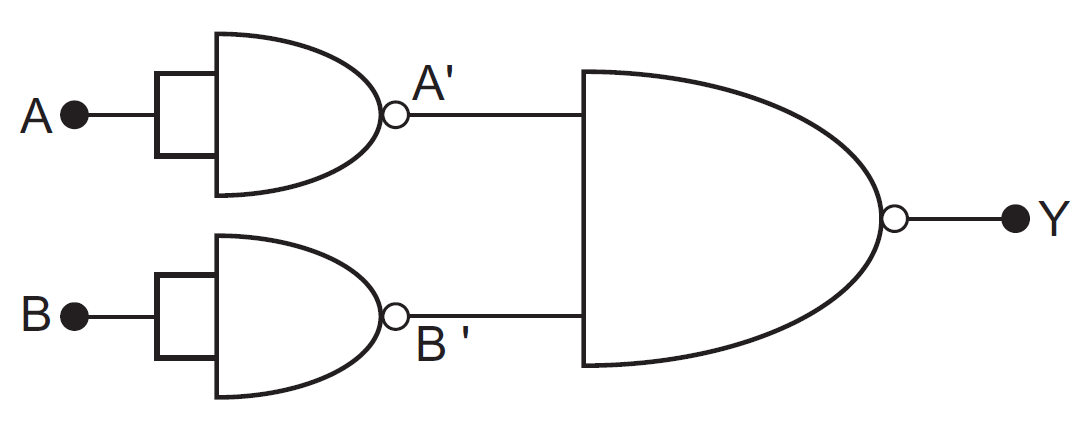
In the circuit shown in the figure, identify the equivalent gate of the circuit and make its truth table.