Question
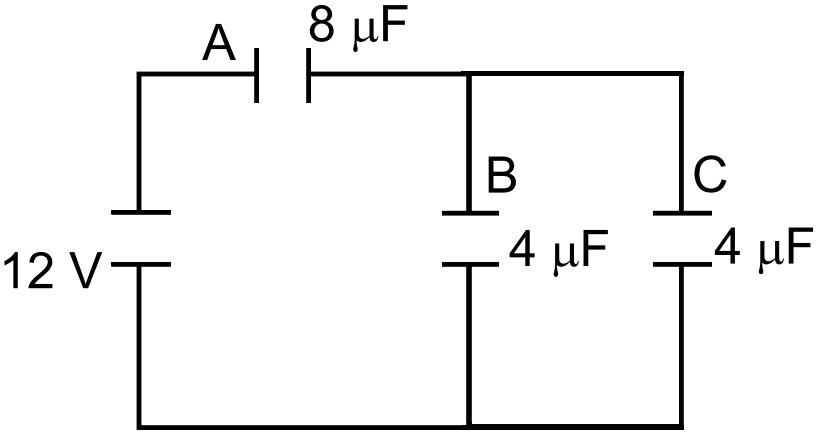
Which among the curves shown in Fig. 1.35 cannot possibly represent electrostatic field lines?

Answer

  1. Figure (a) cannot represent electrostatic field lines since electrostatic field lines start or end only at 90° to the surface of the conductor.
  2. Figure (b) too cannot represent electrostatic field lines as electrostatic field lines do not start from a negative charge. Electric field lines always traverse from a region of positive charge to a region of negative charge.
  3. Electrostatic field lines are represented by figure (c).
  4. Figure (d) cannot represent electrostatic field lines since no two such lines of force can intersect each other.
  5. As electrostatic field lines cannot form closed loop, therefore figure (d) also does not represent electrostatic field lines.

Need a full question paper?

Generate a complete, print-ready paper with questions like this in minutes — across 16+ boards, with answer keys.
Start Generating Free

Similar questions

A sample of paramagnetic salt contains $2.0 \times 10^{24}$ atomic dipoles each of dipole moment $1.5 \times 10^{–23} J T^{–1}$. The sample is placed under a homogeneous magnetic field of $0.64 T,$ and cooled to a temperature of $4.2 K$. The degree of magnetic saturation achieved is equal to $15\%$. What is the total dipole moment of the sample for a magnetic field of $0.98 T$ and a temperature of $2.8 K$? $($Assume Curie’s law$)$
The energy level diagram of an element is given below. Identify, by doing necessary calculations, which transition corresponds to the emission of a spectral line of wavelength $102.7 \ nm$.
 
A closely wound solenoid of $2000$ turns and area of cross$-$section $1.6 \times 10^{–4} m2$, carrying a current of $4.0 A,$ is suspended through its centre allowing it to turn in a horizontal plane.
  1. What is the magnetic moment associated with the solenoid?
  2. What is the force and torque on the solenoid if a uniform horizontal magnetic field of $7.5 \times 10^{–2}\ T$ is set up at an angle of $30^\circ$ with the axis of the solenoid?
A point source emitting light uniformly in all directions is placed 60cm above a table-top. The illuminance at a point on the table-top, directly below the source, is 15 lux. Find the illuminance at a point on the table-top 80cm away from the first point.
In a typical fission reaction, the nucleus is split into two middle-weight nuclei of unequal masses. Which of the two (heavier or lighter) has greater kinetic energy? Greater linear momentum?
$^{228}Th$ emits an alpha particle to reduce to $^{224}Ra.$ Calculate the kinetic energy of the alpha particle emitted in the following decay:
$\text{ }^{228}\text{Th}\rightarrow\text{ }^{224}\text{Ra}^*+\alpha$
$\text{ }^{224}\text{Ra}^*\rightarrow\text{ }^{224}\text{Ra}+\gamma(217\text{kev}).$
Atomic mass of $^{228}Th$ is $228.028726u,$ that of $^{224}Ra$ is $224.020196u$ and that of $\text{ }^4_2\text{He}$ is $4.00260u.$
When we stir a liquid vigorously, it becomes warm. Is it a reversible process?
Find the charge appearing on each of the three capacitors shown in figure.
When charcoal is prepared from a living tree, it shows a disintegration rate of $15.3$ disintegrations of $^{14}C$ per gram per minute. A sample from an ancient piece of charcoal shows $^{14}C$ activity to be $12.3$ disintegrations per gram per minute. How old is this sample? Half$-$life of $^{14}C$ is $5730y$.
In a $p-n$ junction, the depletion region is $400\ nm$ wide and an electric field of $5 \times 10^5\ V/m$ exists in it.
  1. Find the height of the potential barrier.
  2. What should be the minimum kinetic energy of a conduction electron which can diffuse from the $n-$side to the $p-$side?