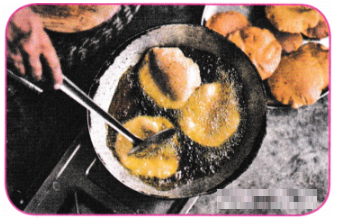
The scientific method starts with a question based on observation, like “Why is one side of a puri thinner than the other?” We begin by forming hypotheses: maybe the dough is uneven, or one side receives more heat. To test this, we must control variables like dough thickness, oil temperature, and type of flour. We can use tools to measure puff-up time, observe the shape and thickness before and after frying, and record the results. For example, dropping puris of different thicknesses or changing the oil temperature can help determine how these factors affect puffing. Repeating the experiment and changing one variable at a time while keeping others constant allows a systematic study. This shows how even a kitchen observation follows the steps of scientific inquiry.