Question
Explain how the width of depletion layer in a p-n junction diode changes when the junction is (i) forward biased (ii) reverse biased.

Answer

  1. In forward biasing, the depletion layer decreases.

Reason: Majority charge carriers come closer to junction.

  1. In reverse biasing, the width of depletion layer increases.

Reason: The majority charge carries go farther away from the junction.

Need a full question paper?

Generate a complete, print-ready paper with questions like this in minutes — across 16+ boards, with answer keys.
Start Generating Free

Similar questions

A straight solenoid of length 50 cm has 1000 turns and a mean cross-sectional area of $2 \times 10^{-4} m^2$. It is placed with its axis at $30^{\circ}$, with a uniform magnetic field of 0.32 T . Find the torque acting on the solenoid when a current of 2 A is passed through it.
Assume that the magnetic field is uniform in a cubical region and is zero outside. Can you project a charged particle from outside into the field so that the particle describes a complete circle in the field?
Answer the following:
A man fixes outside his house one evening a two metre high insulating slab carrying on its top a large aluminium sheet of area 1m2. Will he get an electric shock if he touches the metal sheet next morning?
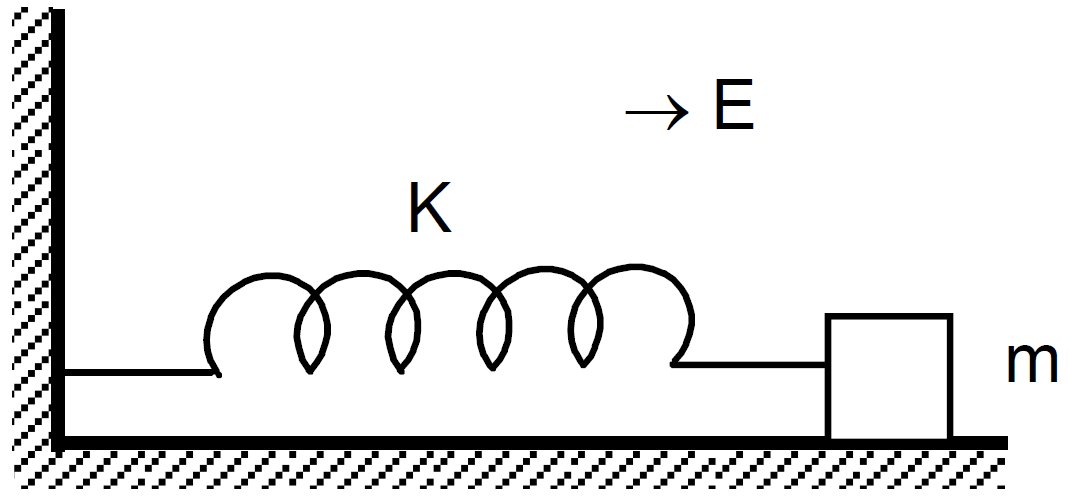
A block of mass m having a charge q is placed on a smooth horizontal table and is connected to a wall through an unstressed spring of spring constant k as shown in figure. A horizontal electric field E parallel to the spring is switched on. Find the amplitude of the resulting SHM of the block.

Why potentiometer is more effective instrument in measuring electromotive force of cell than voltmeter?
Write the statements of Kirchhoff's laws.
Define threshold frequency. How does it relate with the work function of the metal?
An atom absorbs a photon of wavelength 500nm and emits another photon of wavelength 700nm. Find the net energy absorbed by the atom in the process.
Find the wavelength of electromagnetic waves of frequency 5 × 10¹⁹Hz in free space. Give its two applications.
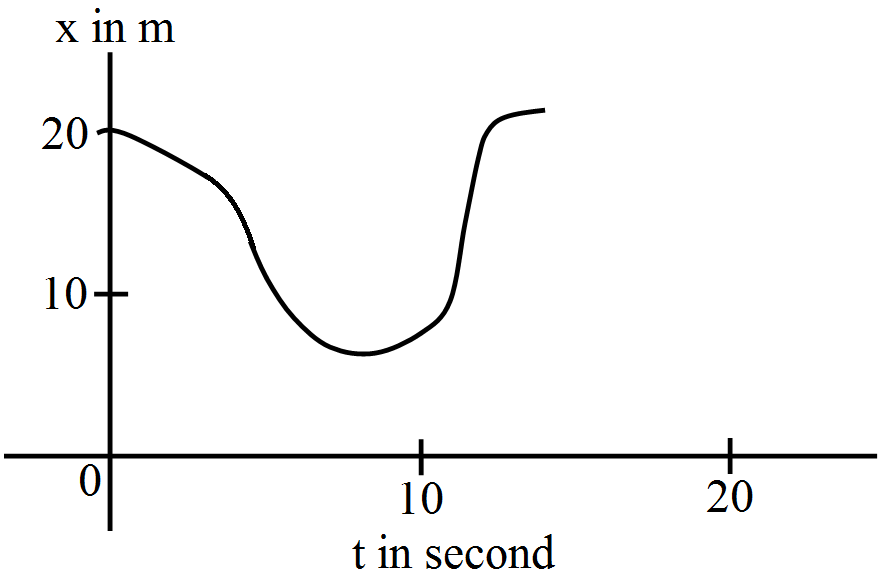
Figure shows x-t graph of a particle. Find the time t such that the average velocity of the particle during the period 0 to t is zero.