Question
Explain innate immunity in detail

Answer

Innate immunity is non-specific immunity, which is present at the time of birth.
1) Physical barrier :
Our skin is the main physical barrier that prevents the entry of microorganisms.
Mucous membrane lining the respiratory tract, gastrointestinal tract and urinary tract also helps to prevent germs from entering the body.
2) Physiological barrier:
Acid in the stomach, saliva in the mouth, tears in the eyes etc. inhibit the growth of pathogens.
3) Cellular Barrier :
Some white blood cells [WBCs] in our body, such as polymorphonuclear leukocytes and natural killer cells, a type of lymphoid cell in the blood, can feed on and destroy microbes.
(4)Cytokine barrier:
Virus-infected cells secrete proteins called interferons, which protect other uninfected cells from virus infection.

Need a full question paper?

Generate a complete, print-ready paper with questions like this in minutes — across 16+ boards, with answer keys.
Start Generating Free

Similar questions

Write a short note on pollination by wind.
Differentiate between Monohybrid & Dihybrid Cross.
Read the following and answer any four questions from (i) to (v) given below:

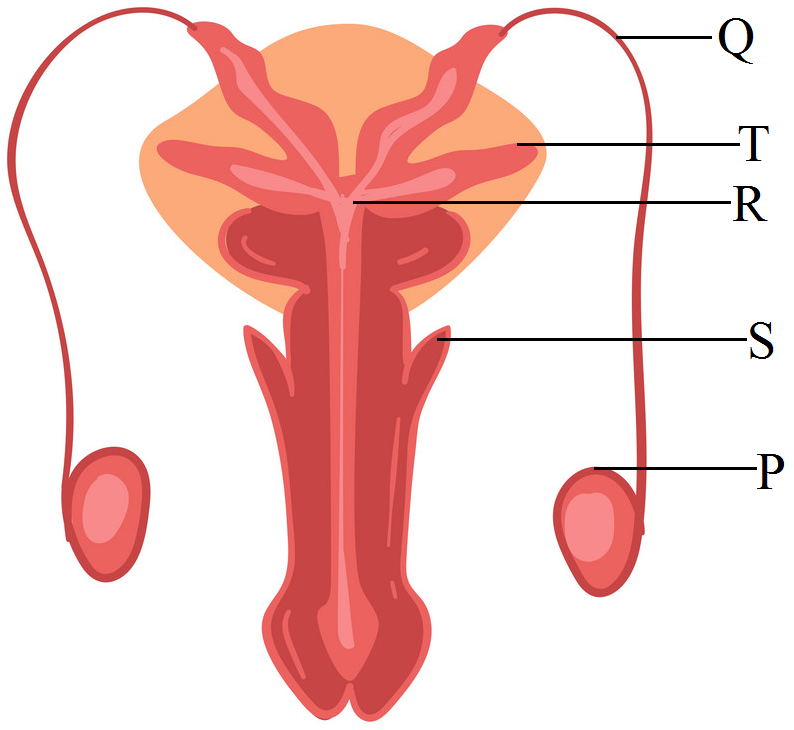
Human male reproductive system comprises of a pair of testes, primary sex organs associated with formation of gametes and production of sex hormone. Study the given figure of human male reproductive system and answer the following questions.

  1. Which of the following is correct for labelled part P?
  1. P is rete testis which transports sperms to outside.
  2. P is epididymis which secretes fluid that nourish the sperms.
  3. P is epididymis that carry sperms and secretion of seminal vesicles.
  4. P is rete testis, which lies along inner side of each testis and stores the sperms.
  1. Identify the correctly matched pair.
  1. Q - Vasa efferentia.
  2. R - Ejaculatory duct.
  3. S - Seminal vesicle.
  4. T - Cowper's gland.
  1. Which statement is incorrect for Q?
  1. It carries spermatozoa from epididymis to ejaculatory duct.
  2. Q are only 2 in number.
  3. It arises from rete testis.
  4. It constitutes male sex accessory duct.
  1. Which structure passes through the prostate gland and carries sperms and secretion of seminal vesicle?
  1. P.
  2. T.
  3. S.
  4. R.
  1. Assertion: Mucus present in secretion of bulbourethral gland decreases the number of sperms damaged during ejaculation.

Reason: Mucus lubricates the end of penis and lining of the urethra.

  1. Both assertion and reason are true, and reason is the correct explanation of assertion.
  2. Both assertion and reason are true, but reason is not the correct explanation of assertion.
  3. Assertion is true, but reason is false.
  4. Both assertion and reason are false.
Read the following and answer any four questions from (i) to (v) given below:

ln many species of fig trees, there is a tight one-to-one relationship with the pollinator species of wasp. It means that a given fig species can be pollinated only by its 'partner' wasp species and no other species. The wasp pollinates the fig inflorescence while looking for suitable egg-laying sites. ln return for the favour of pollination, the fig offers the wasp some of its developing seeds as food for the developing wasp larvae.

  1. The interaction between fig trees and wasp is an example of:
  1. Mutualism
  2. Commensalism
  3. Amensalism
  4. Parasitism
  1. AD the given interactions are similar to interaction between fig trees and wasp, except.
  1. Plant and animal relation for pollination.
  2. Association of algae and fungi in lichens.
  3. Association of cattle egret and grazing cattle.
  4. Association of fungi and roots of higher plants in mycorrhiza.
  1. In which of the following interactions both partners are adversely affected?
  1. Parasitism
  2. Mutualism
  3. Competition
  4. Predation
  1. ln relationship between fig and wasp:
  1. One benefitted other harmed.
  2. Both are benefitted.
  3. One benefitted other unaffected.
  4. One inhibited, other unaffected.
  1. Assertion: Fig and wasp cannot complete their life cycle without each other.

Reason: They show mutualistic relationship.
  1. Both assertion and reason are true and reason is the correct explanation of assertion.
  2. Both assertion and reason are true but reason is not the correct explanation of assertion.
  3. Assertion is true but reason is false.
  4. Both assertion and reason are false.
Read the following text carefully and answer the questions that follow:
Transgenic animals can serve as factories that in some cases, may produce large amounts of proteins more efficiently. Transgenic mice have been engineered to express human antibodies by introducing a large segment of human DNA encoding human immunoglobulin genes. In transgenic large animals such as cows or sheep proteins of pharmaceutical value can be produced in large quantities in milk which is later purified. Transgenes can be used to alter many phenotypic properties including growth rate, fat composition, milk production, hair texture, etc.
i. In transgenic animals, i.e. cow and sheep proteins of pharmaceutical value are produced in large quantities in which gland. (1)
ii. Why is mouse the most preferred animal for studies on gene transfer? (1)
iii. Why does the production of transgenic animals take place? (2)
OR
Assertion (A): Transgenic mice have been engineered to express human antibodies. (2)
Reason (R): Large segments of human DNA encoding human immunoglobulin have been transferred to mice.
a. Both A and R are true and R is the correct explanation of A.
b. Both A and R are true but R is not the correct explanation of A.
c. A is true but R is false.
d. A is false but R is true.
Read the following text carefully and answer the questions that follow:
A pathogen is defined as an organism causing disease to its host, with the severity of the disease symptoms referred to as virulence. Pathogens are taxonomically widely diverse and comprise viruses and bacteria as well as unicellular and multicellular eukaryotes. The immune system of a person is suppressed. He was found positive for a pathogen in the diagnostic test ELISA.
Image
i. Name the disease, the patient is suffering from. (1)
ii. Which pathogen is identified by ELISA test? (1)
iii. Which cells of the body are attacked by the pathogen? (2)
OR
Suggest preventive measures of the infection. (2)
Read the following and answer any four questions from (i) to (v) given below:

Siddharth is a chain smoker. He got into this habit in early adolescence due to peer pressure and gradually got addicted to this habit. Its now almost 20 years he is into the habit of smoking. Since few months he is experiencing pain in chest, shortness of breath, wheezing and chronic cough with phlegm. He seeked advice of a medical practitioner who diagnosed him with lung cancer. Based on the above information, answer the following questions.

  1. What do you think is the possible carcinogen responsible for Siddharth's lung cancer?
  1. Nitrosamines
  2. Benzo(a)pyrene
  3. Hydrazine
  4. All of these
  1. How is lung cancer diagnosed?
  1. Computerised tomography scan
  2. Sputum cytolog
  3. Biopsy of lung tissue
  4. All of these
  1. From which of the following type of cancer is Siddharth suffering from?
  1. Sarcoma
  2. Carcinoma
  3. Lymphoma
  4. Leukemia
  1. Select the correct statement.
  1. Surgery, radiotherapy and chemotherapy can be used to treat lung cancer.
  2. Chemotherapy involves the exposure of cancerous parts to X rays which destroy rapidly growing cancer cells.
  3. Surgical removal of lung cancer tissue is suggested at advanced stage 4.
  4. Monoclonal antibodies can effectively treat lung cancer and can cure it completely.
  1. Assertion: Lung cancer if not treated at an early stage can spread to other initial organs of the body.

Reason: Cancer cell have uncontrolled proliferation and ability to invade new sites (metastasis).

  1. Both assertion and reason are true and reason is the correct explanation of assertion.
  2. Both assertion and reason are true but reason is not the correct explanation of assertion.
  3. Assertion is true but reason is false.
  4. Both assertion and reason are false
​​​​Read the following and answer any four questions from (i) to (v) given below:

Edward Wilson described diversity at all levels of biological organisation ranging from macromolecules inside the cells to biomes. It is of three inter-related hierarchial levels-genetic diversity, species diversity and conununity ecosystem diversity. Species diversity is the variety in the number and richness of the species of a region. For example, the Western ghats have a greater amphibian species diversity than the Eastern ghats.

  1. The number of species per unit area is called.
  1. Species evenness.
  2. Species richness.
  3. Species equitability.
  4. Both (a) and (c).
  1. The table below gives the population (in thousands) of ten species (A - J) in four areas (I - IV) consisting of the number of habitats given within brackets against each. Study the table and answer the question which follows:
Area and number of habitats
Species and their population (in thousands) in the area
A
B
C
D
E
F
G
H
I
J
I(11)
23
12
0.52
6.0
-
3.1
1.1
9.0
-
10.3
II(11)
10.2
-
0.62
-
1.5
3.0
-
8.2
1.1
11.2
III(13)
11.3
0.9
0.48
2.4
1.4
4.2
0.8
8.4
2.2
4.1
IV(12)
3.2
10.2
1.1
4.8
0.4
3.3
0.8
7.3
1.3
2.1
Which are out of I to IV shows maximum species diversity?

  1. II
  2. III
  3. IV
  4. I
  1. Study the given populations and choose the correct answer in relation to species diversity.
Population
Species
Species
Individuals
Population A
I
Mammals
3
II
Birds
2
III
Amphibians
2
Population B
I
Mammals
2
II
Mammals
2
III
Amphibians
1
Population C
I
Mammals
3
II
Mammals
2
III
Mammals
4


Maximum diversity
Minimum diversity
(a)
Population B
Population C
(b)
Population A
Population C
(c)
Population A
Population B
(d)
Population B
Population A
  1. The concept of species diversity has two components : evenness and richness. Evenness is based on the relative abundance of species. Richness is based on the total number of species present. Diversity indices combine a measure of richness and evenness. The Simpson index (D) is calculated from the following equations:

$\text{D}=\displaystyle\sum_{\text{i}=1}(\text{n}_\text{i}/\text{N})^2$

where, n = total number of organisms of particular species

N = total number of organisms of all species

Below are data collected in two terrestrial plant conununities that represent part of a successional chronosequence. ln this case the values were measured as percent cover.

Early Successional Community
Late Successional Community
Species
Percent Cover
Species
Percent Cover
A
83
F
24
B
5
G
20
C
9
H
18
D
2
I
23
E
1
J
15
The data indicate that, relative to the early successional community, the late successional community has which of the following characteristics?

 
Species Richness
Evenness
(a)
Higher
Higher
(b)
Higher
Lower
(c)
Same
Lower
(d)
Same
Higher
  1. Select the incorrect statement regarding species diversity.
  1. It results in polymorph formation and is useful in adaptation to changes in environmental conditions.
  2. Number of individuals of different species represent species evenness.
  3. It influences biotic interactions and stability of the community.
  4. It is a trait of the community.
Explain the amplification of gene of interest using PCR (Diagram is must)
Read the following and answer any four questions from (i) to (v) given below:

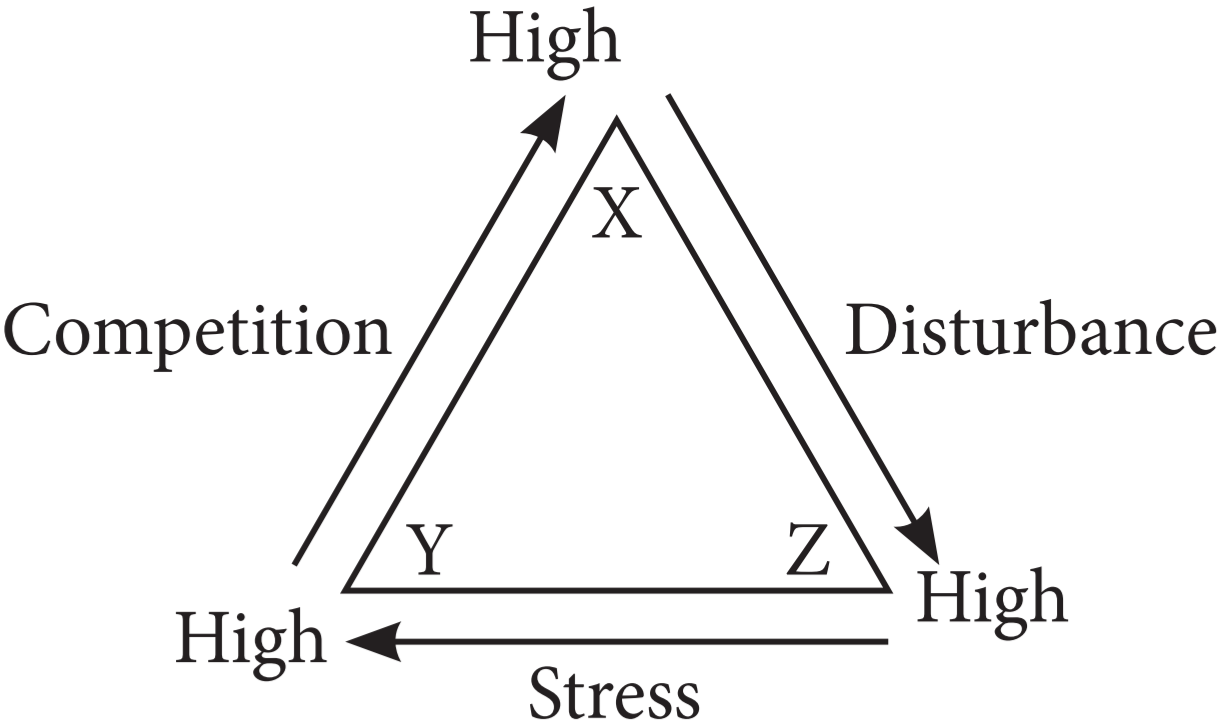
During teaching about various environmental factors, a teacher draw a figure that depicts like history strategies for three plant species (X, Y and Z) along 3 axes - strength of competition with other organisms, level of disturbance in the habitat and level of environmental stress in the habitat. Species X grows in habitats where competition among species is high but disturbance and stress are low. Species Y grows in habitats with high environmental stress but with low intraspecies competition. Species Z grows in highly disturbed habitats with low environmental stress.

  1. Which of the following is correct regarding plant type X?
  1. It has slow growth rate.
  2. It lives in area with high probability of severe environmental changes.
  3. It has good competitive ability at low population densities near the carrying capacity.
  4. None of these.
  1. Environmental stress occurs through.
  1. Very low temperature.
  2. Drought.
  3. Nutrient deficiency.
  4. All of these.
  1. Select the correct option regarding plant type X, Y and Z.
  1. X type of plants are likely to be trees.
  2. Y type of plants could be desert plants.
  3. Z type of plants could be herbaceous plant.
  4. All of these.
  1. Y type of plants grow under high stress and:
  1. Produce large number of seeds in a short time after rains.
  2. Have rapid growth.
  3. Produce less number of seed in a long time after rain.
  4. Both (a) and (b).
  1. Assertion: Plant growth rate is high in area of high stress and high disturbance.

Reason: High stress and high disturbance promote breeding capacity in plants.

  1. Both assertion and reason are true and reason is the correct explanation of assertion.
  2. Both assertion and reason are true but reason is not the correct explanation of assertion.
  3. Assertion is true but reason is false.
  4. Both assertion and reason are false.