Question
Define molar specific heat capacities at constant volume and pressure. Considering thermodynamical process in a cylinder with parameters P, V and T, derive the Mayer's relation.

Answer

Molar specific heat capacity is the heat energy required to raise the temperature of 1 mole of a substance by 1K and expressed in J mol-1 K-1.
$\text{C}=\frac{\text{Q}}{1\text{mole 1}\text{K}}$
Depending on the condition that whether volume or pressure is constant, molar specific heat is written as Cv and Cp.
Relation between Cp and CvSuppose one mole of a gas is heated so that its temperature rises by dT.
Heat supplied $=1\times\text{C}_\text{V}\times\text{C}_\text{V}\text{dT}\dots(\text{i})$
Since the volume is constant, the gas will not perform external work in accordance with the first law of thermodynamics and the heat supplied will be just equal to the increase in the internal energy of the gas.
$\therefore\text{dU}=\text{C}_{\text{V}}\text{dT}\dots\text{(ii)}$
Let the gas be heated at constant pressure to again increase its temperature by dT, and dQ be the amount of heat supplied, therefore,
dQ = 1 × CP × dT = CPdT ...(iii)
The heat supplied at a constant pressure increases the temperature by dT hence increases its internal energy by dU = CvdT as well as enables the gas to perform work dW.
dW = PdV ...(iv)
From the first law of thermodynamics, we have
dQ = dU + dW
Substituting the values, we get,
$\text{C}_\text{P}\text{dT}=\text{C}_\text{v}\text{dT}+\text{PdV}$
But PV = RT (For one mole of the gas)
or PdV = RdT
$\therefore\text{C}_\text{P}\text{dT}=\text{C}_\text{V}\text{dT}$
$\text{C}_\text{P}-\text{C}_\text{V}=\text{R}$
This is the relation between two principal specific heats of the gas when Cp, Cv and R are measured in the units of either heat or of work.

Need a full question paper?

Generate a complete, print-ready paper with questions like this in minutes — across 16+ boards, with answer keys.
Start Generating Free

Similar questions

A rod of negligible heat cafacity has length 20cm, area of cross section 1.0cm and thermal conductivity 200Wm-1°C-1. The temperature of one end is maintained at 0°C and that of the other end is slowly and linearly varied from 0°C to 60°C in 10 minutes. Assuming no loss of heat through the sides, find the total heat transmitted through the rod in these 10 minutes.
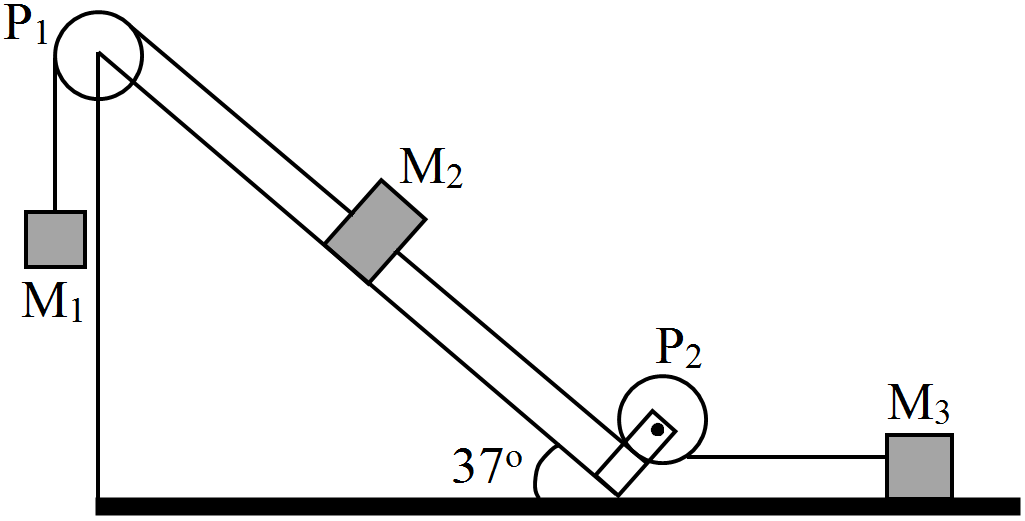
Masses M1, M2 and M3 are connected by light strings whith pass over pulleys P1 and P1 as shown. The masses move such that the string between P1 and P2 is parallel to incline and the string between P2 and M3 is hoizontal, M2 = M3 = 4kg. The coeffiecient of kinetic friction between masses and the surface is 0.25. The angle of inclination of plane is 37° to the horizontal. lf the mass M1 moves downwards with uniform velocity, find M1 and the tension in the horizontal string. Given 8 = 9.8 m/ s2 and $\sin\text{}37^\circ=\frac35.$

i. Analytically, find the resultant $\vec{R}$ of two vectors $\vec{A}$ and $\vec{B}$ inclined at an angle $\theta$.
ii. Find the angle between two vectors $\vec{P}$ and $\vec{Q}$ if resultant of the vectors is given by $R ^2= P ^2+ Q ^2$.
A circular loop carrying a current i is made of a wire of length L. A uniform magnetic field B exists parallel to the plane of the loop.
  1. Find the torque on the loop.
  2. If the same length of the wire is used to form a square loop, what would be the torque? Which is larger?
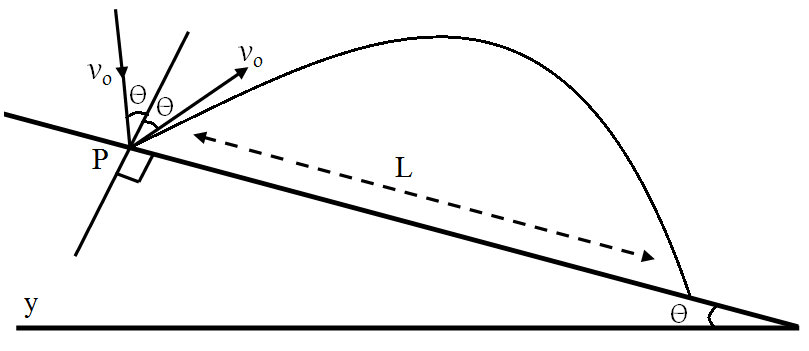
A particle falling vertically from a height hits a plane surface inclined to horizontal at an angle $\theta$ with speed $\text{v}_0$ and rebounds elastically. Find the distance along the plane where if will hit second time.

(Hint:

  1. After rebound, particle still has speed Vo to start.
  2. Work out angle particle speed has with horizontal after it rebounds.
  3. Rest is similar to if particle is projected up the incline.
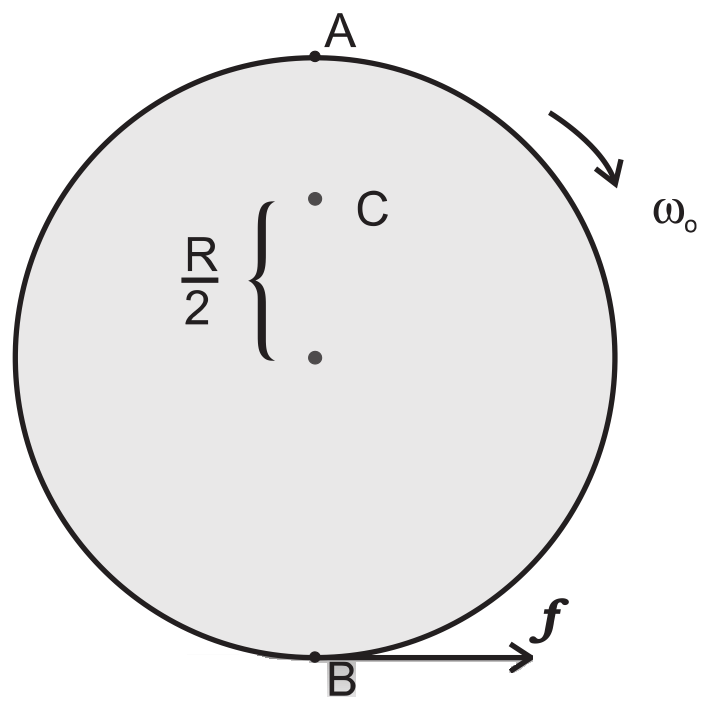
A disc rotating about its axis with angular speed $\omega_0$ is placed lightly (without any translational push) on a perfectly frictionless table. The radius of the disc is R. What are the linear velocities of the points A, B and C on the disc shown in will the disc roll in the direction indicated?

State Newton's third law of motion. Discuss its consequences.
Prove that the path of projectile thrown at an angle $\theta$ to the horizontal plane will be parabolic. Obtain the formula for the maximum height attained by this.
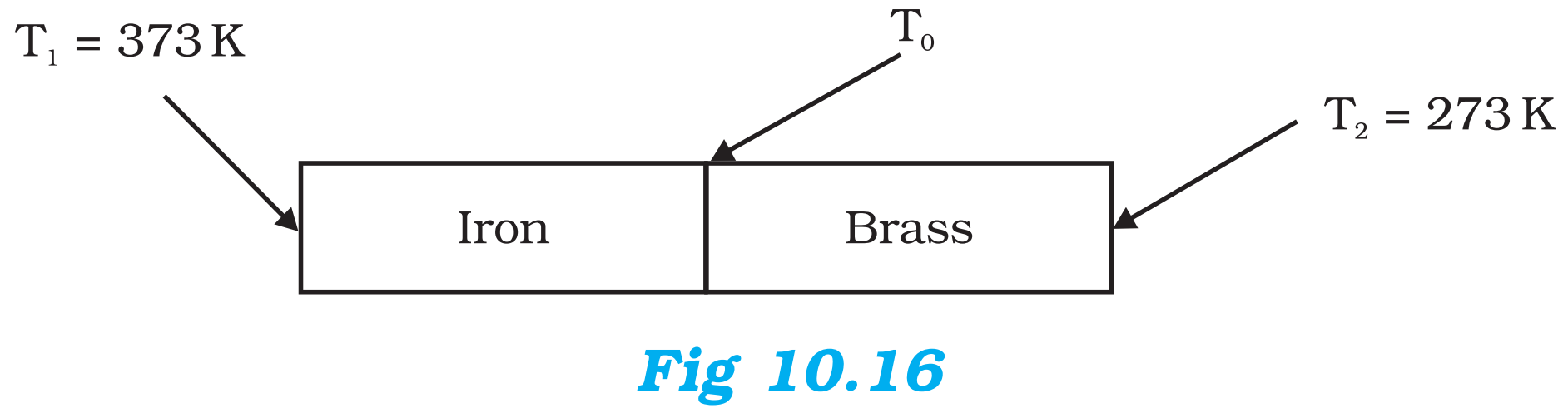
An iron bar $\left(L_1=0.1 m , A_1=\right.$ $\left.0.02 m ^2, K_1=79 W m ^{-1} K ^{-1}\right)$ and a brass bar $\left(L_2=0.1 m , A_2=0.02 m ^2\right.$, $K_2=109 W m ^{-1} K ^{-1}$ ) are soldered end to end as shown in Fig. 10.16. The free ends of the iron bar and brass bar are maintained at $373 K$ and $273 K$ respectively. Obtain expressions for and hence compute (i) the temperature of the junction of the two bars, (ii) the equivalent thermal conductivity of the compound bar, and (iii) the heat current through the compound bar.
Image
A moving car encounters air resistance which is proportional to the square of the speed of the car. What is the ratio of the power required at 40kmh-1 to that required at 80kmh-1 with the same braking force?