Question
Explain ‘mirage’ as an illustration of refraction.

Answer

i. On a hot clear Sunny day, along a level road, there appears a pond of water ahead of the road. Flowever, if we physically reach the spot, there is nothing but the dry road and water pond again appears some distance ahead. This illusion is called mirage.

ii. Mirage results from the refraction of light through a non-uniform medium.

iii. On a hot day the air in contact with the road is hottest and as we go up, it gets gradually cooler. The refractive index of air thus decreases with height. Hot air tends to be less optically dense than cooler air which results into a non-uniform medium.

iv. Light travels in a straight line through a uniform medium but refracts when traveling through a non-uniform medium.

v. Thus, the ray of light coming from the top of an object get refracted while travelling downwards into less optically dense air and become more and more horizontal as shown in Figure.
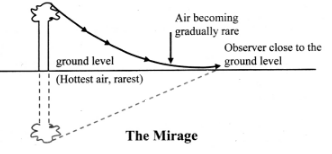
Image

vi. As it almost touches the road, it bends (refracts) upward. Then onwards, upward bending continues due to denser air.

vii. As a result, for an observer, it appears to be coming from below thereby giving an illusion of reflection from an (imaginary) water surface.

Need a full question paper?

Generate a complete, print-ready paper with questions like this in minutes — across 16+ boards, with answer keys.

Start Generating Free

Similar questions

Why is a minimum two stage rocket necessary for launching of a satellite?
Explain the concept of series combination of cells.
What is the solid angle subtended by the moon at any point of the Earth, given the diameter of the moon is $3474 \ km$ and its distance from the Earth $3.84 \times 10^8 m$?
At a given place on the Earth, a bar magnet of magnetic moment $\vec{m}$ is kept horizontal in the EastWest direction. $P$ and $Q$ are the two neutral points due to magnetic field of this magnet and $\vec{B}_{ H }$ is the horizontal component of the Earth's magnetic field.
$i$. Calculate the angles between position vectors of $P$ and $Q$ with the direction of $\vec{m}$.
$ii$. Points $P$ and $Q$ are $1 m$ from the centre of the bar magnet and $B_H=3.5 \times 10^{-5} T$. Calculate magnetic dipole moment of the bar magnet.
Neutral point is that point where the resultant magnetic field is zero.
The magnitude of current density in a copper wire is $500 A/cm²$. If the number of free electrons per cm³ of copper is $8.47 \times 10^{22}$​​​​​​​, calculate the drift velocity of the electrons through the copper wire (charge on an $e = 1.6 \times 10^{-19} C$)
A metro train runs from station A to B to C. It takes 4 minutes in travelling from station A to station B. The train halts at station B for 20 s. Then it starts from station B and reaches station C in next 3 minutes. At the start, the train accelerates for 10 sec to reach the constant speed of 72 km/hr. The train moving at the constant speed is brought to rest in 10 sec. at next station.
(i) Plot the velocity- time graph for the train travelling from the station A to B to C.
(ii) Calculate the distance between the stations A, B and C.
Explain block diagram of  communication system.
A monochromatic ray of light strikes the water $(n = 4/3)$ surface in a cylindrical vessel at angle of incidence $53^\circ $. Depth of water is $36\ cm$. After striking the water surface, how long will the light take to reach the bottom of the vessel? [Angles of the most popular Pythagorean triangle of sides in the ratio $3 : 4 : 5$ are nearly $37^\circ , 53^\circ $ and $90^\circ ]$
With a help of diagram, state the direction of flux due to positive charge, negative charge and charge outside a closed surface.
Prove that relative permittivity is the ratio of the force between two point charges placed a certain distance apart in free space or vacuum to the force between the same two point charges when placed at the same distance in the given medium.