Question
Explain nitration of phenol in detail.
Answer

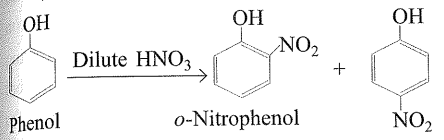
→ Nitration: With dilute nitric acid at low temperature (298 K), phenol yields a mixture of ortho and para nitrophenols.
Image
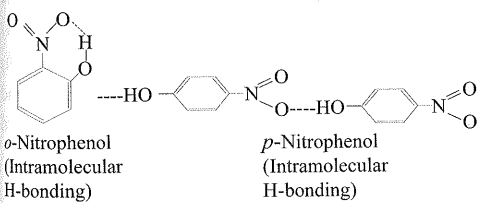
→ The ortho and para isomers can be separated by steam distillation. o-Nitrophenol is steam volatile due to intramolecular hydrogen bonding while p-nitrophenol is less volatile due to intermolecular hydrogen bonding which causes the association of molecules.
Image
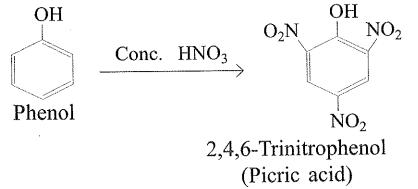
→ With concentrated nitric acid, phenol is converted to 2,4,6-trinitrophenol. The product is commonly known as picric acid. The yield of the reaction product is poor.
Image
→ Nowadays picric acid is prepared by treating phenol first with concentrated sulphuric acid which converts into phenol-2,4-disulphonic acid, and then with concentrated nitric acid to get 2,4,6-trinitrophenol.

Need a full question paper?

Generate a complete, print-ready paper with questions like this in minutes — across 16+ boards, with answer keys.

Start Generating Free

Similar questions

Match the items of column I with items of column II.
 
Column I
 
Column II
(i)
Methanol
(a)
Conversion of phenol to o-hydroxysalicylic acid
(ii)
Kolbe’s reaction
(b)
Ethyl alcohol
(iii)
Williamson’s synthesis
(c)
Conversion of phenol to salicylaldehyde
(iv)
Conversion of 2° alcohol to ketone
(d)
Wood spirit
(v)
Reimer-Tiemann reaction
(e)
Heated copper at 573K
(vi)
Fermentation
(f)
Reaction of alkyl halide with sodium alkoxide
  1. State one use each of DDT and iodoform.
  2. Which compound in the following couples will react faster in SN2 displacement and why?
  1. 1-Bromopentane or 2-bromopentane.
  2. 1-Bromo-2-methylbutane or 2-bromo-2-methylbutane.
Compound with molecular formula $C _4 H _8 O$ reacts with hydrazine and gives hydrazone. It forms iodoform by the reaction with iodine and NaOH but does not react with Fehling solution. Give the structure of this compound and required equations.
Draw figure to show the splitting of d orbitals in an octahedral crystal field.
Identify the compounds A, B and C in the following reaction:
$\text{CH}_3-\text{Be}\ \xrightarrow{\ \ \text{Mg/ Ether}}\ \text{(A)}\ \xrightarrow[\text{(ii)}\text{Water}]{\ \ \text{CO}_2}\ \text{(B)}\ \xrightarrow[\triangle]{\ \ \text{CH}_3\text{OH}/\text{H}^+}\ \text{(C)}$
  1. Describe the following giving suitable examples:
  1. Cannizzaro reaction.
  2. Aldol condensation.
  1. ​​​​​​​Give a chemical test to distinguish between ethanal and propanal.
A compound (X) reacts with PCl5 to form compound Y. Compound Y reacts with ethereal solution of magnesium to form compound (Z), which on treating with propanone and further hydrolysis to give 2-Methyl propan-2-ol. What are the compounds X and Y and also give the equations of the reactions.
The conductivity of 0.001028 mol L-1 acetic acid is 4.95 × 10⁻⁵ S cm-1. Calculate its dissociation constant $\Lambda^{\circ}_{\text{m}}$ if for acetic acid is 390.5 S cm2 mol-1.
Determine the formula for the half life of a first order reaction and prove that the half life of a first order reaction does not depends on the initial concentration of the reactant.