Question
Explain principle of Rutherford and Soddy in relation with redioactive decay.

Answer

When a radioactive element emits $\alpha-$ or $\beta-$ particle the original atom of the element called the parent atom changes into a new atom of another element called the daughter atom and the parent atom is said to be disintegrated. Now, if the daughter atom is also radioactive, the process of disintegration continues till a stable element usually lead is obtained. This phenomenon is known as radioactive disintegration and this gives rise to a series of radioactive elements. There are three main series namely uranium, thorium and actinium series.
In 1903 Rutherford and Soddy together made an exhaustive study of radioactive disintegration and summed up their conclusions in the form of two laws as follows:
(1) Soddy's group displacement law : It may be stated in the following two parts :
(i) When an element is disintegrated by the emission of an $\alpha$ - particle $\left({ }_2^4 He \right)$, the daughter element obtained has an atomic mass number less by 4 and atomic number less by 2 and it falls in a group of periodic table two coloumns to the left of the parent element.
In this way if a parent element X of mass number A and atomic number Z emits an $\alpha$ - particle to form a daughter element Y then the disintegration process can be expressed as follows :
${}_{Z}^{A}X \rightarrow {}_{Z-2}^{A-4}Y + {}_{2}^{4}He$ ($\alpha$ - particle)
Image
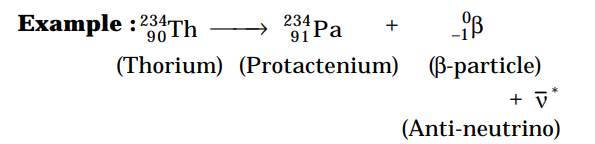
(ii) When an element is disintegrated by the emission of a $\beta$-particle $\left({ }_{-1}^0 \beta\right)$ , the daughter element obtained has an atomic mass number same as that of parent element and atomic number increased by 1 and it falls in a group of periodic table one coloumn to the right.
In this way if a parent element X with mass number A and atomic number Z emits a $\beta$-particle to form a daughter element Y then this disintegration process is expressed as follows :
${}_{Z}^{A}X \rightarrow {}_{Z+1}^{A}Y + {}_{-1}^{0}\beta + \bar{v}$
Image
Although $\gamma$-rays are emitted with the emission of a-particle and $\beta$-particle both, but if only $\gamma$-rays are emitted from some nucleus there is no change in mass number and atomic number of the parent nucleus but it falls in its excited state.
(2) Law of Decay : When a radioactive element disintegrates by emitting $\alpha-$ or β-particles, the number of atoms of the parent element goes on decreasing with passage of time because disintegration occurs spontaneously i.e. it is a continuous process. The continuous decrease in number of atoms of parent element is called radioactive decay. All the atoms of a radioactive element do not disintegrate simultaneously. Which atom will disintegrate first is simply a matter of chance. Thus, the radioactive disintegration process is statistical in nature.
The law of radioactive decay established by Rutherford and Soddy experimentally is stated as follows :
"The rate of disintegration of a radioactive element (i.e., number of atoms disintegrating per second) at any instant is directly proportional to the number of atoms present in the element at that instant."
This law is known as Rutherford-Soddy's law of radioactive decay.
Since radioactive disintegration is a continuous process hence the number of atoms present decreases with time. Therefore, the rate of disintegration decreases with time. According to this law
$\frac{ d N }{ d t }=-\lambda . N$ ...(1)
If N be the number of atoms of a radioactive element present at any given instant $t$ and $d N$, be the number of atoms that disintegrate during the time interval $d t$ (from $t$ to $t+d t)$, and $\lambda$ is called decay constant of radioactive element. The above relation (1) can also be expressed as follows :
$N = N _0 \cdot e^{-\lambda t}$ ...(2)
Or $N = N _0(1 / 2)^n$ ...(3)
where $n$ = number of half-life in time '$t$'.
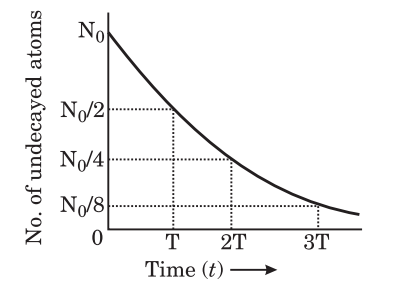
A graph between undecayed atoms and time is shown in the figure given here. The radioactive substance decreases exponentially with time i.e. more rapidly first and slowly afterwards.
Image

Need a full question paper?

Generate a complete, print-ready paper with questions like this in minutes — across 16+ boards, with answer keys.
Start Generating Free

Similar questions

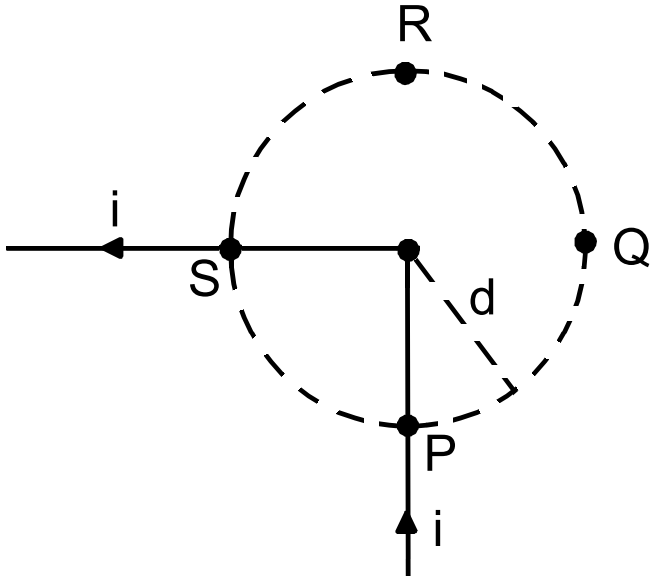
Figure shows a long wire bent at the middle to form a right angle. Show that the magnitudes of the magnetic fields at the points $\text{P, Q, R}$ and $S$ are equal and find this magnitude.
A circuit containing a $80\ mH$ inductor and a $60 \mu\  F$ capacitor in series is connected to a $230\ V, 50 \ Hz$ supply. The resistance of the circuit is negligible.
$a.$ Obtain the current amplitude and rms values.
$b.$ Obtain the rms values of potential drops across each element.
$c.$ What is the average power transferred to the inductor?
$d.$ What is the average power transferred to the capacitor?
$e.$ What is the total average power absorbed by the circuit? $[$‘Average’ implies ‘averaged over one cycle’.$]$
a. State the condition for resonance to occur in series LCR a.c. circuit and derive an expression for resonant frequency.
b. Draw a plot showing the variation of the peak current $\left( i _{ m }\right)$ with frequency of the a.c, source used. Define the quality factor Q of the circuit.
Consider the $D–T$ reaction $($deuterium $–$ tritium fusion$)$ $^2_1\text{H}+^3_1\text{H}\rightarrow^4_2\text{He}+\text{n} $
  1. Calculate the energy released in $\text{MeV}$ in this reaction from the data:
$\text{m}(^2_1\text{H})=2.014102\text{ u}$
$\text{m}(^3_1\text{H})=3.016049\text{ u}$
  1. Consider the radius of both deuterium and tritium to be approximately $2.0 fm$. What is the kinetic energy needed to overcome the coulomb repulsion between the two nuclei? To what temperature must the gas be heated to initiate the reaction? $($Hint: Kinetic energy required for one fusion event $=$ average thermal kinetic energy available with the interacting particles $= 2(3kT/2); k =$ Boltzman’s constant $, T =$ absolute temperature.$)$
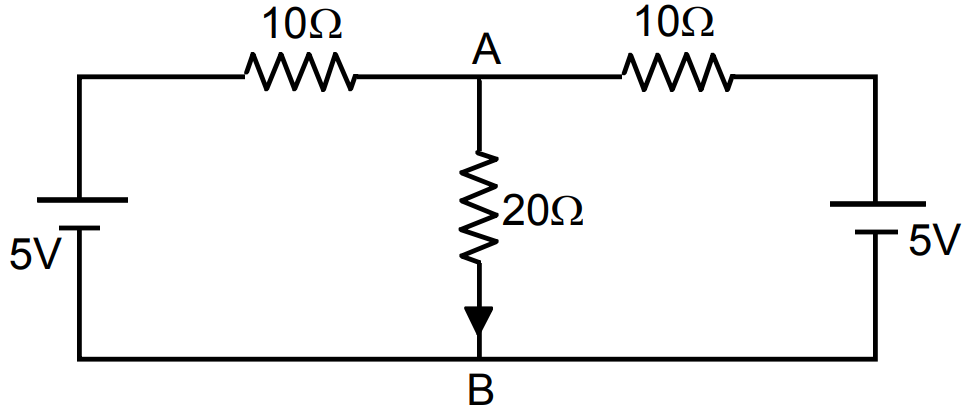
(a) Find the current in the $20\Omega$ resistor shown in the figure. (b) If a capacitor of capacitance $4\mu\text{F}$ is joined between the points A and B, what would be the electrostatic energy stored in it in steady state?
Two charges $5 \times 10^{–8} C$ and $–3 \times 10^{–8} C$ are located $16 \ cm$ apart. At what point $(s)$ on the line joining the two charges is the electric potential zero? Take the potential at infinity to be zero.
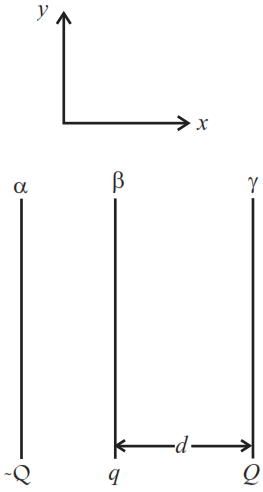
Two fixed, identical conducting plates $(\alpha\ \ \ \beta)$, each of surface area $S$ are charged to $-Q$ and $q,$ respectively, where $Q > q > 0.$ A third identical plate $(\gamma)$, free to move is located on the other side of the plate with charge $q$ at $a$ distance $d ($Fig$).$ The third plate is released and collides with the plate $\beta$. Assume the collision is elastic and the time of collision is sufficient to redistribute charge amongst $\beta\ \ \ \gamma$.

Find the charges on $\beta$ and $\gamma$ after the collision.
The earth revolves round the sun due to gravitational attraction. Suppose that the sun and the earth are point particles with their existing masses and that Bohr's quantization rule for angular momentum is valid in the case of gravitation.
(a) Calculate the minimum radius the earth can have for its orbit.
(b) What is the value of the principal quantum number n for the present radius? Mass of the earth $= 6.0 \times 10^{-24}kg.$ Mass of the sun $= 2.0 \times 10^{30}kg,$ earth $-$ sun distance $= 1.5 \times 10^{11}m$.
A uniform rod pivoted at its upper end hangs vertically. It is displaced through an angle of $60^\circ$ and then released. Find the magnitude of the force acting on a particle of mass dm at the tip of the rod when the rod makes an angle of $37^\circ$ with the vertical.
Calculate the:
  1. Momentum and,
  2. De Broglie wavelength of the electrons accelerated through a potential difference of $56 V.$