Question
Explain quantitatively the order of magnitude difference between the diamagnetic susceptibility of N2 (~5 × 10-9) (at STP) and Cu (~10-5).

Answer

Key concept:
Magnetic susceptibility: It is the property of the substance which shows how easily a substance can be magnetised. It can also be defined as the ratio of intensity of magnetisation (I) in a substance to the magnetic intensity (H) applied to the substance, i.e., $\text{XM}=\frac{\text{I}}{\text{H}}$.
According to the problem, we have
Density of nitrogen $\rho_{\text{N}_2}=\frac{28\text{g}}{22.4\text{L}}=\frac{28\text{g}}{22400\text{cc}}$
Also, density of copper $\rho_{\text{Cu}}=\frac{8\text{g}}{22.4\text{L}}=\frac{8\text{g}}{22400\text{cc}}$
So, ration of both densities
$\frac{\rho_{\text{N}_2}}{\rho_\text{Cu}}=\frac{28}{22400}\times\frac{1}{8}=16\times10^{-4}$
Also given $\frac{\chi_{\text{N}_2}}{\chi_\text{Cu}}=\frac{5\times10^{-9}}{10^{-5}}=5\times10^{-4}$
we know that, $\chi=\frac{\text{Magentisation (M)}}{\text{Magnetic intensity (H)}}$
$=\frac{\text{Magnetic moment (M)/Volime (V)}}{\text{H}}$
$=\frac{\text{M}}{\text{HV}}=\frac{\text{M}}{\text{H}(\text{mass/density})}=\frac{\text{M}\rho}{\text{Hm}}$
$\chi\propto\rho\ \ \Big(\because\ \frac{\text{M}}{\text{Hm}}=\text{constant}\Big)$
Hence, $\frac{\chi_{\text{N}_2}}{\chi_\text{Cu}}=\frac{\rho_{\text{N}_2}}{\rho_\text{Cu}}=1.6\times10^{-4}$
Therefore, we can say that magnitude difference or major difference between the diamagnetic susceptibility of N2 and Cu is 1.6 × 10-4.

Need a full question paper?

Generate a complete, print-ready paper with questions like this in minutes — across 16+ boards, with answer keys.
Start Generating Free

Similar questions

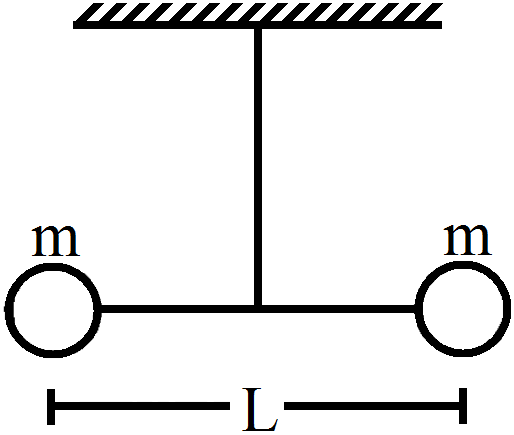
Two small balls, each of mass m are connected by a light rigid rod of length L. The system is suspended from its centre by a thin wire of torsional constant k. The rod is rotated about the wire through an angle $\theta_0$ and released. Find the tension in the rod' as the system passes through the mean position.

Explain the experiments of Faraday and Henry for explaining and describing the phenomenon of electromagnetic induction.
A group of hydrogen atoms are prepared in n = 4 states. List the wavelength that are emitted as the atoms make transitions and return to n = 2 states.
A 20cm long conducting rod is set into pure translation with a uniform velocity of 10cm/s-1 perpendicular to its length. A uniform magnetic field of magnitude 0.10T exists in a direction perpendicular to the plane of motion.
  1. Find the average magnetic force on the free electrons of the rod.
  2. For what electric field inside the rod, the electric force on a free elctron will balance the magnetic force? How is this electric field created?
  3. Find the motional emf between the ends of the rod.
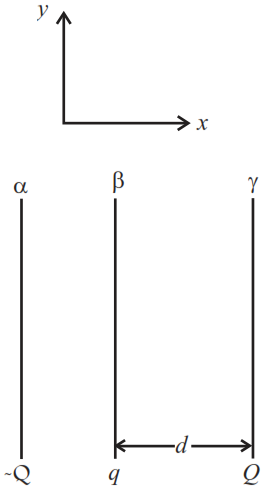
Two fixed, identical conducting plates $(\alpha\ \&\ \beta)$, each of surface area S are charged to -Q and q, respectively, where Q > q > 0. A third identical plate $(\gamma)$, free to move is located on the other side of the plate with charge q at a distance d (Fig.). The third plate is released and collides with the plate $\beta$. Assume the collision is elastic and the time of collision is sufficient to redistribute charge amongst $\beta\ \&\ \gamma$.

Find the electric field acting on the plate $\gamma$ before collision.
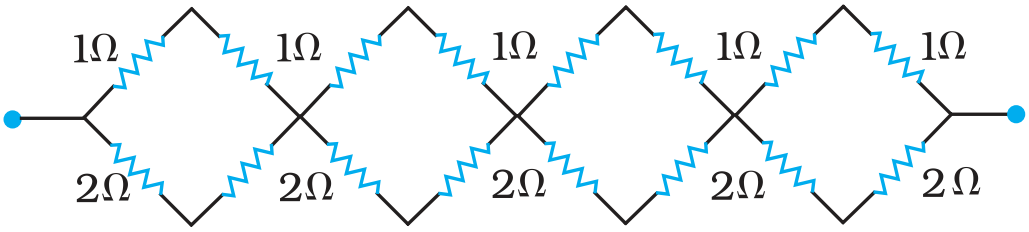
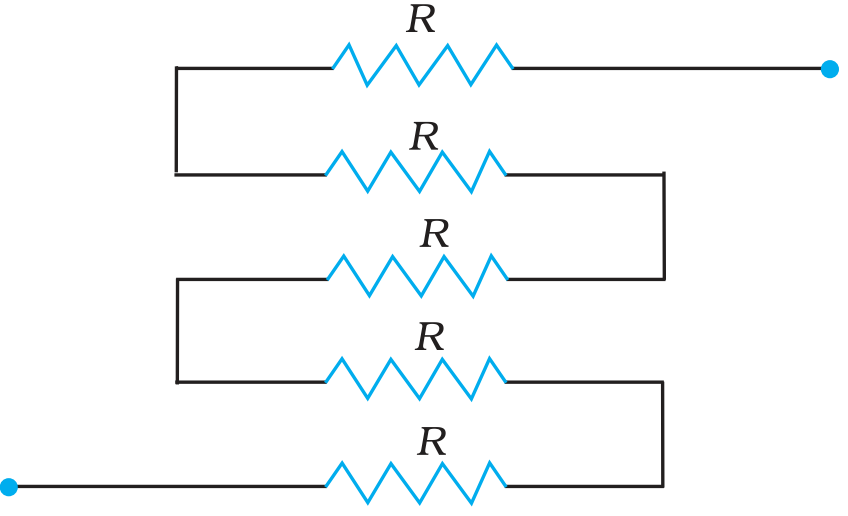
Determine the equivalent resistance of networks shown in Fig.


Calculate potential energy of a point charge -q placed along the axis due to a charge +Q uniformly distributed along a ring of radius R. Sketch P.E. as a function of axial distance z from the centre of the ring. Looking at graph, can you see what would happen if -q is displaced slightly from the centre of the ring (along the axis)?
A bar magnet of length 1cm and cross-sectional area 1.0cm2 produces a magnetic field of 1.5 × 10. T at a point in end-on position at a distance 15cm away from the centre.
  1. Find the magnetic moment M of the magnet.
  2. Find the magnetization I of the magnet.
  3. Find the magnetic field B at the centre of the magnet.
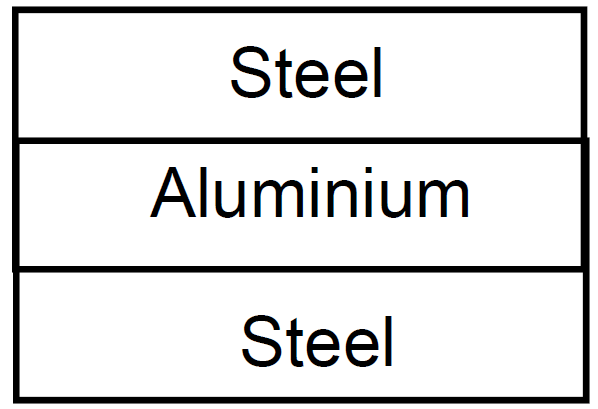
Two steel rods and an aluminium rod of equal length l0 and equal cross section are joined rigidly at their ends as shown in the figure below. All the rods are in a state of zero tension at 0°C. Find the length of the system when the temperature is raised to $\theta$. Coefficient of linear expanaion of aluminium and steel are $\alpha_\text{a}$ and $\alpha_\text{s}$respectively. Young's modulus of aluminium is Ya and of steel is Ys.

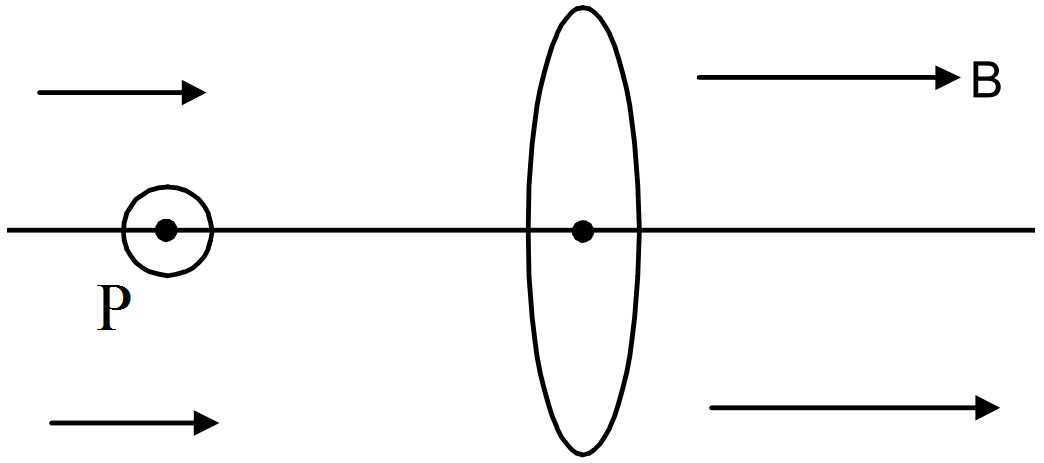
Shows a convex lens of focal length 12cm lying in a uniform magnetic field B of magnitude 1.2T parallel to its principal axis. A particle with charge 2.0 × 10⁻³C and mass 2.0 × 10⁻⁵ kg is projected perpendicular to the plane of the diagram with a speed of 4.8 ms-1. The particle moves along a circle with its centre on the principal axis at a distance of 18cm from the lens. Show that the image of the particle moves along a circle and find the radius of that circle.