Question
Explain the experiments of Faraday and Henry for explaining and describing the phenomenon of electromagnetic induction.

Answer

SELF

Need a full question paper?

Generate a complete, print-ready paper with questions like this in minutes — across 16+ boards, with answer keys.

Start Generating Free

Similar questions

  1. Draw a ray diagram to show the image formation by a combination of two thin convex lenses in contact. Obtain the expression for the power of this combination in terms of the focal lengths of the lenses.
  2. A ray of light passing from air through an equilateral glass prism undergoes minimum deviation when the angle of incidence is $\frac{3}{4}$th of the angle of prism. Calculate the speed of light in the prism.
Consider a circular ring of radius r, uniformly charged with linear charge density $\lambda.$ Find the electric potential at a point on the axis at a distance x from the centre of the ring. Using this expression for the potential, find the electric field at this point.
Why does blowing over a spoonful of hot tea cools it? Does evaporation play a role? Does radiation play a role?
An LC circuit contains a 20mH inductor and a 50μF capacitor with an initial charge of 10mC. The resistance of the circuit is negligible.
Let the instant the circuit is closed be t = 0.
  1. What is the total energy stored initially? Is it conserved during LC oscillations?
  2. What is the natural frequency of the circuit?
  3. At what time is the energy stored
  1. completely electrical (i.e., stored in the capacitor)?
  2. completely magnetic (i.e., stored in the inductor)?
  1. At what times is the total energy shared equally between the inductor and the capacitor?
  2. If a resistor is inserted in the circuit, how much energy is eventually dissipated as heat?
(a) Prove that the peak value ( $I_m$ ) of an alternating current is $\sqrt{2}$ times its root mean square ( rms ) value.(b) If alternating current $I=4 sin \omega t$ of and voltage $V =200 \sin (\omega t+\pi / 3)$, calculate the dissipated average power in the circuit.
Find the wavelength of the radiation emitted by hydrogen in the transitions (a) n = 3 to n= 2, (b) n = 5 to n = 4 and (c) n = 10 to n = 9.
An object is placed at a distance of 30cm from a converging lens of focal length 15cm. A normal eye (near point 25cm, far point infinity) is placed close to the lens on the other side.
  1.  Can the eye see the object clearly?
  2.  What should be the minimum separation between the lens and the eye so that the eye can clearly see the object?
  3.  Can a diverging lens, placed in contact with the converging lens, help in seeing the object clearly when the eye is close to the lens?
A body of mass 2kg is lying on a rough inclined plane of inclination 30°. Find the magnitude of the force parallel to the incline needed to make the block move:
  1. Up the incline
  2. Down the incline. Coefficient of static friction = 0.2.
  1. Draw a labelled ray diagram showing the formation of image by a compound microscope in normal adjustment. Derive the expression for its magnifying power.
  2. How does the resolving power of a microscope change when.
  1. The diameter of the objective lens is decreased,
  2. The wavelength of the incident light is increased.

Justify your answer in each case.

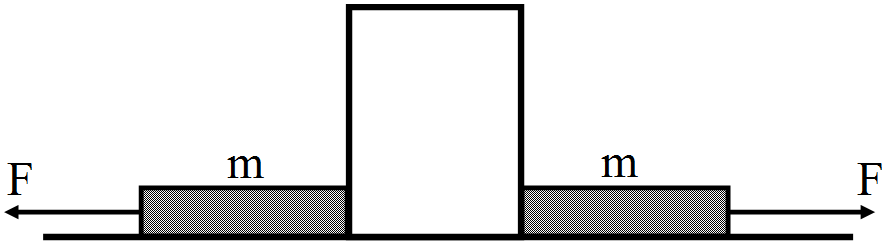
Figure shows a heavy block kept on a frictionless surface and being pulled by two ropes of equal mass m. At t = 0, the force on the left rope is withdrawn but the
force on the right end continues to act. Let F1 and F2 be the magnitudes of the forces by the right rope and the left rope on the block respectively:

  1. F= F2 = F for t < 0.
  2. F1 = F2 = F + mg for t < 0.
  3. F1 = F, F2 = F for t > 0.
  4. F1< F, F2 = F for t > 0.