Question
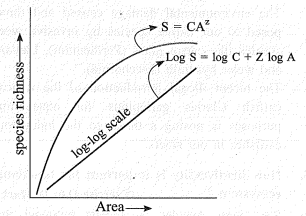
Explain Species-Area relationships graph.

Need a full question paper?

Generate a complete, print-ready paper with questions like this in minutes — across 16+ boards, with answer keys.
Start Generating Free

Similar questions

Read the following and answer any four questions from (i) to (v) given below:

Pollen-pistil interaction is the group of events that occur from the time of pollen deposition over the stigma to the time of pollen tube entry into ovule. It is a dynamic process which has checks at several places for promotion or inhibition of pollen growth. Pollen-pistil interaction is a safety measure to ensure that illegitimate crossings do not occur. Compatibility and incompatibility of the pollen-pistil is determined by special proteins. The compatible pollens are able to absorb water and nutrients from the surface of the stigma. They germinate and produce pollen tubes. Pollen tubes grow into the style. Their growth and path through the style are also determined by specific chemicals.

  1. Which of the following parts of gynoecium determines the compatible nature of pollen?
  1. Stigma.
  2. Style.
  3. Ovary.
  4. Thalamus.
  1. In Triforium, which type of self-incompatibility is found?
  1. Gametophytic self-incompatibility (GSI).
  2. Sporophytic self-incompatibility (SSI).
  3.  Both GSI and SSI.
  4. None of these.
  1. Select the incorrect statement.
  1. In Asteraceae, incompatibility is due to the genotype of the sporophytic stigmatic tissues.
  2. In members of Brassicaceae, incompatibility is due to the genotype of the pollen.
  3. Nature has imposed self-incompatibility to avoid highly homozygous individuals, which have a very low survival value.
  4. None of these.
  1. Which of the following are examples of self incompatibility?
  1. Tobacco.
  2. Potato.
  3. Crucifers.
  4. All of these.
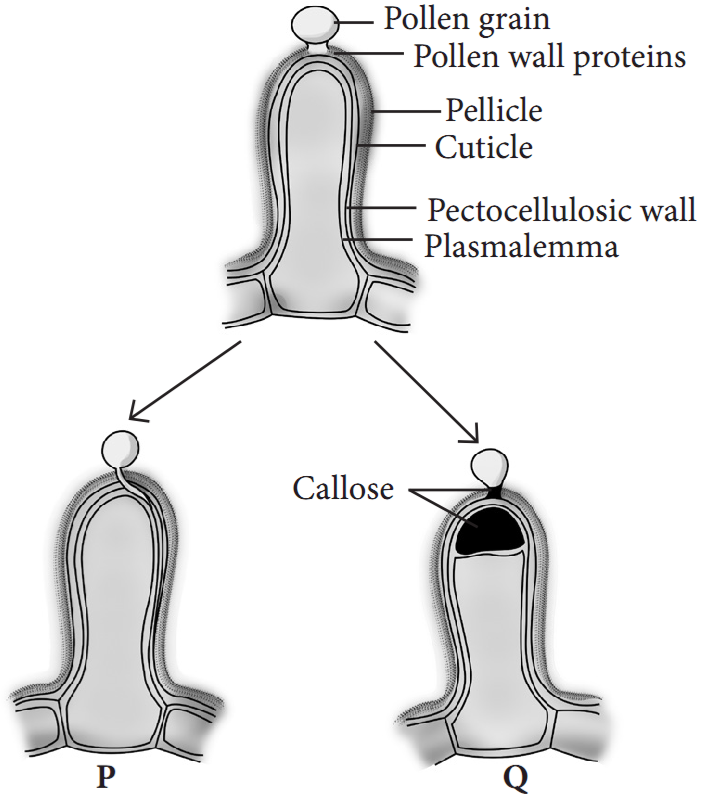
  1. Given figures show the pollen-stigma interaction, where pollen wall proteins are released onto the pellicle of stigmatic papillae, where a recognition reaction occurs.

Which of the following statements drawn from given figures is incorrect?

  1. P indicates compatible reaction in which the pollen tube penetrates the cuticle and grows down the papilla.
  2. Development of callose plug between the plasma membrane and pectocellulosic layer of stigmatic papillae results in the incompatibility reaction in Q.
  3. A callose plug, which appears at the tip of pollen in Q, is dissolved by callase enzyme secreted by stigma resulting in compatibility reaction.
  4. Deposition of callose can be employed as a reliable bioassay to detect compatibility or incompatibility reactions of pollen and stigma.
Read the following and answer any four questions from (i) to (v) given below:
The pollen grains or microspores are the male reproductive bodies of a flower and are contained in the pollen sac or microsporangia. Each pollen grain consists of a single microscopic cell, possessing two coats: the exine and the in tine. The exine of a pollen grain is made of chemically stable material. Because of this, pollen grains are often very well preserved for thousands of years in soil and sediments.
  1. One of the most resistant biological material present in the exine of pollen grain is:
  1. Pectocellulose.
  2. Sporopollenin.
  3. Suberin.
  4. Cellulose.
  1. The exine possesses one or more thin places known as:
  1. Raphe.
  2. Germ pores.
  3. Hilum.
  4. Endothecium.
  1. What is the function of germ pore?
  1. Emergence of radicle.
  2. Absorption of water for seed germination.
  3. Initiation of pollen tube.
  4. All of these.
  1. What is the key advantage to the plant for having such strong pollen grain walls?
  1. It protects the vital genetic material in the pollen grain.
  2. It allows pollen to serve as a valuable fossil record for the study of ancient plants.
  3. It prevents the pollen tube from growing out before the pollen grain reaches the stigma of a compatible species.
  4. It gives weight to the pollen grain, allowing it to cling better to the body surfaces of insect pollinators.
  1. The number of germ pores in dicots and monocots respectively are:
  1. One and three.
  2. Three and two.
  3. Two and three.
  4. Three and one.
Read the following and answer any four questions from (i) to (v) given below:

When it comes to biopesticides, one of the most widely used fungi is Beauveria bassiana. It infects a range of insects like, pecan weevil, Colorado potato beetle, kudzu bug, etc. It causes a disease known as the white muscardine. Even after an insect is killed, the white mold continues to produce millions of new infective spores that are released into the environment. It is commercially formulated as products including Naturalis L, Mycotrol, BotaniGard, etc. Some other widely used molds are Trichoderma, Metarhizium, etc. Some of them release enzymes that dissolve potential pathogens, others form barriers around plant roots and make it impossible for harmful bacteria and pathogens to pass through.

  1. The key benefits of the biopesticides are that they are:
  1. Highly effective.
  2. Target specific.
  3. Reduced environmental risks.
  4. all of these.
  1. Naturalis-L is a conunercial formulation containing:
  1. Bacterial biopesticide.
  2. Fungal biopesticide.
  3. Fungal biofertiliser.
  4. Chemical pesticide.
  1. Which of the following is used as an effective bacterial biopesticide?
  1. Trichoderma.
  2. Beauveria.
  3. Bacillus thuringiensis.
  4. All of these.
  1. Baeuveria causes a disease called:
  1. White muscardine.
  2. Aspergillosis
  3. Green muscardine.
  4. Powdary mildews.
  1. Assertion: Trichoderma, found in root ecosystem, exerts biological control over several plant pathogens.

Reason: Trichoderma release enzyme which inhibits growth of several disease causing pathogens.

  1. Both assertion and reason are true and reason is the correct explanation of assertion.
  2. Both assertion and reason are true but reason is not the correct explanation of assertion.
  3. Assertion is true but reason is false.
  4. Both assertion and reason are false.
Read the following and answer any four questions from (i) to (v) given below:

Reerna, Jai and Ankit are suffering from autoimmune diseases of adrenal cortex, joints and thyroid gland, respectively. Their immune system failed to recognise self and non-self and started destroying their body's own proteins. They are seeking proper medical help for their conditions but their condition cannot be cured completely.

Based on the above information, answer the following questions.

  1. Select the option that correctly identifies autoimmune diseases of Reema, Jai and Ankit.
S no.
Reema
Jai
Ankit
(a)
Diabetes
Grave's disease
Rheumatic fever
(b)
Pernicious anaemia
Multiple sclerosis
Myasthenia gravis
(c)
Addison's disease
Rheumatoid arthritis
Hashismoto's thyroiditis
(d)
Systemic lupus erythematosus
Severe combined immunodeficiency disease
AIDS
  1. Reema's autoimmune condition is characterised by
  1. Undersecretion of insulin.
  2. Destruction of RB Cs and low RB C count.
  3. Undersecretion of adrenal cortex hormones.
  4. Low production of intrinsic factor required for absorption of B12
  1. What do you think is the major cause of Jai's condition?
  1. Deterioration of myelin sheath around nerve cells, leading to loss of precise muscle control
  2. Destruction of heart cells, leading to weakening of entire heart wall.
  3. Destruction of beta cells, leading to undersecretion of insulin.
  4. Deposition of immune complexes of IgM, IgG and complement in joints thereby inflaming joints, destroying articular cartilage and fusing bones.
  1. How do you think Ankit's condition got diagnosed?
  1. Low level of thyroid hormone and elevated levels of TSH in Ankit's blood.
  2. Presence of antibodies against thyroid pen oxidase (TPO antibodies) in Ankit's blood.
  3. Elevated erythrocyte sedimentation rate (ESR), reduced C-reactive protein (CRP) in Ankit.
  4. Both (a) and (b)
  1. Assertion: Immunosuppressive drugs often reduce the severity of autoimmune disorders.

Reason: Monoclonal antibodies have been successfully used in the treatment of autoimmune disease.
  1. Both assertion and reason are true, and reason is the correct explanation of assertion.
  2. Both assertion and reason are true, but reason is not the correct explanation of assertion.
  3. Assertion is true, but reason is false.
  4. Both assertion and reason are false.
Read the following and answer any four questions from (i) to (v) given below:

Tools used in the formation of recombinant DNA are of three types. These are enzymes, cloning vectors and competent host. lysing enzymes are used to extract DNA for experimental purpose from the cells. Cleaving enzymes break the DNA molecules. TI1ey are of three types : exonucleases, endonucleases and restriction endonucleases. A competent host is required for transformation with recombinant DNA and cloning vectors help to propagate DNA.

  1. Which of the following is an example of natural Iysing activity in a human body?
  1. Lysozyme present in tears dissolve the bacterial cell wall.
  2. Conversion of starch to maltose in the buccal cavity
  3. Absorption of digested food into the intestinal cells.
  4. Conversion of protein molecules into amino acids in the stomach.
  1. Which of the following depicts exonuclease activity?
  1.  

  1.  

  1.  


  1. All of these
  1. Cloning vectors are the DNA molecules that.
  1. Carry foreign DNA segment but do not replicate inside the host cell.
  2. Carry foreign DNA segment and replicate inside the host cell.
  3. Transfer nuclear DNA form nucleus to the cytoplasm of the same cells.
  4. Help in sealing gaps in DNA segments.
  1. Transfer of DNA into a eucaryotic cell is called:
  1. Transformation.
  2. Transduction.
  3. Transfection.
  4. Electroporation.
  1. Assertion: Type I restriction enzymes are not used in rDNA technology.

Reason: Biotechnology mostly involves cutting and pasting of desired DNA fragments.

  1. Both assertion and reason are true and reason is the correct explanation of assertion.
  2. Both assertion and reason are true but reason is not the correct explanation of assertion.
  3. Assertion is true but reason is false.
  4. Both assertion and reason are false.
Explain Competition as a population Interaction with suitable examples.
Read the following and answer any four questions from (i) to (v) given below:

The endosperm makes the main source of food for the embryo. Generally the endosperm nucleus divides after the division of the oospore, but in several cases the endosperm is formed to a great extent even before the first division of the oospore. There are three general types of endosperm formation: (a) nuclear type, (b) cellular type and (c) helobial type. The endosperm is usually triploid, but haploid endosperm is also found. Endosperm may either be completely consumed by the developing embryo before seed maturation, or it may persist in the mature seed.

  1. Haploid endosperm is found in:
  1. Pin us.
  2. Cauliflower.
  3. Sunflower.
  4. Pea.
  1. Persistent endosperm is found in:

P. Pea Q. Castor R. Bean S. Coconut T. Groundnut.

  1. Q and S.
  2. P and T.
  3. R, S and T.
  4. P, S and T.
  1. Milk of tender coconut represents (A) and the surrounding white coconut meal represents (B).
S. No
A
B
(a)
Cellular endosperm
Free- nuclear endosperm
(b)
Free-nuclear endosperm
Cellular endosperm
(c)
Helobial endosperm
Cellular endosperm
(d)
Free-nuclear endosperm
Helobial endosperm
  1. If an endosperm cell of a gymnosperm contains 12 chromosomes, the number of chromosomes in each cell of the root will be:
  1. 4
  2. 24
  3. 16
  4. 6
  1. In angiosperms, normally after fertilization:
  1. The zygote divides earlier than the primary endosperm nucleus.
  2. The primary endosperm nucleus divides earlier than the zygote.
  3. Both the zygote and primary endosperm nucleus divide simultaneously.
  4. Both the zygote and primary endosperm nucleus undergo a resting period.
What is the mechanism by which the AIDS virus causes deficiency of immune system of the infected person?
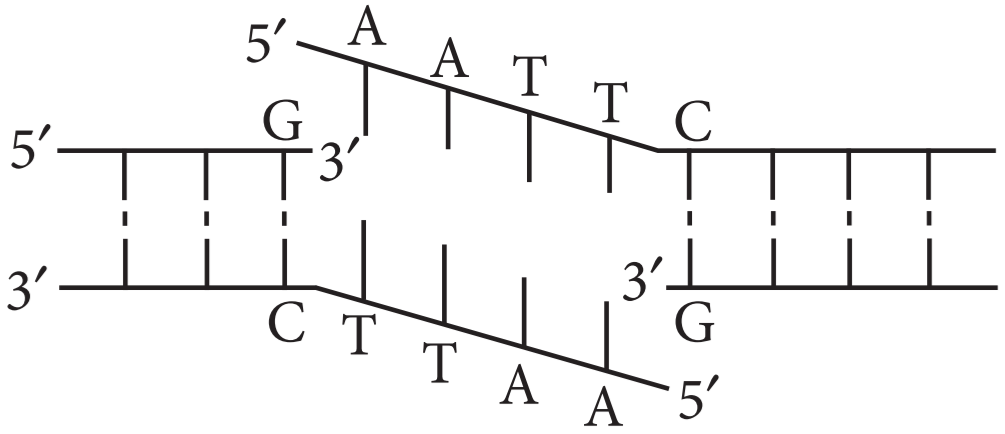
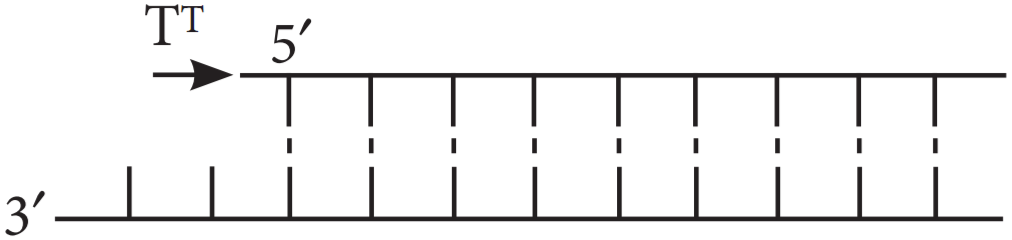
How interesingly Gene is amplified by using PCR? Explain with diagram.
Read the following and answer any four questions from (i) to (v) given below:
The first menstruation is called menarche, that usually occurs between 12 and 15 years. In human females, menstruation is repeated at an average interval of about 28/29 days and is called menstrual cycle. It is regulated by certain hormones, as pituitary gland is stimulated by releasing factors produced in the hypothalamus. The hormones produced by pituitary gland influence the ovaries. The hormones secreted by the ovaries affect the walls of the uterus.
  1. The breakdown of endometrium is characteristic of:
  1. Proliferative phase.
  2. Luteal phase.
  3. Ovulatory phase.
  4. Menstrual phase.
  1. Which days of the menstrual cycle marks the proliferative phase?
  1. 1-5
  2. 15-28
  3. 6-13
  4. 10-14
  1. Which of the following occurs during secretory phase?
  1. Empty Graafian follicle changes into corpus luteum.
  2. Primary follicle changes into Graafian follicle.
  3. Endometrium rebuilds and estrogen secretion increases.
  4. LH surge, inducing release of an ovum.
  1. Identify the hormones that attain peak level during ovulatory phase.
  1. FSH.
  2. Progesterone.
  3. LH.
  4. Both (a) and (c).
  1. Withdrawal of which hormone causes degeneration of corpus luteum?
  1. FSH.
  2. LH.
  3. Progesterone.
  4. Estrogen.