Question
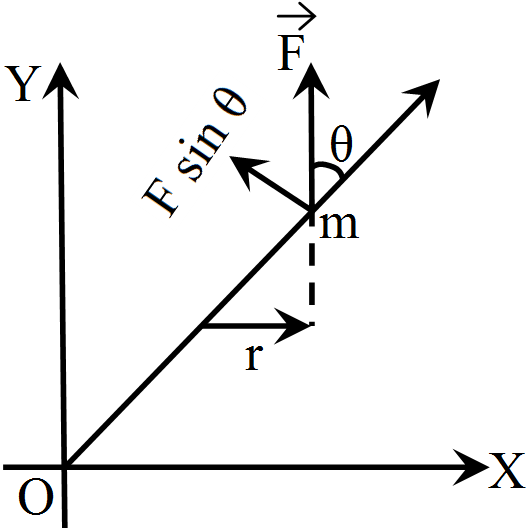
Explain that torque is only due to transverse component of force. Radial component has nothing to do with torque.
Answer

Torque is defined as the moment of force. $\tau=\vec{\text{r}}\times\vec{\text{F}}=\text{r}\text{ F}\sin\theta\ \hat{\text{n}}.\hat{\text{n}}$ is along axis of rotation. If a force $\vec{\text{F}}$ acts at an angle $\theta$ to the position vector i then $\text{F}\sin\theta$ acts perpendicularly to the position- vector. Therefor $\tau=\text{r}_{\bot}\text{F}$ and so the radial component does not bring any influence on the torque.

Need a full question paper?

Generate a complete, print-ready paper with questions like this in minutes — across 16+ boards, with answer keys.
Start Generating Free

Similar questions

A bomb at rest explodes into three parts of the same mass. The moments of the two parts is $-2 p_{\mathrm{i}}$ and $\mathrm{p}_{\mathrm{j}}$. What will be the momentum of the third part?
A box of wood is placed on a 30° slope. If the coefficient of friction be 0.1, what is the downward acceleration of the wooden box?
Calculate the efficiency of a Carnot's engine working between steam point and ice point.
Express unified atomic mass unit in kg.
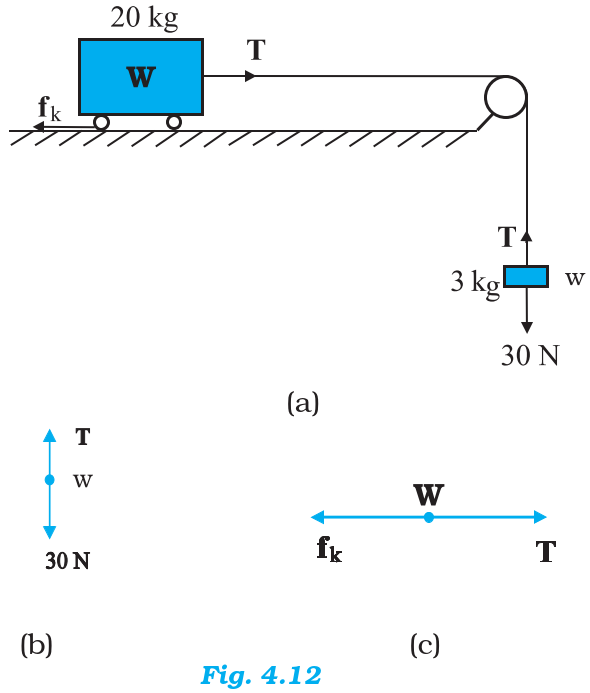
What is the acceleration of the block and trolley system shown in a Fig. 4.12(a), if the coefficient of kinetic friction between the trolley and the surface is 0.04 ? What is the tension in the string? (Take $g=$ $10 m s ^{-2}$ ). Neglect the mass of the string.
Image
Three simple harmonic motions of equal amplitudes A and equal time periods in the same direction combine. The phase of the second motion is 60° ahead of the first and the phase of the third motion is 60° ahead of the second. Find the amplitude of the resultant motion.
A radioactive isotope is being produced at a constant rate $\frac{\text{dN}}{\text{dt}}=\text{R}$ in an experiment. The isotope has a half-life $\text{t}_{\frac{1}2{}}.$ Show that after a time $\text{t}>>\text{t}_{\frac{1}{2}},$ the number of active nuclei will become constant. Find the value of this constant.
Show that the coefficient of volume expansion for a solid substance is three times its coefficient of linear expansion.
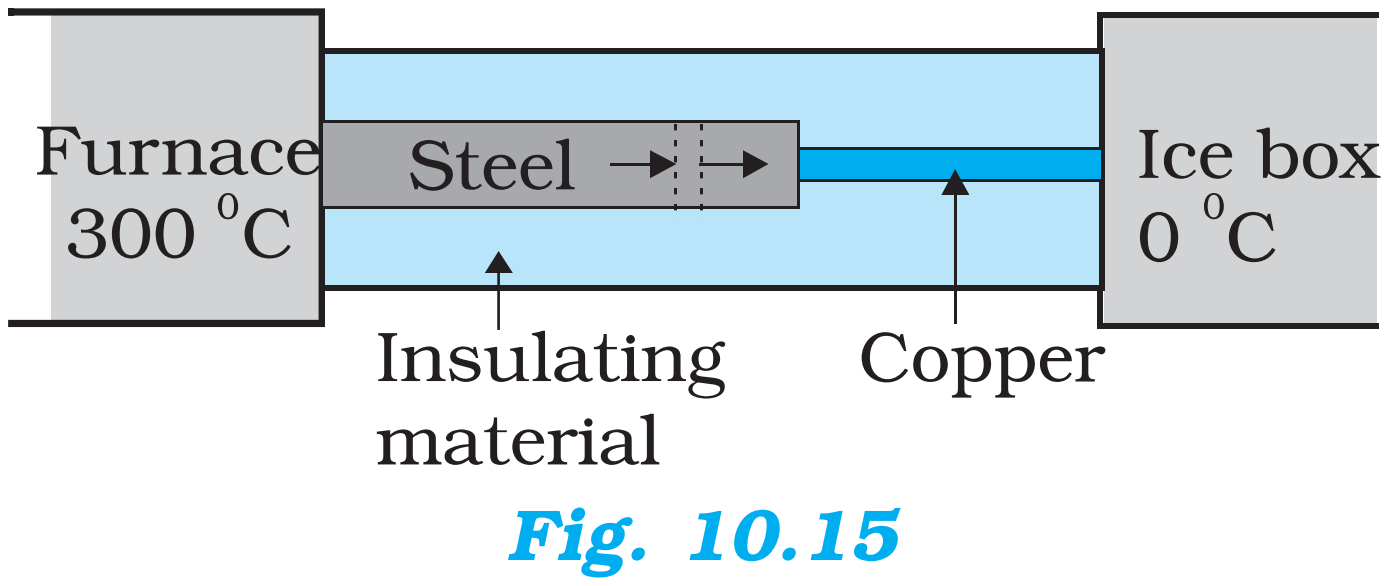
What is the temperature of the steel-copper junction in the steady state of the system shown in Fig. 10.15. Length of the steel rod $=15.0 cm$, length of the copper rod $=10.0 cm$, temperature of the furnace $=300^{\circ} C$, temperature of the other end $=0{ }^{\circ} C$. The area of cross section of the steel rod is twice that of the copper rod. (Thermal conductivity of steel $=50.2 J s ^{-1} m ^{-1} K ^{-1}$; and of copper $\left.=385 J s ^{-1} m ^{-1} K ^{-1}\right)$.
Image
How to find displacement from velocity-time graph? Explain.