Question
Express unified atomic mass unit in kg.

Answer

The unified atomic mass unit is the standard unit that is used for indicating mass on an atomic or molecular scale (atomic mass). One unified atomic mass unit is approximately the mass of one nucleon (either a single proton or neutron) and is numerically equivalent to 1g/mol. It is defined as one- twelfth of the mass of an unbound neutral atom of carbon-12 in its nuclear and electronic ground state.

Need a full question paper?

Generate a complete, print-ready paper with questions like this in minutes — across 16+ boards, with answer keys.
Start Generating Free

Similar questions

Calculate the temperature which has same numeral value on celsius and Fahrenheit scale.
For ordinary terrestrial experiments, which of the observers below are inertial and which are non-inertial:
  1. A child revolving in a giant wheel.
  2. A driver in a sports car moving with a constant high speed of $200kmh^{-1}$ on a straight road.
  3. The pilot of an aeroplane which is taking off.
  4. A cyclist negotiating a sharp turn.
  5. The guard of a train which is slowing down to stop at a station.
Find out whether these phenomena are reversible or not :
  1. Waterfall.
  2. Rusting of iron.
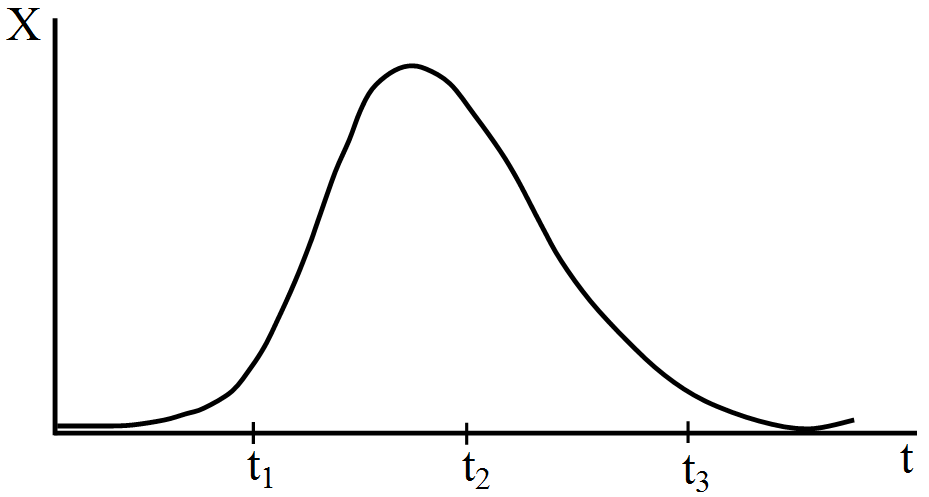
Figure shows the $x$ coordinate of a particle as a function of time. Find the signs of $v_x$ and $a_x$ at $t = t_1, t = t_2$ and $t = t_3$.
A monochromatic light source of intensity $6mW$ emits $8 \times 10^{16}$ photons per second. This light ejects photoelectrons from a metal surface. The stopping potential for this setup is $2.0V$. Calculate the work function of the metal.
Two particles have equal masses of 5.0 g each and opposite charges of $+4.0 \times 10^{-5} \mathrm{C}$ and $-4.0 \times 10^{-5} \mathrm{C}$. They are released from rest with a separation of 1.0 m between them. Find the speeds of the particles when the separation is reduced to 50 cm .
Determine the volume contraction of a solid copper cube, $10cm$ on an edge, when subjected to a hydraulic pressure of $7.0 \times 10^6 Pa$.
Name the three modes of transfer of heat from one object to other. Also, cite one example for each one of them.
A diver having a moment of inertia of $6.0kg-m^2$ about an axis through its centre of mass rotates at an angular speed of $2rad/s$ about this axis. If he folds his hands and feet to decrease the moment of inertia to $5.0kg-m^2​​​​​​​$, what will be the new angular speed?
Two bodies make an elastic head-on collision on a smooth horizontal table kept in a car. Do you expect a change in the result if the car is accelerated on a horizontal road because of the noninertial character of the frame? Does the equation "Velocity of separation = Velocity of approach" remain valid in an accelerating car? Does the equation "Final momentum = Initial momentum" remain valid in the accelerating car?