Question
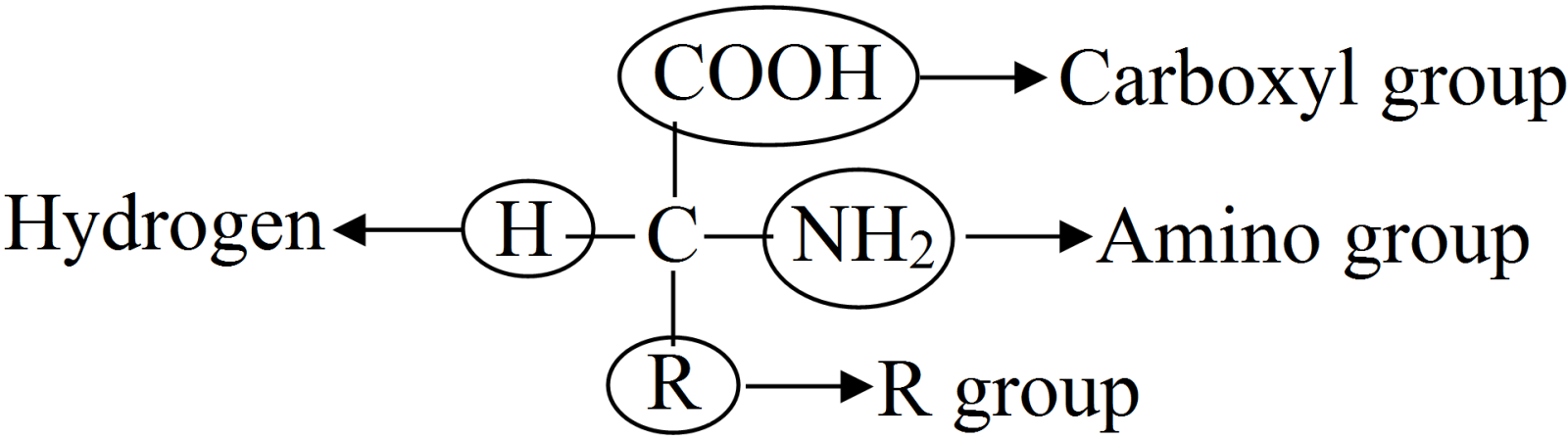
Explain the basic structure of an Amino acid.

Answer

Amino acid is an organic compound, which has an amino group and an acidic group, present as substituents on the same carbon; i.e., the a-carbon. Because of this amino acids are also called a-amino acids. On four valency positions there The are four substituent groups. They are hydrogen, carboxyl group, amino group and On a variable group. The variable group is called the 'R' group. The nature of R group decides the type of an amino acid.

Need a full question paper?

Generate a complete, print-ready paper with questions like this in minutes — across 16+ boards, with answer keys.
Start Generating Free

Similar questions

How many vertebrae in all do we have? Categorise them on the basis of their location giving the specific number in each category.
Explain the three types of cell junctions.
Analyse the events during every stage of cell cycle and notice how the following two parameters change.
Amount of DNA content (C) per cell.
Find out what do the terms ‘algal bloom’ and ‘red-tides’ signify.
Distinguish between the following:
Protoxylem and metaxylem.
Ankit, a Xl class student was continuously listening to his sister and her friend's discussion about the growth of plant. They were discussing that plant growth involves three phenomena, i.e., differentiation, dedifferentiation and redifferention. Listening this Ankit interrupted them in between and asked her sister to elaborate the things in detail and the basic phenomenon behind it. As the topic was the part of the Ankit's syllabus also. Her sister explained him that the cells in plant undergo differentiation to attain a maturity in order to perform specific functions.
  1. What is dedifferentiation? Name two tissues formed by this process phenomenon.
  2. What is redifferentiation?
  3. What value is learnt from the Ankit's character as an ideal biology student.
Draw the labelled diagram of the following:
V.S. of maize seed.
Draw the sectional view of coelomate, pseudocoelomate and acoelomate.
An Rh-negative woman is carrying an Rh-positive foetus for the second time. Describe the consequences of Rh-incompatibility in this case?

OR

Why is it necessary to check the Rh-factor of the blood of a pregnant woman?

Why are the classification systems changing every now and then?