Question
Explain the effective internal resistance of cells connected in series combination. Compare the results to the external resistance.
Answer

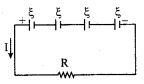
Cells in series Several cells can be connected to form a battery. In a series connection, the negative terminal of one cell is connected to the positive terminal of the second cell, the negative terminal of the second cell is connected to the positive terminal of the third cell and so on. The free positive terminal of the first cell and the free negative terminal of the last cell become the terminals of the battery.

Image
Suppose n cells, each of emf ξ volts and internal resistance r ohms are connected in series with an external resistance R.
The total emf of the battery = nξ
The total resistance in the circuit = nr + R
By Ohm’s law, the current in the circuit is

$
I =\frac{\text { total } emf }{\text { total resistance }}=\frac{n \xi}{n r+ R }
$
total resistance $n r+ R$
Case (a) If $r<R$, then,
$
I =\frac{n \xi}{R} nl _1 \approx nl _1
$
where, $l$, is the current due to a single cell $\left( I _1=\frac{\xi}{ R }\right)$
Thus, if $r$ is negligible when compared to $R$ the current supplied by the battery is $n$ times that supplied by a single cell.
Case (b) If $r> R , I =\frac{n \xi}{n r} \approx \frac{\xi}{R}$
It is the current due to a single cell. That is, current due to the whole battery is the same as that due to a single cell and hence there is no advantage in connecting several cells. Thus the series connection of cells is advantageous only when the effective internal resistance of the cells is negligibly small compared with $R$.

Need a full question paper?

Generate a complete, print-ready paper with questions like this in minutes — across 16+ boards, with answer keys.

Start Generating Free