Questions

[ 5 Marks Questions ]

🎯

Test yourself on this topic

4 questions · timed · auto-graded

Question 15 Marks
Explain the effective internal resistance of cells connected in parallel combination. Compare the results to the external resistance.
Answer
Cells in parallel: In parallel connection, all the positive terminals of the cells are connected to one point and all the negative terminals to a second point. These two points form the positive and negative terminals of the battery.
Let n cells be connected in parallel between points A and B and a resistance R is connected between points A and B. Let ξ, be the emf and r the internal resistance of each cell.
The equivalent internal resistance of the battery is $\frac{1}{r_{e q}}=\frac{1}{r}+\frac{1}{r}+\ldots .$. $\frac{1}{r}$ (n terms) $=\frac{n}{r}$.
So $r _{\text {eg }}=\frac{r}{n}$ and the total resistance in the circuit $= R +\frac{r}{n}$. The total emf is the potential difference between the points $A$ and $B$, which is equal to $\xi$. The current in the circuit is given by
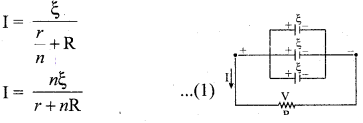
Image

where II is the current due to a single cell and is equal to $\frac{\xi}{R}$ when R is negligible. Thus, the current through the external resistance due to the whole battery is $n$ times the current due to a single cell.
Case (b) If $r << R . I =\frac{\xi}{ R } \ldots . .$.
(3)The above equation implies that the current due to the whole battery is the same as that due to a single cell. Hence it is advantageous to connect cells in parallel when the external resistance is very small compared to the internal resistance of the cells."
View full question & answer
Question 25 Marks
Explain the effective internal resistance of cells connected in series combination. Compare the results to the external resistance.
Answer
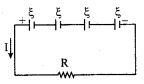
Cells in series Several cells can be connected to form a battery. In a series connection, the negative terminal of one cell is connected to the positive terminal of the second cell, the negative terminal of the second cell is connected to the positive terminal of the third cell and so on. The free positive terminal of the first cell and the free negative terminal of the last cell become the terminals of the battery.

Image
Suppose n cells, each of emf ξ volts and internal resistance r ohms are connected in series with an external resistance R.
The total emf of the battery = nξ
The total resistance in the circuit = nr + R
By Ohm’s law, the current in the circuit is

$
I =\frac{\text { total } emf }{\text { total resistance }}=\frac{n \xi}{n r+ R }
$
total resistance $n r+ R$
Case (a) If $r<R$, then,
$
I =\frac{n \xi}{R} nl _1 \approx nl _1
$
where, $l$, is the current due to a single cell $\left( I _1=\frac{\xi}{ R }\right)$
Thus, if $r$ is negligible when compared to $R$ the current supplied by the battery is $n$ times that supplied by a single cell.
Case (b) If $r> R , I =\frac{n \xi}{n r} \approx \frac{\xi}{R}$
It is the current due to a single cell. That is, current due to the whole battery is the same as that due to a single cell and hence there is no advantage in connecting several cells. Thus the series connection of cells is advantageous only when the effective internal resistance of the cells is negligibly small compared with $R$.
View full question & answer
Question 35 Marks
Explain in details of the temperature dependence of resistivity.
Answer
Temperature dependence of resistivity: The resistivity of a material is dependent on temperature. It is experimentally found that for a wide range of temperatures, the resistivity of a conductor increases with an increase in temperature according to the expression, $ \rho_{ T }=\rho_0\left[1+\alpha\left( T - T _0\right)\right] $ where $\rho_{ T }$ is the resistivity of a conductor at $T _0 C , \rho_0$ is the resistivity of the conductor at some reference temperature To (usually at $20^{\circ} C$ ) and $a$ is the temperature coefficient of resistivity. It is defined as the ratio of increase in resistivity per degree rise in temperature to its resistivity atto. From the equation (1), we can write
$ \rho_{ T }-\rho_0=\alpha \rho_0\left( T - T _0\right)$
$\therefore \alpha=\frac{\rho_{ T }-\rho_0}{\rho_0\left( T - T _0\right)}=\frac{\Delta p}{\rho_0 \Delta T} $
where $\Delta_\rho=\rho_T-\rho_0$ is change in resistivity for a change in temperature $\Delta T = T - T _0$. Its unit is per ${ }^{\circ} C$.
2. $\alpha$ of semiconductors: For semiconductors, the resistivity decreases with an increase in temperature. As the temperature increases, more electrons will be liberated from their atoms (Refer to unit 9 for conduction in semiconductors). Hence the current increases and therefore the resistivity decreases. A semiconductor with a negative temperature coefficient of resistance is called a thermistor. We can understand the temperature dependence of resistivity in the following way. The electrical conductivity, $\sigma=\frac{n e^2 \tau}{m} \frac{m}{n e^2 \tau}$. As the resistivity is inverse of $\sigma$, it can be written as, $\sigma=\frac{n e^2 \tau}{m} \frac{m}{n e^2 \tau} \ldots \ldots$ The resistivity of materials is 1. inversely proportional to the number density $(n)$ of the electrons 2. inversely proportional to the average time between the collisions $(\tau)$. In metals, if the temperature increases, the average time between the collision $(\tau)$ decreases and $n$ is independent of temperature. In semiconductors when temperature increases, $n$ increases, and $\tau$ decreases, but an increase in $n$ is dominant than decreasing $x$, so that overall resistivity decreases.
View full question & answer
Question 45 Marks
Explain the concept of colour code for carbon resistors.
Answer
Color code for Carbon resistors:
Carbon resistors consist of a ceramic core, on which a thin layer of crystalline carbon is deposited. These resistors are inexpensive, stable, and compact in size. Color rings are used to indicate the value of the resistance according to the rules.
Three coloured rings are used to indicate the values of a resistor: the first two rings are significant figures of resistances, the third ring indicates the decimal multiplier after them. The fourth color, silver or gold, shows the tolerance of the resistor at $10 \%$ or $5 \%$. If there is no fourth ring, the tolerance is $20 \%$. For the resistor, the first digit $=5$ (green), the second digit $=6$ (blue), decimal multiplier $=10^3$ (orange) and tolerance $=5 \%$ (gold). The value of resistance $=56 \times 10^3 Q$ or $56 k \Omega$ with the tolerance value of $5 \%$.
View full question & answer
[ 5 Marks Questions ] - Physics STD 12 Questions - Vidyadip