Question
Explain the excited states for the hydrogen atom.

Answer


Image
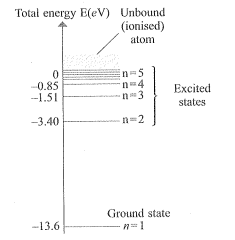
$\rightarrow$ At room temperature, most of the hydrogen atoms are in ground state.
$\rightarrow$ When a hydrogen atom receives energy by processes such as electron collisions, the atom may acquire sufficient energy to raise the
electron to higher energy states.
The atom is then said to be in an excited state.
$\rightarrow$ Putting $n=2$ in
$E _{ n }=-\frac{13.6}{n^2} e V$
$E _2=-3.4 e V .$
$\rightarrow $ It means that the energy required to excite an electron in hydrogen atom to its first excited state, is an energy equal to
$E _2- E _1 =-3.40 eV -(-13.6) eV$
$ =-3.4 eV +13.6 eV$
$ =10.2 eV$
$\rightarrow$ Similarly, $E _3=-1.51 eV$
$\rightarrow$ To excite the hydrogen atom from its ground state to second excited state, energy required is
$E _3- E _1 =-1.51 eV -(-13.6) eV$
$ =-1.51 eV +13.6 eV$
$ =12.09 eV$
$\rightarrow$ In contrast, when an electron moves from an excited state to a lower energy state a photon is emitted.
$\rightarrow$ Thus, as the excitation of hydrogen atom increases $($as $n$ increases$)$ the value of minimum energy required to free the electron from the excited atom decreases.
$\rightarrow$​​​​​​​ The energies of the excited states come closer and closer together as $n$ increases.

Need a full question paper?

Generate a complete, print-ready paper with questions like this in minutes — across 16+ boards, with answer keys.
Start Generating Free

Similar questions

The image of a small electric bulb fixed on the wall of a room is to be obtained on the opposite wall $3 m$ away by means of a large convex lens. What is the maximum possible focal length of the lens required for the purpose?
Is it necessary for the plane of the orbit of a satellite to pass through the centre of the earth?
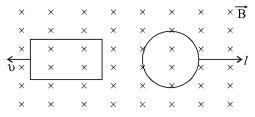
A rectangular loop and a circular loop are moving out of a uniform magnetic field with a constant velocity $v$ as shown in the figure :
Image
Magnetic field is perpendicular to the plane of loops. Explain in which loop, the magnitude of induced emf will remain constant while emerging out of magnetic field?
a. It is not advisable to use a galvanometer as such to measure current directly. Why?
b. Why should the value of resistance connected in parallel to a galvanometer be low?
c. Is the reading shown by an ammeter in a circuit less than or more than the actual value of current flowing in the circuit? Why?
Two loudspeakers are arranged facing each other at some distance. Will a person standing behind one of the loudspeakers clearly hear the sound of the other loudspeaker or the clarity will be seriously damaged because of the 'collision' of the two sounds in between?
Energy of a photon is 7.5 eV. Find its frequency.
Do two positively charged balls attract each other?
$a$. An electron moving horizontally with a velocity of $4 \times 10^4 m / s$ enters a region of uniform magnetic field of $10^{-5} T$ acting vertically upward as shown in the figure. Draw its trajectory and find out the time it takes to

Image

$b$. A straight wire of mass $200 g $and length $1.5\ m$ carries a current of $2 A$. It is suspended in mid air by a uniform magnetic field $B$. What is the magnitude of the magnetic field?
Figure shows a conducting square loop placed parallel to the pole faces of a ring magnet. The Pole$-$faces have an area of $1\ cm^2 $ each and the field between the poles is $0.10T$. The wires making the loop are all outside the magnetic field. If the magnet is removed in $1.0s$, what is the average emf induced in the loop?
A free neutron beta $-$ decays to a proton with a half $-$ life of $14$ minutes.
  1. What is the decay constant?
  2. Find the energy liberated in the process.