Question
Explain the I-V characteristics of a reverse biased junction diode.

Answer

i. The positive terminal of the external voltage is connected to the cathode (n-side) and negative terminal to the anode (p-side) across the diode.
ii. In case of reverse bias the width of the depletion region increases and the p-n junction behaves like a high resistance.
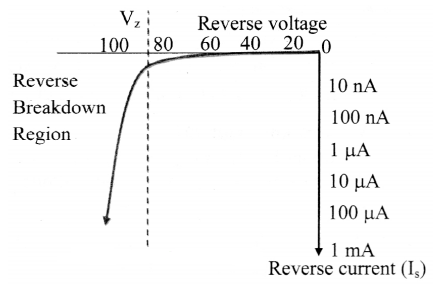
iii. Practically no current flows through it with an increase in the reverse bias voltage. However, a very small leakage current does flow through the junction which is of the order of a few micro amperes, (µA).
iv. When the reverse bias voltage applied to a diode is increased to sufficiently large value, it causes the p-n junction to overheat. The overheating of the junction results in a sudden rise in the current through the junction. This is because covalent bonds break and a large number of carries are available for conduction. The diode thus no longer behaves like a diode. This effect is called the avalanche breakdown.
v. The reverse biased characteristic of a diode is shown in figure.
Image

Need a full question paper?

Generate a complete, print-ready paper with questions like this in minutes — across 16+ boards, with answer keys.

Start Generating Free

Similar questions

What are some commonly known facts about magnetism?
If the Earth were made of wood, the mass of wooden Earth would have been $10 \%$ as much as it is now (without change in its diameter). Calculate escape speed from the surface of this Earth.
Explain why the Earth doesn't appear to move even though the object of mass $m \  \ ( m << M )$ kept on the Earth exerts equal and opposite gravitational force on it.
A network of resistors is connected to a $14 V$ battery with internal resistance $1 Q$ as shown in the circuit diagram.
$i.$ Calculate the equivalent resistance,
$ii.$ Current in each resistor,
$iii.$ Voltage drops $V_{A B}, V_{B C}$ and $V_{D C}$.
Image
Explain the concept of additive nature of charge.
A ball thrown vertically upwards from a point P on earth reaches a point Q and returns back to earth striking at a point R. Draw speed-time graph to depict the motion of the ball (Neglect air resistance).
A stone is thrown with an initial velocity components of $20 \ m/s$ along the vertical, and $15 \ m/s$ along the horizontal direction. Determine the position and velocity of the stone after $3 s.$ Determine the maximum height that it will reach and the total distance travelled along the horizontal on reaching the ground. $($Assume $g = 10 \ m/s^2)$
(i) State the conditions under which a rainbow can be seen.
(ii) Explain the formation of a primary rainbow. For which angular range with the horizontal is it visible?
(iii) Explain the formation of a secondary rainbow. For which angular range with the horizontal is it visible?
(iv) Is it possible to see primary and secondary rainbow simultaneously? Under what conditions?
Derive the expression for average acceleration and instantaneous acceleration for the motion of an object in $x-y$ plane.
Explain series combination of resistors.