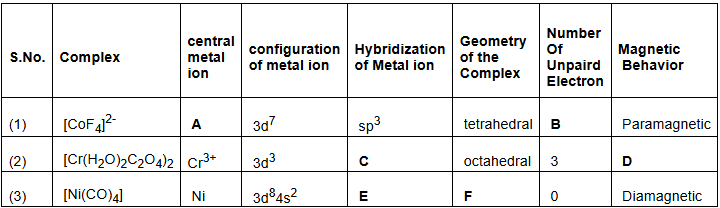
Question
Explain the limitations of valence bound theory.

Answer

self

Need a full question paper?

Generate a complete, print-ready paper with questions like this in minutes — across 16+ boards, with answer keys.

Start Generating Free

Similar questions

Explain the following :
(i) Fermentation
(ii) Dehydration
(iii) Hydrogen bonding in alcohols.
  1. Define the following terms:
  1. Ideal solution.
  2. Azeotrope.
  3. Osmotic pressure.
  1. A solution of glucose (C6H12O6) in water is labelled as 10% by weight. What would be the molality of solution?

(Molar mass of glucose = 180 g mol-1).

  1. Account for the following:
  1. Transition metals show variable oxidation states.
  2. Zn, Cd and Hg are soft metals.
  3. Evalue for the Mn3+/Mn2+ couple is highly

positive (+ 1·57 V) as compared to Cr3+/Cr2+.

  1. Write one similarity and one difference between the chemistry of lanthanoid and actinoid elements.
Explain the following reactions of phenol :
(i) Nitration
(ii) Gatterman aldehyde synthesis
(iii) Fries rearrangement
(iv) Reaction with mercuric acetate.
The time required for 10% completion of a first order reaction at 298 K is equal to that required for its 25% completion at 308 K. If the value of A is 4 × 10¹⁰ s-1 Calculate k at 318 K and Ea.
i. Write the structure of main products when aniline reacts with the following reagents :
a. $Br _2$ water
b. HCl
c. $\left( CH _3 CO \right)_2 O /$ pyridine
ii. Arrange the following in the increasing order of their boiling point:$C _2 H _5 NH _2, C _2 H _5 OH ,\left( CH _3\right)_3 N$
iii. Give a simple chemical test to distinguish between the following pair of compounds : $\left( CH _3\right)_2 NH$ and $\left( CH _3\right)_3 N$.
The rate constant for the decomposition of N2O5 at various temperatures is given below:
T/°C 0 20 40 60 80
105 × k/s-1 0.0787 1.70 25.7 178 2140
Draw a graph between ln k and 1/T and calculate the values of A and Ea. Predict the rate constant at 30° and 50°C.
(a). Out of formic acid and acetic acid, which one will give the HVZ reaction? Give a suitable reason in support of your answer and write the chemical reaction involved.
(b). Alcohols are acidic but they are weaker acids than water. Arrange various isomers of butanol in the increasing order of their acidic nature. Give a reason for the same.
(c). An organic compound A which is a Grignard reagent is used to obtain 2-methylbutan-2-ol on reaction with a carbonyl compound 'B'. Identify A' and 'B'. Write the equation for the reaction between A and B.
What is vapour pressure? When a non- volatile solute is dissolved in any liquid, the vapour pressure of the liquid decreases. Give reason.