Question
Explain the phenomenon of nuclear fission.

Answer

$\rightarrow$ When a heavy nucleus is bombarded with a neutron, then first neutron is absorbed.
This nucleus is in a highly excited state. As a result, it splits into two lighter nuclei of approximately equal mass to become stable.
$\rightarrow$ Neutron is chargeless so it does not have to face coulomb forces.
So neutron is a best projectile.
$\rightarrow$ When a neutron is bombarded on the nucleus of uranium its nucleus breaks into two almost equal parts. Its nuclear reaction is as below :
${ }_{92}^{235} U +{ }_0^1 n \rightarrow{ }_{92}^{236} U \rightarrow{ }_{56}^{144} B a+{ }_{36}^{89} K r+3\left({ }_0^1 n\right)+ Q$
${ }_{92}^{235} U +{ }_0^1 n \rightarrow{ }_{92}^{236} U \rightarrow{ }_{51}^{133} S b+{ }_{41}^{99} N b+4\left({ }_0^1 n\right)+ Q$
${ }_{92}^{235} U +{ }_0^1 n \rightarrow{ }_{92}^{236} U \rightarrow{ }_{54}^{140} Xe +{ }_{38}^{94} S r+2\left({ }_0^1 n\right)+ Q$
$\rightarrow$ The fission fragments are radioactive and by successive emmision of $\beta-$ particles results in the stable nuclei.
$\rightarrow$ During the fission process of uranium the energy released per fission is almost 200 MeV .
$\rightarrow$ Suppose a nucleus with mass number $A =240$ breaks into two fragments each of $A =120$.
$\rightarrow$ Binding energy per nucleon for a nucleus with $A =240$ is $7.6 MeV$ and for a nucleus with
$A =120$ is $8.5 MeV.$ 
$\rightarrow$ Gain in binding energy per nucleon
$=8.5-7.6$
$=0.9 MeV$
$\rightarrow$ Total gain in binding energy
$=0.9 \times 240$
$=216 MeV .$
$\rightarrow$ The disintegration energy in fission events first appears as the kinetic energy of the fragments and neutrons. Eventually it is transferred to the surrounding matter appearing as heat.
$\rightarrow $ In a nuclear reactor this process takes place in a controlled manner whereas in an atomic bomb this process takes place in an uncontrolled manner.

Need a full question paper?

Generate a complete, print-ready paper with questions like this in minutes — across 16+ boards, with answer keys.

Start Generating Free

Similar questions

Find the energy, the frequency and the momentum of an X-ray photon of wavelength 0.10nm.
A coil of inductance 5.0mH and negligible resistance is connected to the oscillator of the previous problem. Find the peak currents in the circuit for $\omega=100\text{s}^{-1},500\text{s}^{-1},1000\text{s}^{-1}.$
Define coefficient of mutual induction i.e. mutual inductance.
When the current in a primary coil is changed from zero to 2.0 A within 300 ms, then an induced emf of a 0.80 volt is produced in secondary coil. Calculate coefficient of mutual inductance between the two coils.
Get the electric field due to a uniformly charged infinite plane sheet.
For a normal eye, the far point is at infinity and the near point of distinct vision is about 25 cm in front of the eye. The cornea of the eye provides a converging power of about 40 dioptres, and the least converging power of the eye-lens behind the cornea is about 20 dioptres. From this rough data estimate the range of accommodation (i.e., the range of converging power of the eye-lens) of a normal eye.
Are matter waves electromagnetic?
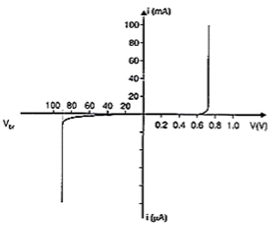
The following figure shows the V-I characteristics of a semiconductor diode.
i. Identify the semiconductor diode used.
ii. Draw the circuit diagram to obtain the given characteristics of this device.
iii. Briefly explain how this diode can be used as a voltage regulator.
Image
How is the mutual inductance of a pair of coils affected when:
i. separation between the coils is increased?
ii. the number of turns of each coil is increased?
iii. A thin iron sheet is placed between the two coils, other factors remaining the same?
$A$ charge of $+2.0 \times 10^{-8}C$ is placed on the positive plate and a charge of $-1.0 \times 10^{-8}C$ on the negative plate of a parallel $-$ plate capacitor of capacitance $1.2\times10^{-3}\mu\text{F}.$ Calculate the potential difference developed between the plates.
Compare the properties of soft iron and steel.