Question
Explain the principle, construction, working and application of moving coil galvanometer.

Answer

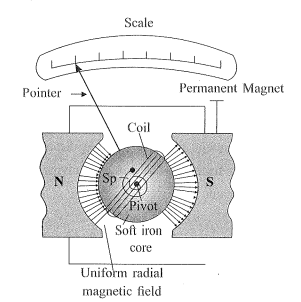
Image
Figure shows a moving coil galvanometer.
• Principle :
A torque is exerted on the current carrying coil placed in uniform magnetic field.
• Construction :
A thin copper wire is wounded on rectangular frame placed between two cylindrical permanent magnets as shown in the figure. The coil is arranged so it can rotate freely.
A small cylinder of soft iron is placed on the axis of the coil, without touching the coil, to produce a uniform radial magnetic field.
When current is passed through the coil a torque acts on it and it deflects. The steady deflection of coil is indicated by a pointer attached with it.
• Working :
When a current flows through the coil, a torque acts on it, causing it to deflect.
If the area vector of the coil makes an angle $\theta$ with the magnetic field, torque acting on coil is
$\tau= NIBA \sin \theta$
Due to the radial magnetic field, the angle between $\overrightarrow{ A }$ and $\overrightarrow{ B }$ will always be $90^{\circ}$.
$\therefore \tau=\text { NIBA }$
Due to the deflection of the coil, the restoring torque is produced in the spring which is directly proportional to the deflection of the coil $(\phi)$
$\therefore$ Restoring torque $\tau^{\prime}=k \phi$
Where, $k=$ torsional constant of the spring.
For steady deflection, from equation (1) \& (2)
$\begin{aligned}
\tau^{\prime} & =\tau \\
k \phi & =\text { NIAB } \\
\therefore \phi & =\left(\frac{ BAN }{k}\right) \cdot I \\
\therefore \phi & \propto I \quad(\because B , A , N , K \text { are constant })
\end{aligned}$
Thus, the deflection of the coil is directly proportional to the current.
Uses : Galvanometer is used to detect the presence of current in the circuit.
To measure small electric currents (of the order $10^{-6} A$ )
Using galvanometer, ammeter and voltmeter can be constructed.

Need a full question paper?

Generate a complete, print-ready paper with questions like this in minutes — across 16+ boards, with answer keys.
Start Generating Free

Similar questions

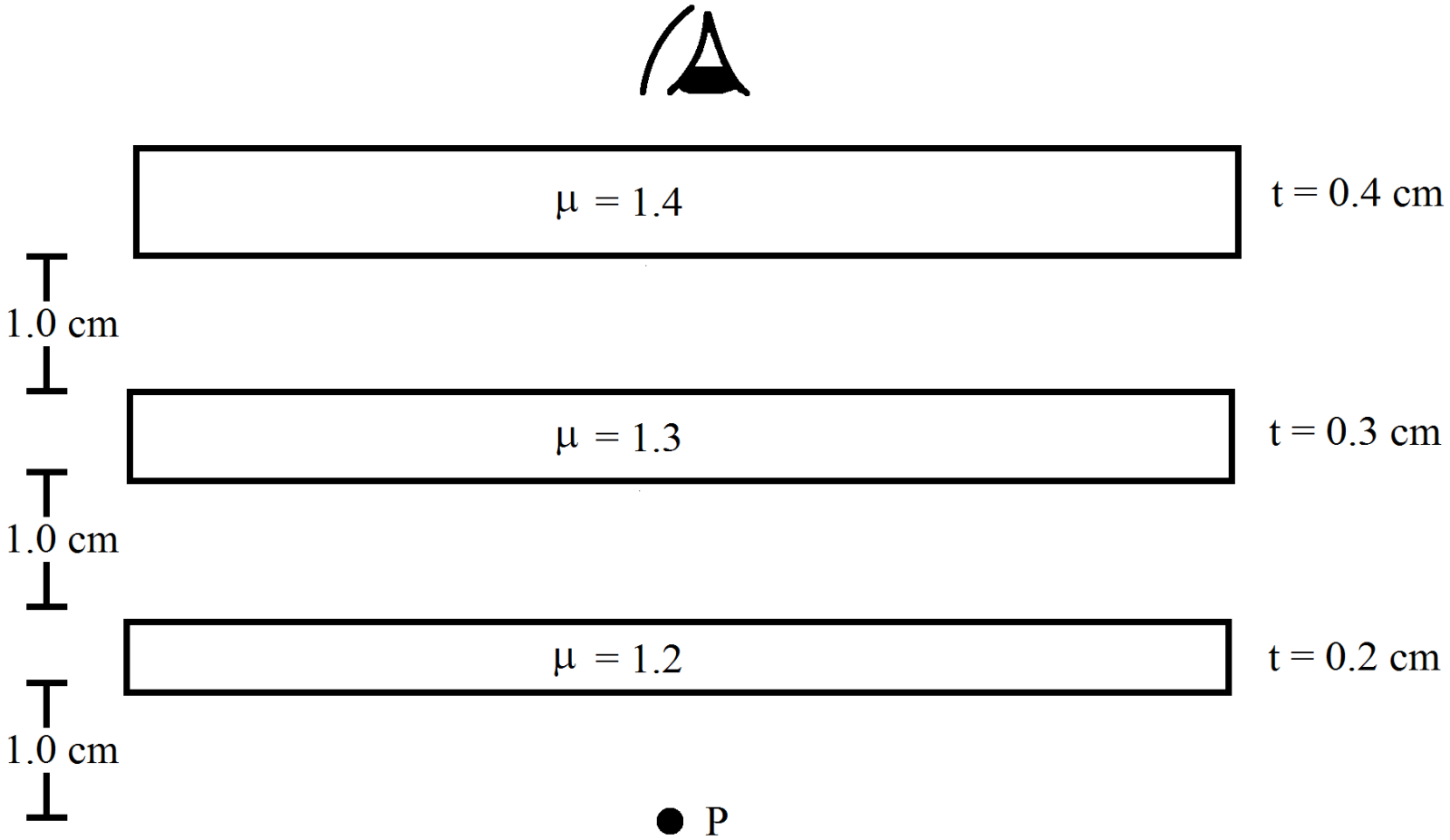
Locate the image of the point P as seen by the eye in the figure.
How are em waves produced by oscillating charges? Draw a sketch of linearly polarised em waves propagating in the Z-direction. Indicate the directions of the oscillating electric and magnetic fields.
An equiconvex lens of focal length $'f\ '$ is cut into two identical plane convex lenses. How will the power of each part be related to the focal length of the original lens? A double convex lens of $+5D$ is made of glass of refractive index $1.55$ with both faces of equal radii of curvature. Find the value of its radius of curvature.
A hydrogen atom in ground state absorbs a photon of ultraviolet radiation of wavelength 50nm. Assuming that the entire photon energy is taken up by the electron with what kinetic energy will the electron be ejected?
Two parallel wires carry equal currents of 10A along the same direction and are separated by a distance of 2.0cm. Find the magnetic field at a point which is 2.0cm away from each of these wires
The magnetic field $B$ inside a long solenoid, carrying a current of $5.00A,$ is $3.14 \times 10^{-2}T$. Find the number of turns per unit length of the solenoid.
How many time constants will elapse before the power delivered by a battery drops to half of its maximum value in an RC circuit?
An inductor $\text{L}$ of inductance $\text{XL}$ is connected in series with a bulb $\text{B}$ and an ac source. How would brightness of the bulb change when $\text{(i)}$ number of turns in the inductor is reduced$, \text{(ii)}$ an iron rod is inserted in the inductor and $\text{(iii)}$ a capacitor of reactance $\text{X}_\text{C} = \text{X}_\text{L}$ is inserted in series in the circuit. Justify your answer in each case.
Three circuits, each consisting of a switch $'S\ ’$ and two capacitors, are initially charged, as shown in the figure. After the switch has been closed, in which circuit will the charge on the left$-$hand capacitor $(i)$ increase, $(ii)$ decrease and $(iii)$ remain same? Give reasons.
A straight wire of length l can slide on two parallel plastic rails kept in a horizontal plane with a separation d. The coefficient of friction between the wire and the rails is $\mu.$ If the wire carries a current i, what minimum magnetic field should exist in the space in order to slide the wire on the rails?
