Question
Explain the process of divergent evolution in detail. Also, write down the driving force behind it.

Answer

Divergent evolution is the evolution of a number of different forms of animals or plants froms of a common ancestral form. The driving force behind, it is adaptations to newly involved habitat and the prevailing environmental conditions there. As the original population increases in size, it spreads out from its centre of origin to exploit new habitas and food resources. In this results in a number of populations each adapted to its particular habitat eventually these populations will differ from each other sufficiently to become new species. A good example of this process is the evolution of the Australian marsupials into species adapted as carnivores, herbivores, burrowers, fliers, etc. Another example is that of peritadactyl limb in mammals.

Need a full question paper?

Generate a complete, print-ready paper with questions like this in minutes — across 16+ boards, with answer keys.

Start Generating Free

Similar questions

(A) Write the harmful effects caused by alcohol / drug abuse.
(B) Write a brief note :-
(1) Opioids$\quad$$\quad$(2) Cannabinoids
What is the inheritance pattern observed in the size of starch grains and seed shape of Pisum sativum? Workout the monohybrid cross showing the above traits. How does this pattern of inheritance deviate from that of Mendelian law of dominance?
  1. Write an equation for Verhaulst-Pearl Logistic Growth, where.

N - Population density at a timet E.

r - Intrinsic rate of natural increase.

K - Carrying Capacity.
  1. Draw a graph for a population whose population density has reached the carrying capacity.
  2. Why is this logistic growth model considered a more realistic one for most animal populations?
  3. Draw a growth curve where resources are not limiting to growth of a population.
  1. Explain Polygenic inheritance and Multiple allelism with the help of suitable examples.
  2. "Phenylketonuria is a good example that explains Pleiotropy." Justify.
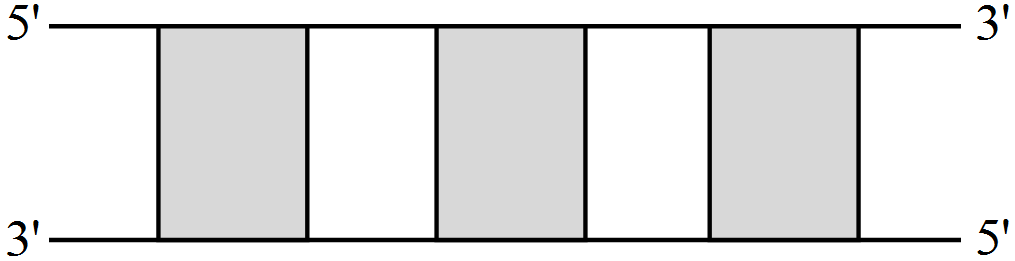
Illustration below is a DNA segment, which constitutes a gene:

  1. Name the shaded and unshaded regions of gene.
  2. Explain how these genes are expressed.
  3. How is this gene different from prokaryotic gene in its expression?
Read the following and answer any four questions from (i) to (v) given below:

Stem cells hold the potential for manifold applications in biotechnology based next generation therapeutics. Scientists are trying to formulate better and more personalised treatment modalities against some seemingly irremediable diseases, by harnessing body's own stem cells and stem cell niche. Stem cells of different origin and level of potency are being investigated for tissue regeneration, treatment of bone defect, drug testing, gene therapy and cell based therapy for muscle damage, spinal cord injury, cancer therapy, etc. 'Tile properties of embryonic and adult stem cells to either self-renew or differentiate into multiple cell lineages make them an attractive source for cell therapies, tissue engineering and as model system for drug screening.

  1. Stem cells are widely used in medical research. Which property of stem cells makes them particularly useful in this research?
  1. They can be fused together to form a zygote.
  2. They can divide and eventually give rise to a whole organism.
  3. They can divide and be made to differentiate into various types of cell.
  4. They will continue to divide indefinitely.
  1. Stem cells can be divided into four main types. Which of the four types of stem cell can differentiate into a limited range of tissues?
  1. Adult stem cells.
  2. Embryonic stem cells.
  3. Fetal stem cells.
  4. Zygotic stem cells.
  1. Which feature of stem cells obtained from blood in the umbilical cord enables their use in the treatment of a variety of blood cancers?
  1. They can differentiate into bone marrow cells.
  2. They can differentiate into any cellular component of blood.
  3. They can replace blood stem cells affected by cancer.
  4. They are totipotent.
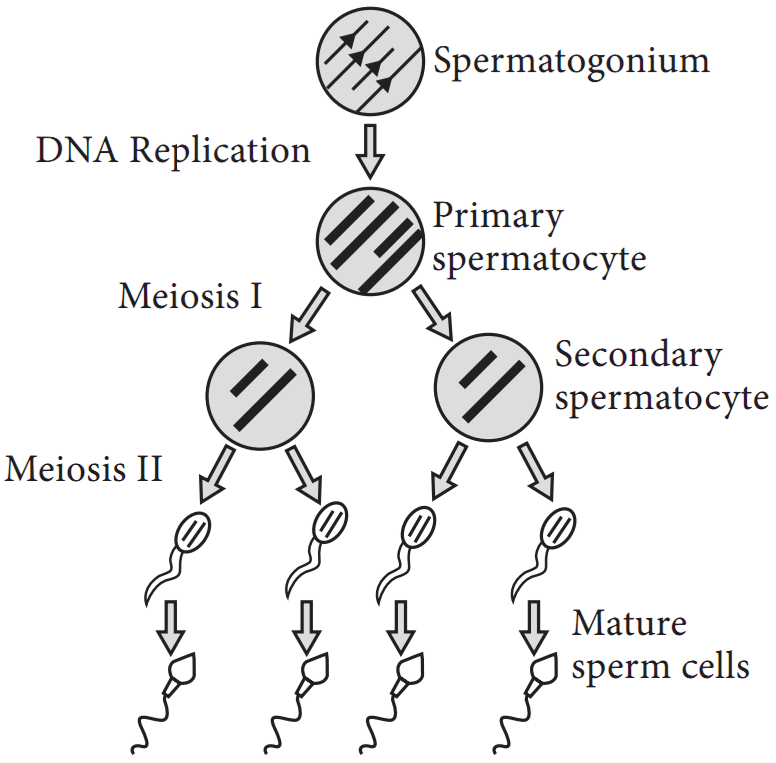
  1. The search for pluripotent stem cells is intense. The spennatogonium is the diploid precursor of haploid sperm in the development pathway of mouse gametes as shown below.

Scientists were interested to find out which stages of sperm development have stem cell capacity. Two experiments were carried out using sterile host males with testes that lacked germ cells. The results are shown in the table.

  Type of cells used Result
Experiment 1 Secondary spermatocytes were injected Fertility was not restored
Experiment 2 Spermatogonia were injected Fertility was restored for the rest of the mouse's life

What property of a stem cell is missing in the secondary spermatocytes?
  1. Specialisation.
  2. Self-renewal.
  3. Commitment.
  4. A proper stem-cell niche.
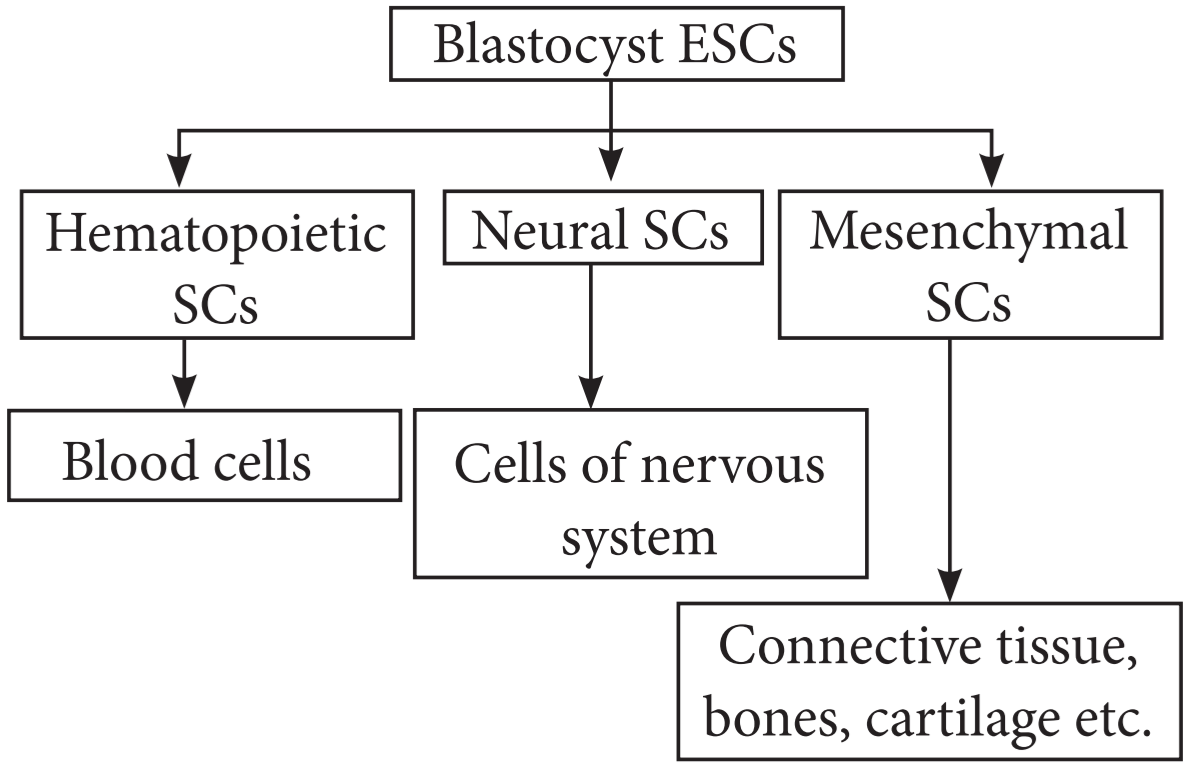
  1. Which feature of embryonic stem cells (ESCs) is illustrated below?

  1. ESCs are capable of dividing.
  2. ESCs are multipotent.
  3. ESCs are pluripotent.
  4. ES Cs show plasticity.
Explain the ill effects of drug and alcohol use in adolescence and tell about its preventions and control.
Describe the law of independent by using punnet's square.
Describe the main idea behind the biological control of pests and diseases.
(a) Draw a sectional view of human ovary and label primary follicle, tertiary follicle, Graafian follicle and corpus luteum in it.
(b) Name the gonadotropins and explain their role in oogenesis and release of ova.