Question
Explain the series connection of capacitors.
Answer

Image

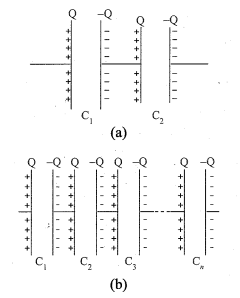
As shown in fig. (a), two capacitors $C _1$ and $C _2$ are connected in series.
The left plate of $C _1$ and the right plate of $C _2$ are connected to two terminals of a battery, and have charges $Q$ and $-Q$ on them, respectively.
Consequently the right plate of $C _1$ has charge $-Q$ and left plate of $C_2$ has charge $Q$ induced on it.
Like this, even though the capacitors may have different capacitance, the charge on them (the charge on each capacitor plate) is same.
Suppose, the potential difference between two terminals of $C_1$ and $C_2$ is $V_1$ and $V_2$ respectively.

The total potential drop V across the combination will be :
$\begin{aligned}
V & = V _1+ V _2 \\
\text { but } C _1 & =\frac{ Q }{ V _1} \\
\therefore V _1 & =\frac{ Q }{ C _1}
\end{aligned}$

Similarly we get $V_2=\frac{Q}{C_2}$
$\begin{array}{l}
\therefore \text { From eq }{ }^{ n } \text { (1) } \\
V =\frac{ Q }{ C _1}+\frac{ Q }{ C _2} \\
\therefore \quad \frac{ V }{ Q }=\frac{1}{ C _1}+\frac{1}{ C _2} \\
\end{array}$

Suppose, the equivalent capacitance for the given combination of capacitors is C , then,
$\begin{array}{l}
\therefore C =\frac{ Q }{ V } \\
\therefore \quad \frac{1}{ C }=\frac{ V }{ Q }
\end{array}\$
$\therefore$ From equation (2) and (3)
$\therefore \frac{1}{ C }=\frac{1}{ C _1}+\frac{1}{ C _2}$

As shown in fig. (b), n capacitors are connected in series.
Their capacitance are $C _1, C _2, C _3$ $C _n$ respectively. Electric charge on each of those, is Q .
Suppose the p.d. across these capacitors, are $V _1$, $V _2, V_3 \ldots . V _n$

The total p.d. of the series combination will be :
$\begin{aligned}
V & = V _1+ V _2+ V _3+\ldots .+ V _n \\
\therefore V & =\frac{ Q }{ C _1}+\frac{ Q }{ C _2}+\frac{ Q }{ C _3}+\ldots .+\frac{ Q }{ C _n} \\
\therefore \frac{ V }{ Q } & =\frac{1}{ C _1}+\frac{1}{ C _2}+\frac{1}{ C _3}+\ldots .+\frac{1}{ C _n}
\end{aligned}$

Suppose, the equivalent (/ effective) capacitance for the given series combination of capacitors is C .
$\begin{array}{l}
\therefore C =\frac{ Q }{ V } \\
\therefore \frac{1}{ C }=\frac{ V }{ Q }
\end{array}$

From equations (4) and (5),
$\therefore \frac{1}{ C }=\frac{1}{ C _1}+\frac{1}{ C _2}+\frac{1}{ C _3}+\ldots .+\frac{1}{ C _n}$

Suppose, the capacitance of each capacitor is same.
Then we get the equivalent capacitance.
$C _{\text {eq }}=\frac{ C }{n}$

Need a full question paper?

Generate a complete, print-ready paper with questions like this in minutes — across 16+ boards, with answer keys.
Start Generating Free

Similar questions

A vessel contains water upto a height of 20cm and above it an oil upto another 20cm. The refractive indices of the water and the oil are 1.33 and 1.30 respectively. Find the apparent depth of the vessel when viewed from above.
An object P is focused by a microscope M. A glass slab of thickness 2.1cm is introduced between P and M. If the refractive index of the slab is 1.5, by what distance should the microscope be shifted to focus the object again?
A neutron is absorbed by a $^{6}_{3}\text{Li}$ nucleus with the subsequent emission of an alpha particle.
  1. Calculate the energy released, in MeV, in this reaction.
  2. Write the corresponding nuclear reaction.
Given: mass $^{6}_{3}\text{Li} =6015126 $ u; mass (neutron) =1.0086654 u; mass (alpha particle) = 4.0026044 u and mass (triton) = 3.0100000 u. Take 1 u = 931 MeV/C2
A charge of +2.0 × 10⁻⁸C is placed on the positive plate and a charge of -1.0 × 10⁻⁸C on the negative plate of a parallel-plate capacitor of capacitance $1.2\times10^{-3}\mu\text{F}.$ Calculate the potential difference developed between the plates.
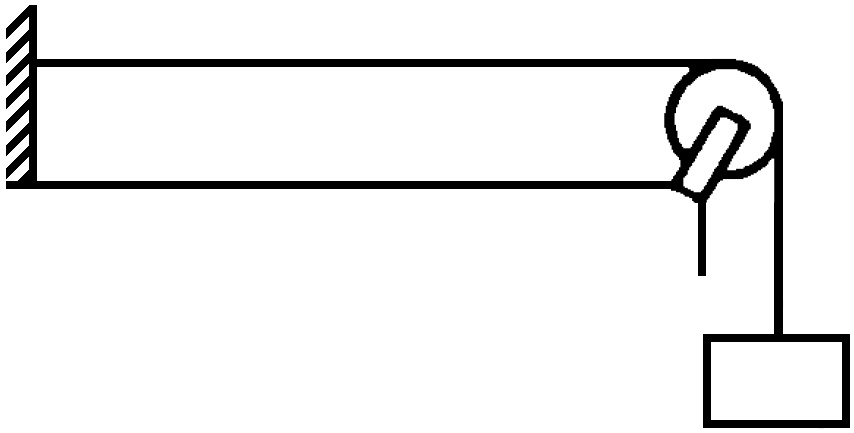
Figure, shows a string stretched by a block going over a pulley. The string vibrates in its tenth harmonic in unison with a particular tuning fork. When a beaker containing water is brought under the block so that the block is completely dipped into the beaker, the string vibrates in its eleventh harmonic. Find the density of the material of the block.

The Q value of a nuclear reaction A + b → C + d is defined by

Q = [ mA + mb – mC – md]c2

where the masses refer to the respective nuclei. Determine from the given data the Q-value of the following reactions and state whether the reactions are exothermic or endothermic.

  1. $^1_1\text{H}+^3_1\text{H}\rightarrow^2_1\text{H}+^2_1\text{H}$
  2. $^{12}_6\text{C}+^{12}_6\text{C}\rightarrow^{20}_{10}\text{Ne}+^4_2\text{He}$

Atomic masses are given to be

$\text{m}(^2_1\text{H})=2.014102\text{ u}$

$\text{m}(^3_1\text{H})=3.016049\text{ u}$

$\text{m}(^{12}_6\text{C})=12.000000\text{ u}$

$\text{m}(^{20}_{10}\text{Ne})=19.992439\text{ u}$
Suppose an attractive nuclear force acts between two protons which may be written as $\text{F}=\text{Ce}^{-\text{kr}}/\text{r}^2.$
  1. Write down the dimensional formulae and appropriate SI units of C and k.
  2. Suppose that k = 1 fermi-1 and that the repulsive electric force between the protons is just balanced by the attractive nuclear force when the separation is 5 fermi. Find the value of C.
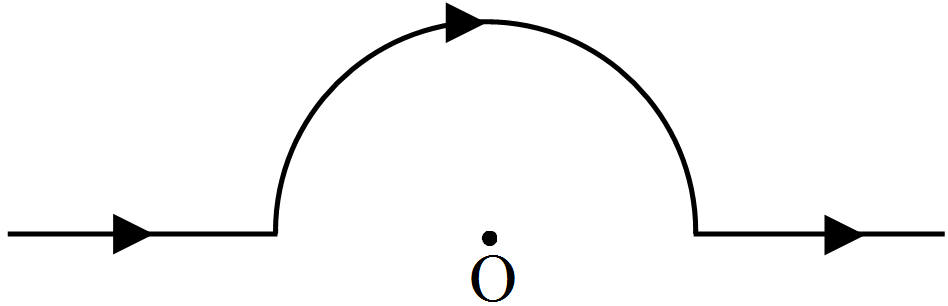
A straight wire carrying a current of 12A is bent into a semi-circular arc of radius 2.0cm as shown. What is the magnetic field at O due to:

  1. Straight segments.
  2. The semi-circular arc?

A uniform square plate of mass 2.0kg and edge 10cm rotates about one of its diagonals under the action of a constant torque of 0.10N-m. Calculate the angular momentum and the kinetic energy of the plate at the end of the fifth second after the start.
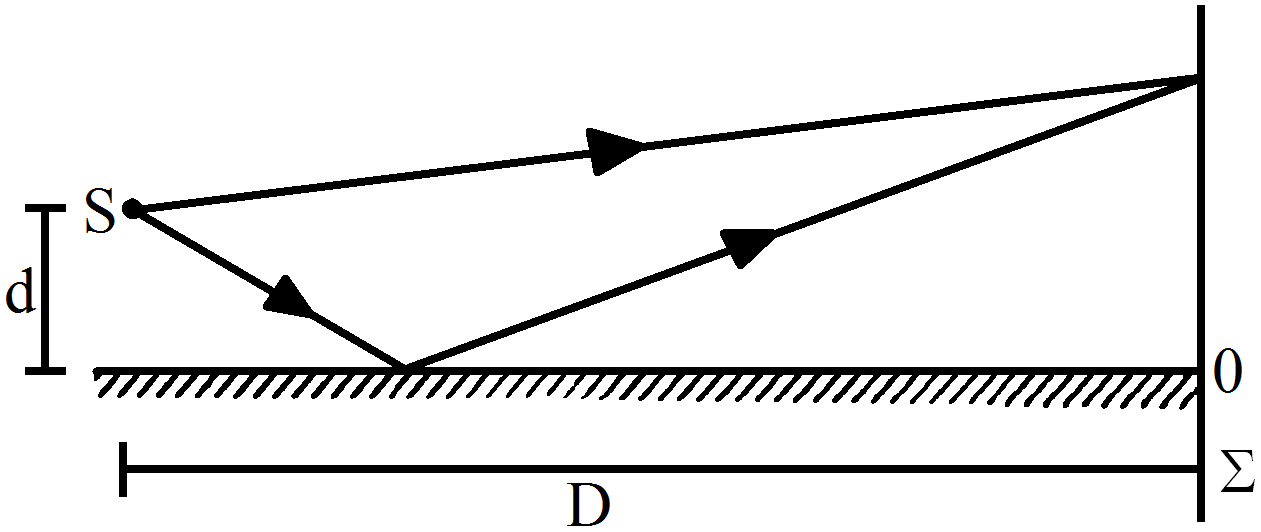
A narrow slit S transmitting light of wavelength $\lambda$ is placed a distance d above a large plane mirror as shown in figure (17-E1). The light coming directly from the slit and that coming after the reflection interfere at a screen $\sum$ placed at a distance D from the slit.

  1. What will be the intensity at a point just above the mirror, i.e., just above O?
  2. At what distance from 0 does the first maximum occur?