Question
Explain the statement 'We have got this Earth planet on lease from our future generations and not as ancestral property from our ancestors'.

Answer

(i) Existence of man is entirely dependent on the existence of ecosystem.
(ii) Man derives his benefits by using various components of the ecosystem.
(iii) We can get these materials easily from the nature as our ancestors protected and conserved them for us.
(iv) Today man has proved his superiority as compared to other animals. He is indiscriminately using the natural resources for personal greed.
(v) Due to this, future generations may not benefit from the nature. They will suffer from pollution, drought, unseasonal rains, green house effect etc.
(vi) Thus, it is our responsibility to preserve, conserve and protect nature so that next generations will get conducive climate and their life may not be in trouble.
(vii) Thus it is rightly said that, we got the planet earth on lease from our future generations and not ancestral property.
(viii) Nature is not our ancestral property but we have to take care of it so that it can be handed over to next generations without any further damage to it.

Need a full question paper?

Generate a complete, print-ready paper with questions like this in minutes — across 16+ boards, with answer keys.
Start Generating Free

Similar questions

The human males use a device X made of a very thin rubber sheet as a covering on the male organ to prevent pregnancy. This device traps the gametes Y in it. In order to prevent pregnancy, the human females use a device Z which is a circle of rubber with a metal spring around it. The device Z is put inside the vagina to cover the cervix. It stops Y from going into the uterus.
  1. What is device X?
  2. What are Y?
  3. Name the device Z.
  4. What is the general name of these methods of birth control (or preventing pregnancy)?
  5. The use of which contraceptive device, X or Z, can protect the persons from sexually transmitted diseases?
What are the factors which affects the rate of a chemical reaction.
An organism A which cannot move from one place to another, makes a simple food B from the substances C and D available in the environment. This food is made in the presence of a green coloured substance E present in organs F in the presence of light energy in a process called G. Some of the simple food B also gets converted into a complex food H for storage purposes. The food H gives a blue-black colour with dilute iodine solution.
  1. What is (i) organism A, (ii) food B and (iii) food H?
  2. What are C and D?
  3. Name (i) green coloured substance E, and (ii) organ F.
  4. What is the process G?
What is the reaction called when oxidation and reduction take place simultaneously? Explain with one example.
Write short notes: Homologous series.
Explain with diagrams what is meant by the “series combination” and “parallel combination” of resistances. In which case the resultant resistance is:
  1. Less, and
  2. More, than either of the individual resistances?
Give one word for “The forest conserved in the name of God.” (Board’s Model Activity Sheet)
Draw the electron-dot structures of the following compounds and state the type of bonding in each case:
  1. $KCl$
  2. $NH_3$
  3. $CaO$
  4. $N_2$
  5. $CaCl_2$
Draw a neat labelled diagram: Forth floatation.

Image

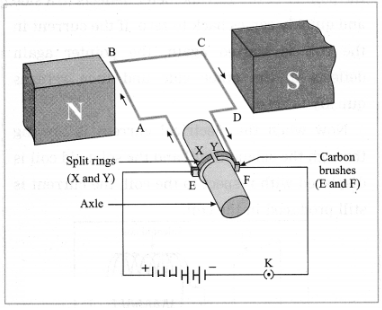
Observe the following diagram and answer the questions. (Practice Activity Sheet – 1)
(a) Construction of which equipment does the following diagram show?
(b) On which principle does this equipment work?
(c) According to which law does the coil ABCD rotate?
(d) Write the law in your own words.
(e) Where is this equipment used?