Question

Image

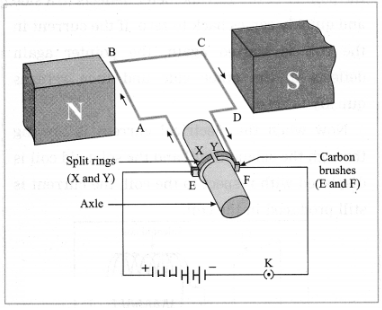
Observe the following diagram and answer the questions. (Practice Activity Sheet – 1)
(a) Construction of which equipment does the following diagram show?
(b) On which principle does this equipment work?
(c) According to which law does the coil ABCD rotate?
(d) Write the law in your own words.
(e) Where is this equipment used?

Answer

(a) Given diagram shows the construction of an electric motor.

(b) An electric motor works on the principle that a current-carrying conductor placed in a magnetic field experiences a force. In this case, the forces acting on different parts of the coil of the motor produce the rotational motion of the coil.

(c) The rotation of the coil is based on Fleming’s left hand rule.

(d) Fleming’s left hand rule: The left hand thumb, index finger, and the middle finger are stretched so as to be perpendicular to each other. If the index finger is in the direction of the magnetic field, and the middle finger points in the direction of the current, then the direction of the thumb in the direction of the force on the conductor.

(e) Uses / applications of an electric motor: (1) In domestic appliances such as a mixer, a blender, a refrigerator and washing machine. (2) In an electric fan, a hair dryer, a record player, a tape recorder and a blower. (3) In an electric car, a rolling mill, an electric crane, an electric lift, a pump, a computer and an electric train.
Need a full question paper?

Generate a complete, print-ready paper with questions like this in minutes — across 16+ boards, with answer keys.

Start Generating Free

Similar questions

What are the conventions used in writing a chemical equation?
In a house two $60W$ electric bulbs are lighted for $4$ hours, and three $100W$ bulbs for $5$ hours everyday. Calculate the electric energy consumed in $30$ days.
In the reaction represented by the following equation:
$\text{CuO(s)}\ +\ \text{H}_2(\text{g})\xrightarrow{\ \ \ \ \ \ \ \ \ \ \ \ }\text{Cu(s)}\ +\ \text{H}_2\text{O(1)}$
  1. Name the substance oxidised.
  2. Name the substance reduced.
  3. Name the oxidising agent.
  4. Name the reducing agent
When hydrogen is passed over copper oxide, copper and steam are formed. Write a balanced equation for this reaction and state which of the chemicals are:
  1. Elements.
  2. Compounds.
  3. Reactants.
  4. Products.
  5. Metals.
  6. Non-metals.
The sea water contains water beetles, tadpole, fish and weeds.
  1. Write a food chain comprising all the given organisms?
  2. Which organisms in the food chain are (i) herbivore, and (ii) carnivores?
  3. Which organisms are (i) predators, and (ii) prey?
  4. Which organisms can trap solar energy to make food?
  5. Which organism is a secondary consumer?
There is a pair of bean-shaped organs P in the human body towards the back, just above the waist. A waste product Q formed by the decomposition of unused proteins in the liver is brought into organ P through blood by an artery R. The numerous tiny filters S present in organ P clean the dirty blood by removing the waste product Q. The clean blood goes into circulation through a vein T. The waste substance Q, other waste salts, and excess water form a yellowish liquid U which goes from organ P into a bag-like structure V through two tubes W. This liquid is then thrown out of the body through a tube X.
  1. What is (i) organ P and (ii) waste substance Q?
  2. Name (i) artery R, and (ii) vein T.
  3. What are tiny filters S known as?
  4. Name (i) liquid U, (ii) structure V, (iii) tubes W and (iv) tube X.
Complete the chart:
Complete the chart as per the objectives of the first aidr:t
If the angle of incidence and angle of emergence of a light ray falling on a glass slab are i and e respectively, prove that i = e. (Practice Activity Sheet – 4)
Which different methods are used for transportation of patients? Why?
An organism X having breathing organs A lives on land. When organism X goes under water, it cannot survive for a long time unless carrying an oxygen cylinder. On the other hand, the organism Y having breathing organs B always lives in water and if taken out of water, it dies after a short while. A third organism Z having breathing organs C and D which lives on the banks of ponds, lakes and rivers can survive on land as well as in water equally well.
  1. What could organism X be? Name the breathing organs A.
  2. What could organism Y be? Name the breathing organs B.
  3. What could organism Z be? Name the breathing organs C and D.
  4. Out of X, Y and Z, which organism is.
  1. Amphibian,
  2. Aquatic,
  3. Terrestrial?