Question
Explain the three pathways of breakdown in living organisms.

Answer

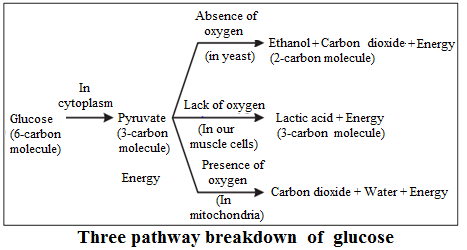
Cellular respiration is the process of breakdown of food substances into simpler ones to release the stored energy. On the basis of presence or absence of oxygen, it can occur through aerobic or anaerobic pathway.
i. Aerobic respiration: Glucose in the presence of oxygen (air), breaks down to carbon dioxide and water with release of large amount of energy. It occurs in three steps, glycolysis, citric acid cycle and ETC.

Glycolysis is breakdown of glucose into pyruvate. It is oxygen independent pathway occurs in cytoplasm. Pyruvate is decarboxylated into acetyl coA in cytoplasm only.
Citric acid cycle is the second phase of cellular respiration in which acetyl Co are enzymatically oxidized into carbon dioxide and the released energy is stored in NADH and $FADH _2$.
Electron transport chain includes downhill flow of electrons to final electron acceptor (Oxygen, which is then reduced into water) through a chain of membranebound carriers to facilitate the uphill transport of protons across a proton-impermeable membrane and ATP synthesis.
Enzymes of citric acid cycle are present in mitochondrial matrix while the electron transport chain is present in inner mitochondrial membrane, hence, the last two phases of aerobic respiration takes place in mitochondria only.
ii. Anaerobic respiration: Glycolysis is breakdown of glucose into pyruvate. It is oxygen independent pathway and is common to both aerobic and anaerobic respiration. Fate of pyruvate depends on oxygen availability. Anaerobic respiration can occur via lactic acid fermentation or alcohol fermentation.
- Alcohol fermentation due to limited oxygen availability, pyruvate remains in cytoplasm where pyruvate decarboxylase and alcohol dehydrogenase enzymes carry out the second phase of anaerobic respiration and produce ethanol and carbon dioxide with limited amount of energy being released.
- Lactic acid fermentation due to limited oxygen availability, pyruvate remains in cytoplasm where it is broken down into lactic acid with limited amount of energy being released.

Need a full question paper?

Generate a complete, print-ready paper with questions like this in minutes — across 16+ boards, with answer keys.
Start Generating Free

Similar questions

An electric circuit consisting of a 0.5m long nichrome wire XY, an ammeter, a voltmeter, four cells of 1.5V each and a plug key was set up.
  1. Draw a diagram of this electric circuit to study the relation between the potential difference maintained between the points ‘X’ and ‘Y’ and the electric current flowing through XY.
  2. Following graph was plotted between V and I values:
What would be the values of ratios when the potential difference is 0.8V, 1.2V and 1.6V respectively? What conclusion do you draw from these values?
  1. What is the resistance of the wire?
With the help of a labelled diagram, describe the working of a nuclear power plant.
How does fertilisation take place? Fertilisation occurs once in a month. Comment.
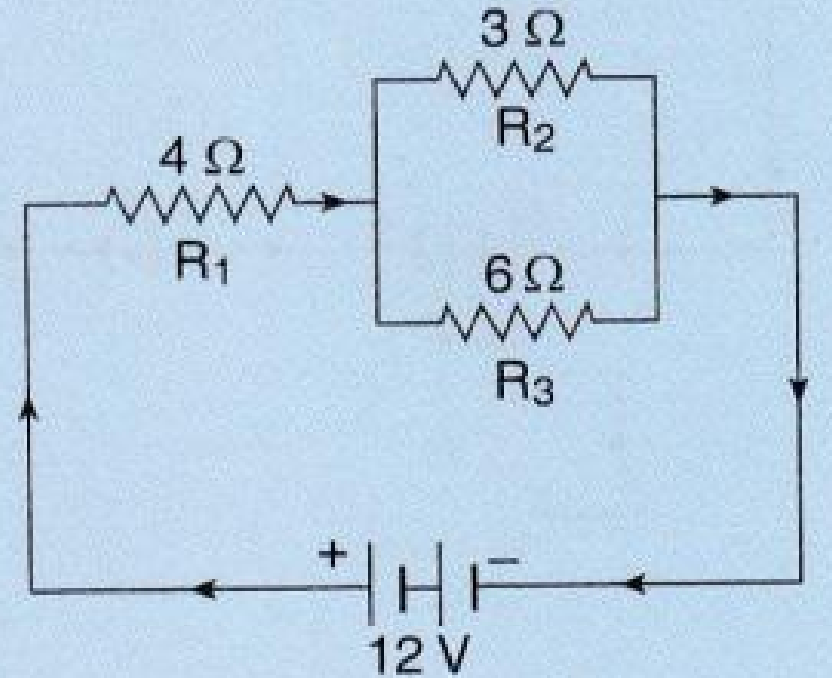
The circuit diagram given below shows the combination of three resistors $R_1 R_2$ and $R_3$ :

Find:
  1. Total resistance of the circuit.
  2. Total current flowing in the circuit.
  3. The potential difference across R.
There are three plants A, B and C. The flowers of plant A open their petals in bright light during the day but close them when it gets dark at night. On the other hand, the flowers of plant B open their petals at night but close them during the day when there is bright light. The leaves of plant C fold up and droop when touched with fingers or any other solid object.
  1. Name the phenomenon shown by the flowers of (i) plant A, and (ii) plant B.
  2. Name one flower each which behaves like the flower of (i) plant A, and (ii) plant B.
  3. Name the phenomenon exhibited by the leaves of plant C.
  4. Name a plant whose leaves behave like those of plant C.
  5. Which plant/ plants exhibit the phenomenon based on growth movements?
A colourless organic liquid $X$ of molecular formula $C _2 H _4 O _2$ turns blue litmus to red. Another colourless organic liquid Y of molecular formula $C _3 H _6 O$ has no action on any litmus but it is used as a nail polish remover. A yet another colourless organic liquid Z of molecular formula $C _2 H _6 O$ has also no action on litmus but it is used in tincture of iodine.
a. Name the liquid X . To which homologous series does it belong? Give the name of another member of this homologous series.
b. Name the liquid Y. To which homologous series does it belong? Write the name of another member of this homologous series.
c. Can you name an organic compound having the same molecular formula as liquid $Y$ but which belongs to a different homologous series? What is this homologous series?
d. Name the liquid Z. To which homologous series does it belong? Write the name of another member of this homologous series.
Following are the two examples of plant movement. One is drooping of leaves in touch-me-not plant and second is
attaching of pea plant to a support with the help of tendrils.
i. What is the stimulus which is common for movement in both the cases?
ii. What is the difference in movement in both the plants? Explain
iii. Give appropriate scientific terms for the movements described in both cases.
When a moist slice of bread was kept aside for a few days then some organism grew on it to form a white cottony mass which later turned black. When this slice of bread was observed through a magnifying glass, then fine thread-like projections and thin stems having bulb-like structures at the top were seen.
  1. What is the common name and scientific name of the organism which grew on the moist slice of bread?
  2. How did this organism grow on the moist slice of bread automatically?
  3. What are the fine, thread-like projections on the surface of slice of bread known as?
  4. What name is given to the knob-like structures and what do they contain?
  5. What is the name of this method of reproduction?
  6. Name one unicellular organism which reproduces by this method.
  7. Name tow non-flowering plants which reproduce by this method.
When a moist slice of bread was kept aside for a few days then some organism grew on it to form a white cottony mass which later turned black. When this slice of bread was observed through a magnifying glass, then fine thread-like projections and thin stems having bulb-like structures at the top were seen.
  1. What is the common name and scientific name of the organism which grew on the moist slice of bread?
  2. How did this organism grow on the moist slice of bread automatically?
  3. What are the fine, thread-like projections on the surface of slice of bread known as?
  4. What name is given to the knob-like structures and what do they contain?
  5. What is the name of this method of reproduction?
  6. Name one unicellular organism which reproduces by this method.
  7. Name tow non-flowering plants which reproduce by this method.
  1. Write the name of the human male reproductive organ that produces sperms and secretes a hormone. Name the hormone secreted and state its function?
  2. Write the site of fertilization and the part where the zygote gets implanted in the human female.
  3. State, in brief, how an embryo gets its nourishment inside the mother's body.