Question
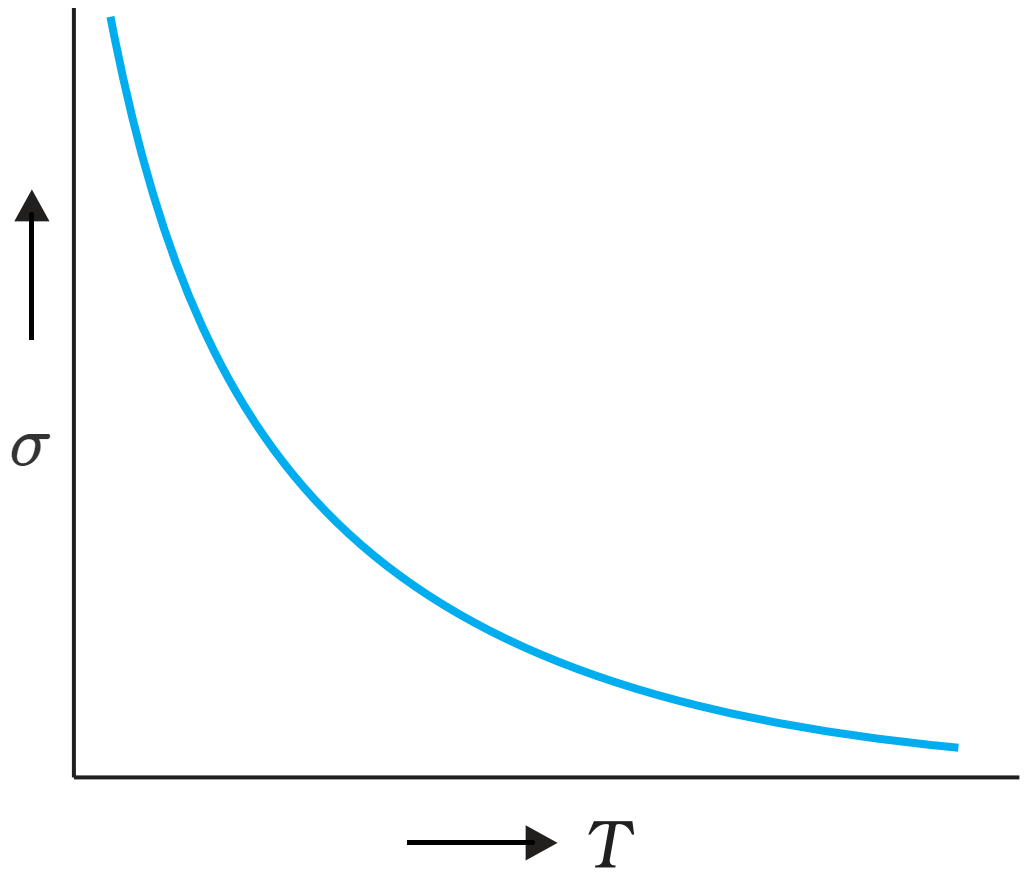
Explain the variation of conductivity with temperature for:
  1. A metallic conductor.
  2. Ionic conductors.
  3. Semiconductors.

Answer

Conductivity of a metallic conductor $\sigma=\frac{1}{\rho}=\frac{\text{ne}^2\tau}{\text{m}}.$
Where m = mass of charge carrier, e = charge on each carrier $\tau$ = relaxation time, n = number density of charge carriers
  1. With rise of temperature, the collision of electrons with fixed lattice ions/ atoms increases so that relaxation time $(\tau)$ decreases. Consequently, the conductivity of metals decreases with rise of temperature.
  2. Conductivity of ionic conductor increases with increase of temperature because with increase of temperature, the ionic bonds break releasing positive and negative ions which are charge carriers in ionic conductors.
  3. In the case of a semiconductors, when temperature increases, covalent bonds break and charge carriers (electrons and holes) become free i.e., n increases, so conductivity increases with rise of temperature.

Need a full question paper?

Generate a complete, print-ready paper with questions like this in minutes — across 16+ boards, with answer keys.
Start Generating Free

Similar questions

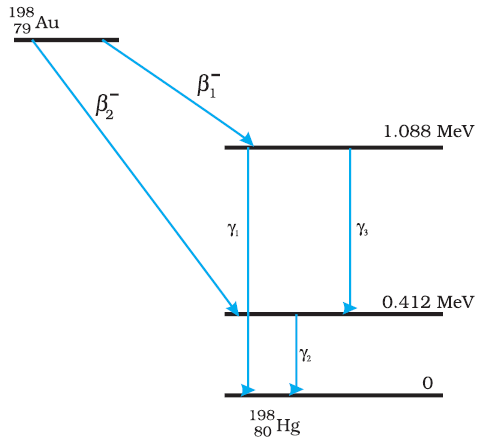
Obtain the maximum kinetic energy of $\beta-$ particles, and the radiation frequencies of $\gamma$ decays in the decay scheme shown in Fig. $13.6$. You are given that:
$\text{m}(^{198}\text{Au})=197.968233\text{ u}$
$\text{m}(^{198}\text{Hg})=197.9667602\text{ u}$
A long straight horizontal cable carries a current of $2.5 A$ in the direction $10^\circ$ south of west to $10^\circ$ north of east. The magnetic meridian of the place happens to be $10^\circ$ west of the geographic meridian. The earth’s magnetic field at the location is $0.33 G,$  and the angle of dip is zero. Locate the line of neutral points $($ignore the thickness of the cable$). ($At neutral points, magnetic field due to a current $-$ carrying cable is equal and opposite to the horizontal component of earth’s magnetic field.$)$
Find the time period of small oscillations of the following systems.
  1. A metre stick suspended through the $20\ cm$ mark.
  2. A ring of mass in and radius $r$ suspended through a point on its periphery.
  3. A uniform square plate of edge a suspended through a corner.
  4. A unifrom disc of mass $m$ and radius $r$ suspended through a point $\frac{\text{r}}{2}$ away from the centre.
(a) For circuits used for transporting electric power, a low power factor implies large power loss in transmission. Explain.
(b) Power factor can often be improved by the use of a capacitor of appropriate capacitance in the circuit. Explain.
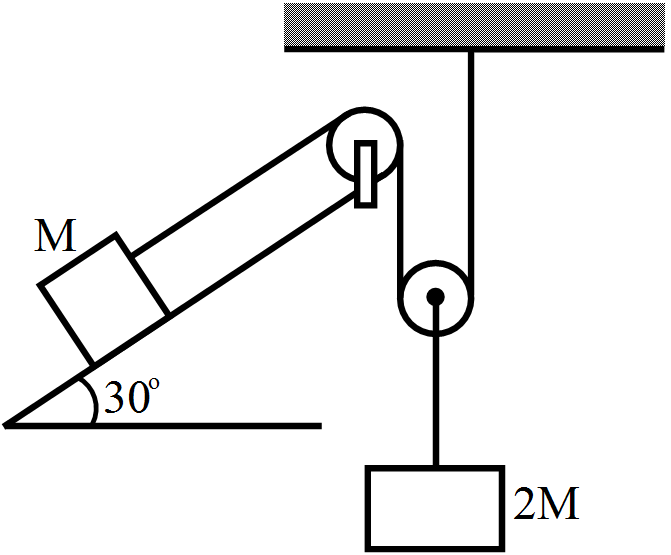
Find the acceleration of the block of mass M in the situation shown in figure. All the surfaces are frictionless and the pulleys and the string are light.
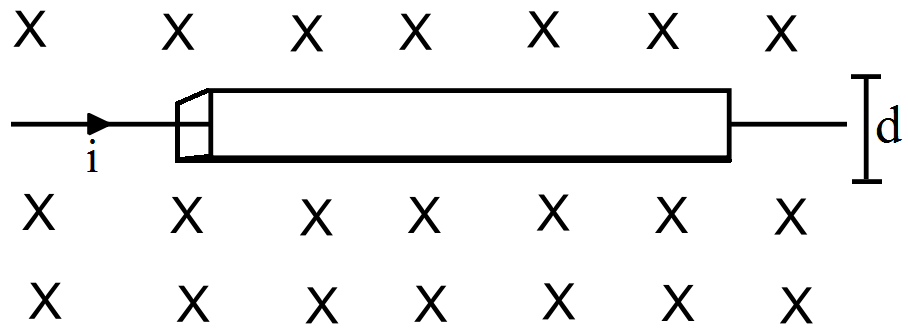
A current i is passed through a silver strip of width d and area of cross-section A. The number of free electrons per unit volume is n.
  1. Find the drift velocity v of the electrons.
  2. If a magnetic field B exists in the region, as shown in the figure, what is the average magnetic force on the free electrons?
  3. Due to the magnetic force, the free electrons get accumulated on one side of the conductor along its length. This produces a transverse electric field in the conductor, which opposes the magnetic force on the electrons. Find the magnitude of the electric field which will stop further accumulation of electrons.
  4. What will be the potential difference developed across the width of the conductor due to the electron-accumulation? The appearance of a transverse emf, when a current-carrying wire is placed in a magnetic field, is called Hall effect.
A metal ball of mass $1\ kg $is heated by means of a $20W$ heater in a room at $20^\circ C$. The temperature of the ball becomes steady at $50^\circ C.$
The angle between the resultant contact force and the normal force exerted by a body on the other is called the angle of friction. Show that, if $\lambda$ be the angle of friction and la the coefficient of static friction, $\lambda\leq\tan^{-1}\mu.$
Two coils $A$ and $B$ have inductances $1.0H$ and $2.0H$ respectively. The resistance of each coil is $10\Omega.$ Each coil is connected to an ideal battery of emf $2.0V$ at $t = 0$ Let $i_A$ and $i_B$ be the currents in the two circuit at time $t$. Find the ratio $\frac{\text{i}_\text{A}}{\text{i}_\text{B}}$
  1. $t = 100ms$
  2. $t = 200ms$
  3. $t = 1s.$
A $10g$ bullet with a charge of $4.00\mu\text{C}$ is fired at a speed of $270m/s^{-1}$ in a horizontal direction. $A$ vertical magnetic field of $500\mu\text{T}$ exists in the space. Find the deflection of the bullet due to the magnetic field as it travels through $100\ m$. Make appropriate approximations.