Question
Explain threshold frequency and stopping potential.###Define the following with respect to photoelectric effect :
(i) Work function (ii) Stopping potential

Answer

Threshold frequency : The minimum frequency below which photon is not capable of emitting an electron is called the threshold frequency. This is represented by $v_0$.
Stopping potential : The negative potential of plate C relative to P at which the photoelectric current becomes zero is called "stopping potential" or "cut off potential".
Work function : The minimum energy required for the emission of photoelectron from a metal is called the 'Work function' of that metal. Generally it represented by W or $\phi_0$. It is expressed in Joule and electron Volt.

Need a full question paper?

Generate a complete, print-ready paper with questions like this in minutes — across 16+ boards, with answer keys.
Start Generating Free

Similar questions

The current in a long solenoid of radius R and having n turns per unit length is given by $\text{i}=\text{i}_0\sin\omega\text{t}.$ A coil having N turns is wound around it near the centre. Find
  1. The induced emf in the coil.
  2. The mutual inductance between the solenoid and the coil.
Suppose, one wishes to construct a 1.0 farad capacitor using circular discs. If the separation between the discs be kept at 1.0mm, what would be the radius of the discs?
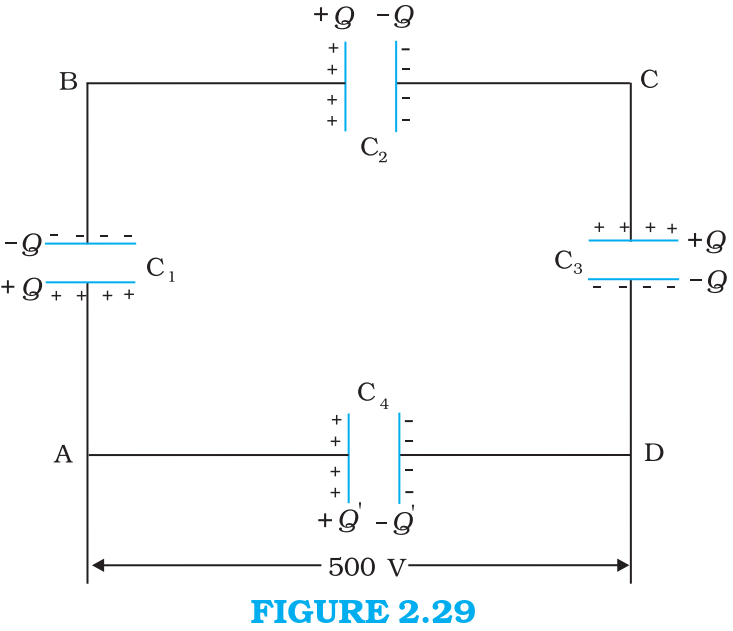
A network of four $10 \mu F$ capacitors is connected to a $500 V$ supply, as shown in Fig. 2.29. Determine (a) the equivalent capacitance of the network and (b) the charge on each capacitor. (Note, the charge on a capacitor is the charge on the plate with higher potential, equal and opposite to the charge on the plate with lower potential.)
Image
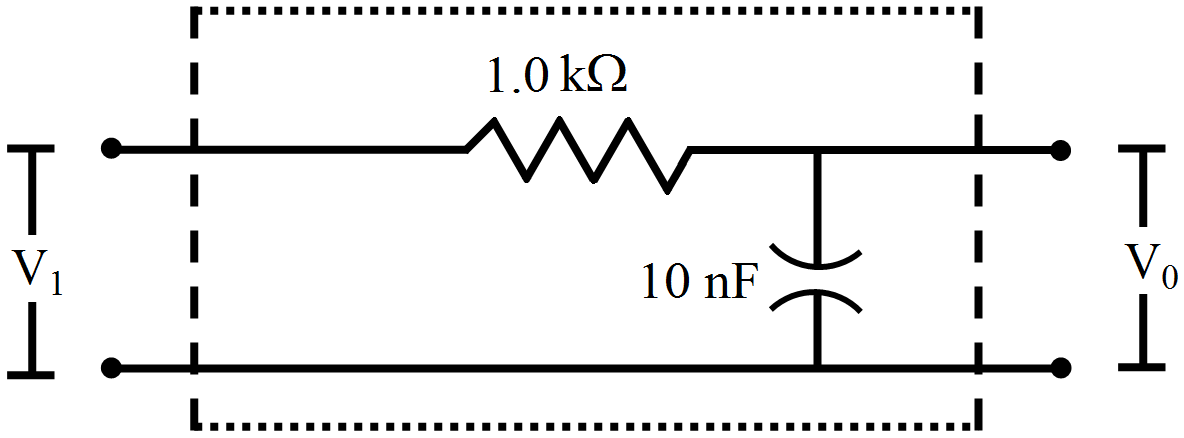
Figure shows a typical circuit for a low-pass filter. An AC input Vi = 10mV is applied at the left end and the output V0 is received at the right end. Find the output voltage for ν = 10kHz, 1.0MHz and 10.0MHz. Note that as the frequency is increased the output decreases and, hence, the name low-pass filter.

Find the energy liberated in the reaction:
223Ra → 209Pb + 14C.
The atomic masses needed are as follows.
223Ra 209Pb 14C
22.018u 208.981u 14.003u
  1. In what way is diffraction from each slit related to the interference pattern in a double slit experiment?
  2. Two wavelengths of sodium light 590 nm and 596 nm are used, in turn, to study the diffraction taking place at a single slit of aperture 2 × 10⁻⁴ m. The distance between the slit and the screen is 1.5 m. Calculate the separation between the positions of the first maxima of the diffraction pattern obtained in the two cases.
A person standing on the top of a cliff 171ft high has to throw a packet to his friend standing on the ground 228ft horizontally away. If he throws the packet directly aiming at the friend with a speed of 15.0ft/s, how short will the packet fall?
A beam of light having wavelengths distributed uniformly between 450nm to 550nm passes through a sample of hydrogen gas. Which wavelength will have the least intensity in the transmitted beam?
Three particles, each of mass 200g, are kept at the corners of an equilateral triangle of side 10cm. Find the moment of inertia of the system about an axis:
  1. Joining two of the particles.
  2. Passing through one of the particles and perpendicular to the plane of the particles.
A point charge is moving along a straight line with a constant velocity u. Consider a small area A perpendicular to the direction of motion of the charge (El). Calculate the displacement current through the area when its distance from the charge is x. The value of x is not large so that the electric field at any instant is essentially given by Coulomb's law.
