Question
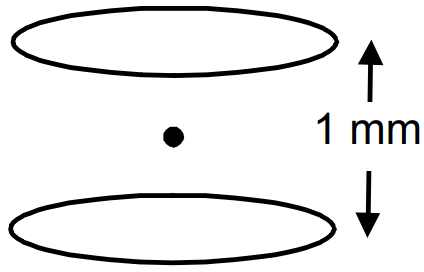
Suppose, one wishes to construct a 1.0 farad capacitor using circular discs. If the separation between the discs be kept at 1.0mm, what would be the radius of the discs?
Answer

Let the radius of the disc = R

$\therefore$ Area $=\pi\text{R}^2$

$\text{C}=1\text{f}$

$\text{D}=1\text{mm}=10^{-3}\text{m}$

$\therefore\text{C}=\frac{\in_0\text{A}}{\text{d}}$

$\Rightarrow1=\frac{8.85\times10^{-12}\times\pi\text{r}^2}{10^{-3}}$

$\Rightarrow\text{r}^2=\frac{10^{-3}\times10^{12}}{8.85\times\pi}=\frac{10^9}{27.784}$

$=5998.5\text{m}=6\text{Km}$

Need a full question paper?

Generate a complete, print-ready paper with questions like this in minutes — across 16+ boards, with answer keys.
Start Generating Free

Similar questions

Two parallel wires carry equal currents of 10A along the same direction and are separated by a distance of 2.0cm. Find the magnetic field at a point which is 2.0cm away from each of these wires
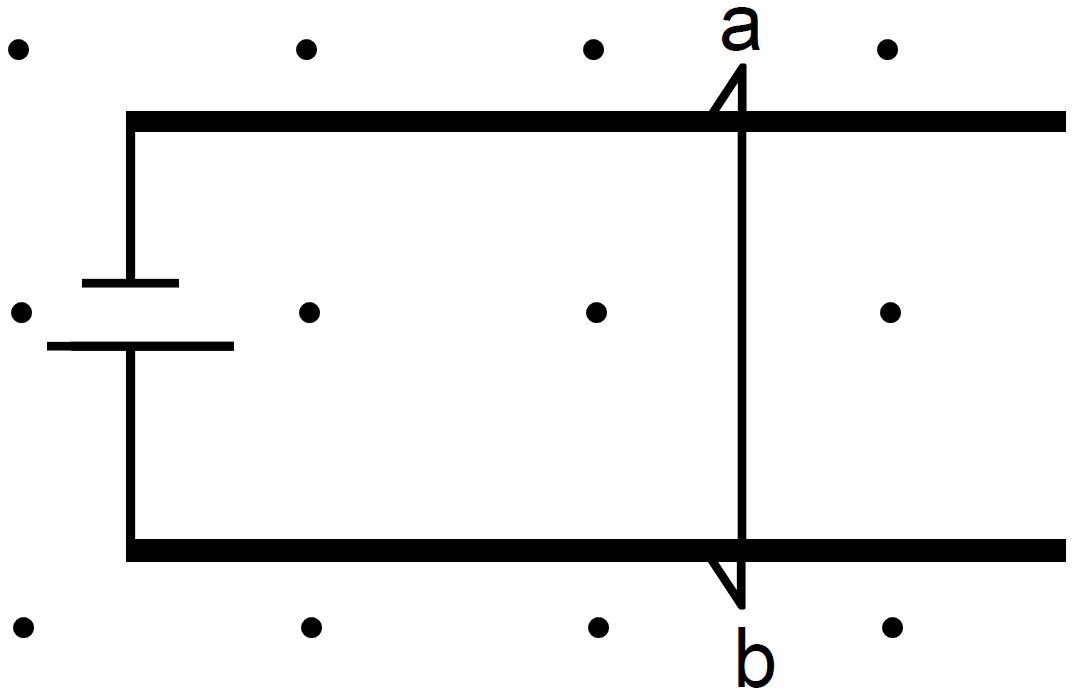
Figure shows a smooth pair of thick metallic rails connected across a battery of emf $\in$ having a negligible internal resistance. A wire ab of length l and resistance r can slide smoothly on the rails. The entire system lies in a horizontal plane and is immersed in a uniform vertical magnetic field B. At an instant t, the wire is given a small velocity u towards right.
  1. Find the current in it at this instant. What is the direction of the current?
  2. What is the force acting on the wire at this instant?
  3. Show that after some time the wire ab will slide with a constant velocity. Find this velocity.

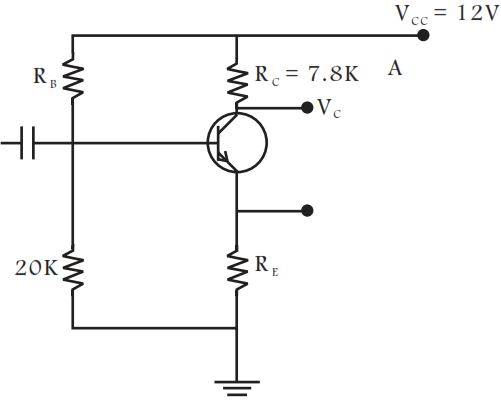
For the transistor circuit shown in Fig, evaluate VE, RB, RE given IC = 1 mA, VCE = 3V, VBE = 0.5 V and VCC = 12 V, β = 100.

An ideal diode should pass a current freely in one direction and should stop it completely in the opposite direction. Which is closer to ideal-vacuum diode or a p-n junction diode?
If the bar magnet in exercise 5.13 is turned around by 180°, where will the new null points be located?
Find the radius and energy of a He+ ion in the states (a) n = 1, (b) n = 4 and (c) n = 10.
A particle starts from the origin, goes along the X-axis to the point (20m, 0) and then returns along the same line to the point (-20m, 0). Find the distance and displacement of the particle during the trip.
A circular coil of 200 turns and radius 10 cm is placed in a uniform magnetic field of 0.5 T, normal to the plane of the coil. If the current in the coil is 3.0 A, calculate the
  1. Total torque on the coil.
  2. Total force on the coil.
  3. Average force on each electron in the coil, due to the magnetic field.
Assume the area of cross - section of the wire to be 10–5 m2 and the free electron density is 1029/m3.
Explain the formation of energy band in solids. Draw energy band diagram for (i) a conductor, (ii) an intrinsic semiconductor.
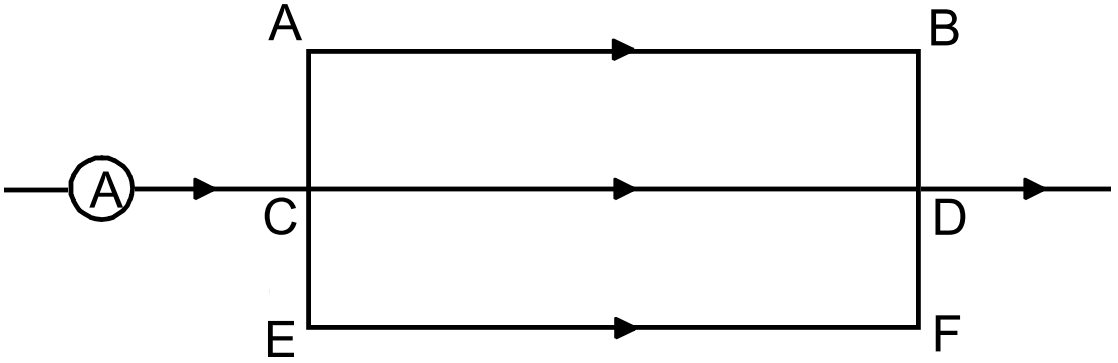
Figure shows a part of an electric circuit. The wires AB, CD and EF are long and have identical resistances. The separation between the neighbouring wires is 1.0cm. The wires AE and BF have negligible resistance and the ammeter reads 30A. Calculate the magnetic force per unit length of AB and CD.