Question
Explain why the reactance provided by a capacitor to an alternating current decreases with increasing frequency.

Answer

A capacitor does not allow flow of direct current through it as the resistance across the gap is infinite. When an alternating voltage is applied across the capacitor plates, the plates are alternately charged and discharged. The current through the capacitor is a result of this changing voltage (or charge). Thus, a capacitor will pass more current through it if the voltage is changing at a faster rate, i.e. if the frequency of supply is higher. This implies that the reactance offered by a capacitor is less with increasing frequency; it is given by $\frac{1}{\omega\text{C}}$.

Need a full question paper?

Generate a complete, print-ready paper with questions like this in minutes — across 16+ boards, with answer keys.

Start Generating Free

Similar questions

Electrons are continuously in motion within a conductor but there is no current in it unless some source of potential is applied across its ends. Give reason.
A long, vertical wire carrying a current of 10A in the upward direction is placed in a region where a horizontal magnetic field of magnitude $2.0 \times 10^{-3}T$ exists from south to north. Find the point where the resultant magnetic field is zero.
Two long straight parallel conductors carry steady current $I_1$ and $I_2$ separated by a distance d. If the currents are flowing in the same direction, show how the magnetic field set up in one produces an attractive force on the other. Obtain the expression for this force. Hence define one ampere.
Suppose that the particle in Exercise in 1.33 is an electron projected with velocity $v_x= 2.0 \times 10^6 m s^{–1}$. If E between the plates separated by 0.5 cm is $9.1 \times 10^2N/C,$ where will the electron strike the upper plate? $(|e|=1.6 \times 10^{–19}C, m_e = 9.1 \times 10^{–31} kg.)$
By what fraction does the mass of a boy increase when he starts running at a speed of 12km/h?
  1. Find equivalent capacitance between A and B in the combination given below. Each capacitor is of 2 μF capacitance.
  1. If a dc source of 7 V is connected across AB, how much charge is drawn from the source and what is the energy stored in the network?
Trace the rays which are passing through a convex lens and a concave lens.
The specification on a heater coil is 250V, 500W. Calculate the resistance of the coil. What will be the resistance of a coil of 1000W to operate at the same voltage?
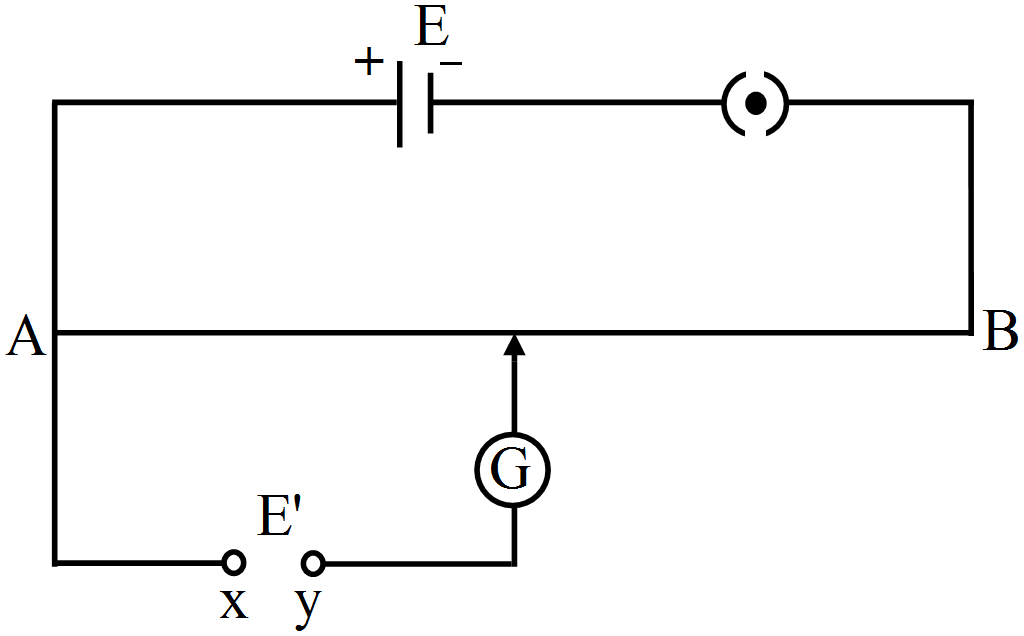
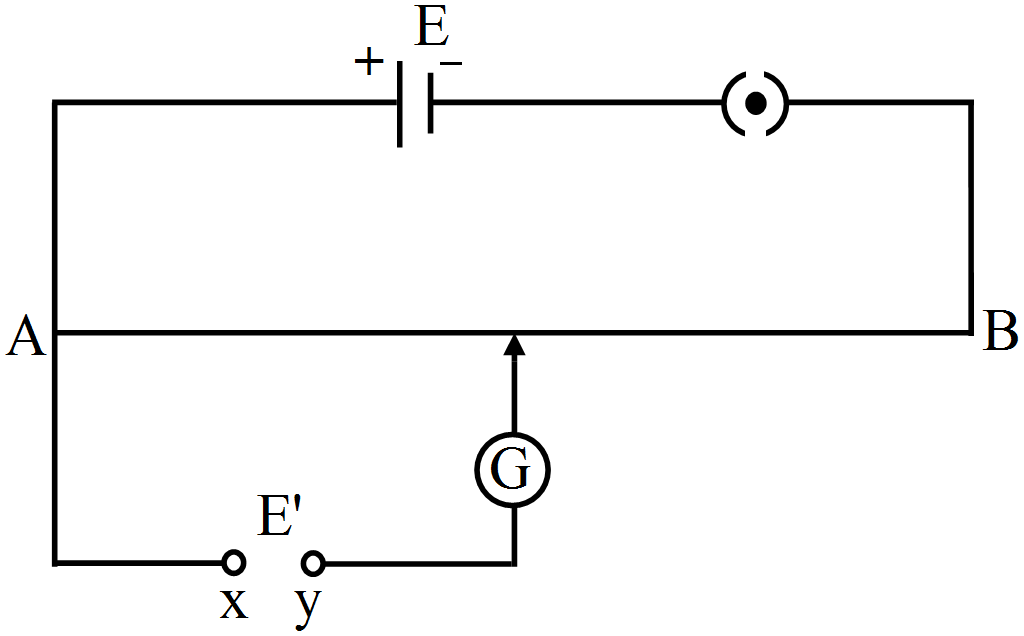
For the potentiometer circuit shown in the given figure, points X and Y represent the two terminals of an unknown emf E'. A student observed that when the jockey is moved from the end A to the end B of the potentiometer wire, the deflection in the galvanometer remains in the same direction.
What may be the two possible faults in the circuit that could result in this observation? If the galvanometer deflection at the end B is (i) more, (ii) less than at the end A, which of the two faults, listed above, would be there in the circuit? Give reason in support of your answer in each case.
(a) What happens if a bar magnet is cut into two pieces: (i) transverse to its length, (ii) along its length?
(b) A magnetised needle in a uniform magnetic field experiences a torque but no net force. An iron nail near a bar magnet, however, experiences a force of attraction in addition to a torque. Why?
(c) Must every magnetic configuration have a north pole and a south pole? What about the field due to a toroid?
(d) Two identical looking iron bars A and B are given, one of which is definitely known to be magnetised. (We do not know which one.) How would one ascertain whether or not both are magnetised? If only one is magnetised, how does one ascertain which one? [Use nothing else but the bars A and B.]