Question
Explain with diagrams the process used to $-$ separate the following substances from the given mixtures.
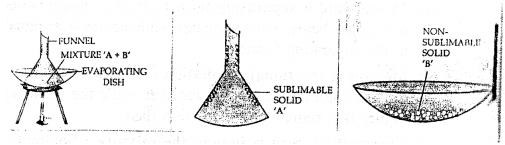
$(a)$ Ammonium chloride from a mixture of $-$ ammonium chloride $\&$  potassium chloride.
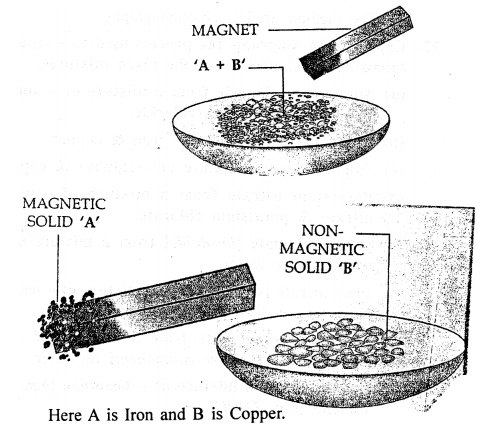
$(b)$ Iron from a mixture of $-$ iron $\&$ copper
$(c)$ Sulphur from a mixture of $-$ sulphur $\&$ copper.
$(d)$ Potassium nitrate from a mixture of $-$ potassium nitrate $\&$ potassium chlorate.
$(e)$ Lead carbonate [insoluble] from a mixture of $-$ lead carbonate $\&$ water.
$(f)$ Lead nitrate [soluble] from a mixture of $-$ lead nitrate $\&$ water Le. lead nitrate solution.
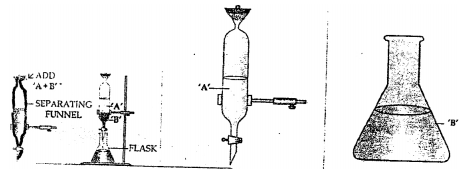
$(g)$ Carbon tetrachloride from a mixture of $-$ carbon tetrachloride $[$heavier component$]\  \&$ water.
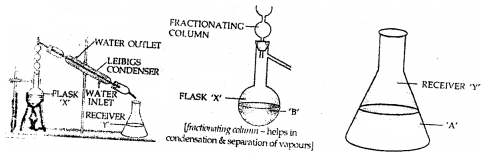
$(h)$ Benzene from a mixture of $-$ benezene $\left[\right. b.p. \left.80^{\circ} C \right]$ toluene $\left[ b . p . \ 110^{\circ} CJ\right.]$.
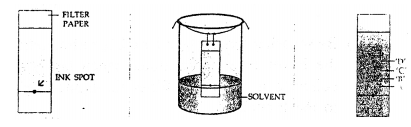
$(i)$ Different dyes $-$ in their liquid constituent ink.
Answer

$(a)$ By sublimation : On heating the mixture in evaporating dish, ammonium chloride sublimes on the walls of funnel and potassium chloride remains in evaporating dish.
Image
Here $A$ is Ammonium Chloride and $B$ is Potassium Chloride.
$(b)$ By magnetic separation : By bringing a magnet near the mixture iron pieces can be separated which will cling to the magnet.
Image
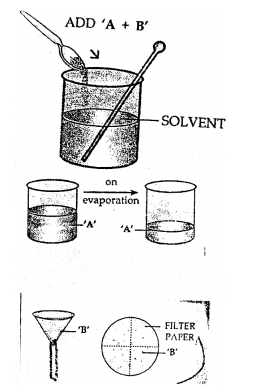
$(c)$ By solvent extraction : Mixture of copper and sulphur is added to the beaker containing solvent carbon disulphide and stirred well. Sulphur dissolves. Put this mixture on filter paper in the funnel. Copper remains on filter paper and sulphur passes into the beaker as filtrate. Sulphur separates as carbon disulphide evaporates.
Image
Here $A$ is for Copper and $B$ is Sulphur.
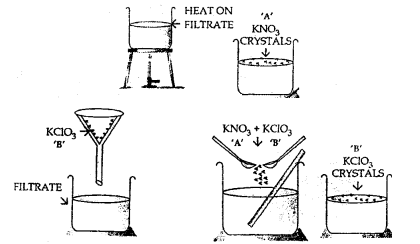
$(d)$ Potassium nitrate $\ce{KNO_3}$ is more soluble than potassium chlorate $\ce{KClO_3}$.
On heating to get saturated solution and on cooling the saturated solution less soluble $\ce{(KClO_3)}$ crystallise out. More soluble $\ce{KNO_3}$ is filtered out from hot saturated solution , and is recrystallised from hot water and dried.
Image
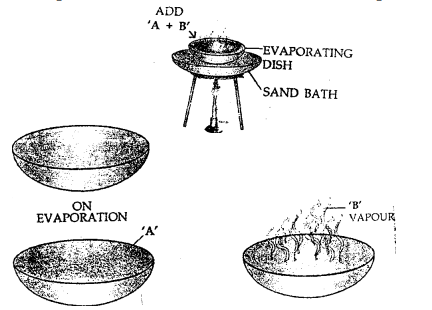
$(e)$ Evaporation : Lead carbonate can be separated by evaporation. On evaporation, water evaporates leaving behind solid lead carbonate which has higher $\ce{M.P}$.
Image
$(f)$ Lead nitrate is separated from soluble lead nitrate solution by crystallisation.
Image
$(g)$ By separing funnel, heavier $\ce{CCl_4}$ carbon tetrachloride form the lower layer is separated when tap is opened and is collected in the flask. Water the lighter top layer remains in the funnel.
Image
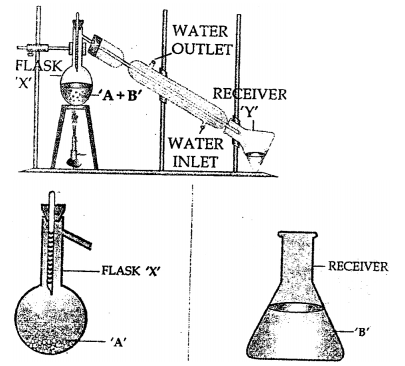
$(h)$ By fractional distillation, miscible low boiling point benzene $(B.P. 80^\circ C)$ evaporates on heating the mixture and condenses in and collects in flask $‘Y’$ where as higher boiling pt. Toluene $(B.P. 110^\circ C)$ remains in flask $‘X’$ after condensation.
Image
$(i)$ By chromatography : Different dyes $[$solid constituents i. e. $\ce{A, B, C, D]}$ in ink which is the liquid constituent. By placing the ink spot containing different solid constituents $[$dyes$]$ on the filter paper. Filter paper is hung with it’s lower end completely dipped in the solvent.
Image
The solvent flows over the ink spot and the solid constituents $[$dyes $\ce{‘A’, ‘B’, ‘C’, ‘D’]}$ separate out.

Need a full question paper?

Generate a complete, print-ready paper with questions like this in minutes — across 16+ boards, with answer keys.

Start Generating Free

Similar questions

Explain in brief $–$ Goldstein’s experiment which led to the discovery of the proton and $–$ Lod Rutherford’s experiment which led to the discovery of the atomic nucleus.
What do you observe when, barium chloride solution is mixed with sodium sulphate solution ?
(a) Define sublimation. State the kind of mixture in which this method is used.
(b) How can you separate the components of the mixture of kerosene oil and water? Mention the principle involved in it.
Draw the atomic diagrams of the following elements showing the distribution of $-$ protons, neutrons  the electrons in the various shells of the atoms.
$a$. Carbon $-{ }^{12} C$
$b$. Oxygen $-{ }_8^{16} O$
$c$. Phosphorus $-{ }^{31}{ }_{15} P$
$d$. Argon $-{ }^{40}{ }_{18} Ar$
$e$. Calcium $-{ }_{20}^{40} Ca$
$[$The upper number represents the $-$ mass number $\ $ the lower number the $ -$ atomic number e.g. calcium $-$ mass number $=40$, atomic number $=20]$
State the main postulates of kinetic theory of matter.
State the mass number, the atomic number, number of neutrons and electronic configuration of the following atoms.
${ }_6^{12} \mathrm{C},{ }_8^{16} \mathrm{O},{ }_9^{19} \mathrm{~F},{ }_{10}^{20} \mathrm{Ne},{ }_{13} \mathrm{Al}^{27},{ }_{17} \mathrm{Cl}^{35}$
Also, draw atomic diagrams for them.
Give the symbols and valencies of following radicals:
$(a)$ Hydroxide $(b)$ Chloride
$(c)$ Carbonate $(d)$ ammonium
$(e)$ Nitrate
Differentiate between :
Reversible and irreversible changes
Elements are broadly classified into metals $\&$ non$-$metals. State six general differences in physical properties of metals $\&$ non$-$metals. State two metals & two non-metals which contradict with the general physical properties $–$ giving y between metalloids $\&$ noble gases.
Give four difference between physical and chemical changes.