Question 14 Marks
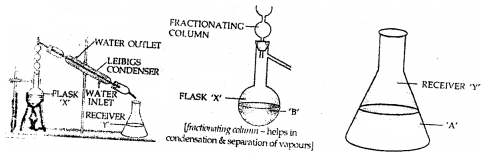
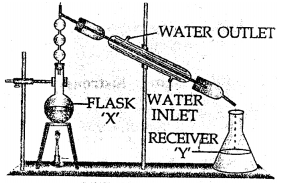
The diagram represents fractional distillation for separation mixtures. Answer the following
$1.$ Can two immiscible liquids be separated by this process.
$2.$ Separation of liquids by this process is based on which physical property?
$3.$ If methyl alcohol $\&$ water are to be separated, which liquid would remain in flask ‘$X$’ after condensation.
$4.$ Give a reason for the above answer.
$5.$ State the purpose of the fractionating column in the apparatus.
$1.$ Can two immiscible liquids be separated by this process.
$2.$ Separation of liquids by this process is based on which physical property?
$3.$ If methyl alcohol $\&$ water are to be separated, which liquid would remain in flask ‘$X$’ after condensation.
$4.$ Give a reason for the above answer.
$5.$ State the purpose of the fractionating column in the apparatus.
Answer
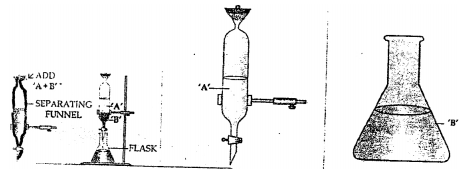
View full question & answer→$1.$ No, they can be separated by separating funnel.
$2.$ The physical property on which separation is based "Difference in their boiling points."
$3.$ Water having boiling point $100^{\circ} C$ will remain in flask ' $X$ '.
$4.$ Alcohol having lower $B.P. 78^{\circ} C$ will evaporate first and condense in the conical flask - receiver ' $Y^{\prime}$.
$5.$ The upper part of the 'Fractionating column is cooler, so as the hot vapours rise up in the column, they get cooled $($condense$)$ and trickle back into the distillation flask ' $X$ '.
$2.$ The physical property on which separation is based "Difference in their boiling points."
$3.$ Water having boiling point $100^{\circ} C$ will remain in flask ' $X$ '.
$4.$ Alcohol having lower $B.P. 78^{\circ} C$ will evaporate first and condense in the conical flask - receiver ' $Y^{\prime}$.
$5.$ The upper part of the 'Fractionating column is cooler, so as the hot vapours rise up in the column, they get cooled $($condense$)$ and trickle back into the distillation flask ' $X$ '.