Current Electricity — Physics STD 12 Science — Question
Maharashtra BoardEnglish MediumSTD 12 SciencePhysicsCurrent Electricity4 Marks
Question
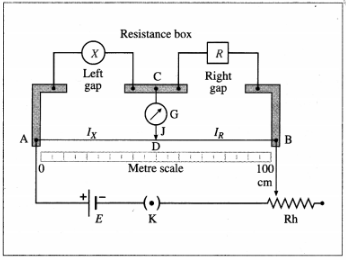
Explain with neat circuit diagram, how you will determine the unknown resistance by using a meter-bridge.
✓
Answer
A metre bridge consists of a rectangular wooden board with two L-shaped thick metallic strips fixed along its three edges. A single thick metallic strip separates two L-shaped strips. A wire of length one metre and uniform cross section is stretched on a metre scale fixed on the wooden board. The ends of the wire are fixed to the L-shaped metallic strips.
An unknown resistance X is connected in the left gap and a resistance box R is connected in the right gap as shown in above figure. One end of a centre-zero galvanometer (G) is connected to terminal C and the other end is connected to a pencil jockey (J). A cell (E) of emf E, plug key (K) and rheostat (Rh) are connected in series between points A and B.
Working : Keeping a suitable resistance (R) in the resistance box, key K is closed to pass a current through the circuit. The jockey is tapped along the wire to locate the equipotential point D when the galvanometer shows zero deflection. The bridge is then balanced and point D is called the null point and the method is called as null deflection method. The distances $l_X$ and $l_R$ of the null point from the two ends of the wire are measured.
$ \frac{X}{R}=\frac{\text { resistance of the wire of length } l_X\left(R_{ AD }\right)}{\text { resistance of the wire of length } l_R\left(R_{ DB }\right)}$
$\therefore \frac{X}{R}=\frac{R_{ AD }}{R_{ DB }} $
Now, $R=\rho \frac{l}{A} \quad$ where $l$ is the length of the wire, $\rho$ is the resistivity of the material of the wire and $A$ is the area of cross section of the wire.
$ \therefore R_{ AD }=\rho \frac{l_{ X }}{A} \text { and } R_{ DB }=\rho \frac{l_{ R }}{A}$
$\therefore \frac{X}{R}=\frac{R_{ AD }}{R_{ DC }}=\frac{\rho l _{ x } / A}{\rho l_{ R } / A } $
$\begin{aligned} \therefore \frac{X}{R} & =\frac{l_X}{l_R} \\ \therefore X & =\frac{l_X}{l_R} \times R\end{aligned}$
As R, $l_X$ and $l_R$ are known, the unknown resistance X can be calculated.
Need a full question paper?
Generate a complete, print-ready paper with questions like this in minutes — across 16+ boards, with answer keys.