Question
Explain with proper diagram, the application of a $p$ - $n$ junction diode as a halfwave rectifier.

Answer


Image
Image
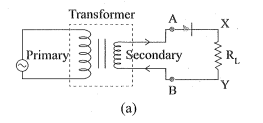
The circuit diagram for the half-wave rectifier is shown in the figure. One $p-n$ junction diode is required in the half wave rectifier circuit.
As shown in fig. (a), the primary coil of a step down transformer is connected to an A.C. source. The secondary coil of transformer is connected in series with the $p-n$ junction diode and load resistance $R_L$.
The secondary of a transformer supplies the desired ac voltage across terminals A and B. When A is positive the diode is forward biased and it conducts. So, some output voltage is obtained between two terminals of load resistance $R_L$.
When A is negative, the diode is reverse-biased and it does not conduct. The reverse saturation current of a diode is negligible and can be considered equal to zero for practical purposes.
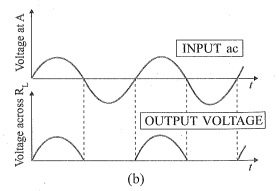
As shown in fig. (b), in the positive half cycle of ac there is a current through the load resistor $R _{ L }$ and we get an output voltage. Whereas there is no current in the negative half-cycle. In the next positive half cycle, again we get the output voltage.
Thus, the output voltage, though still varying, is restricted to only one direction and is said to be rectified. Since the rectified output of this circuit is only for half of the input ac wave so it is called the half-wave rectifier.

Need a full question paper?

Generate a complete, print-ready paper with questions like this in minutes — across 16+ boards, with answer keys.
Start Generating Free

Similar questions

A p-n photodiode is fabricated from a semiconductor with band gap of 2.8 eV. Can it detect a wavelength of 6000 nm?
Can two particles be in equilibrium under the action of their mutual gravitational force? Can three particles be? Can one of the three particles be?
  1. Write the functions of three segments of a transistor.
  2. Draw the circuit diagram for studying the input and output characteristics of n-p-n transistor in common emitter configuration. Using the circuit, explain how input, output characteristics are obtained.
A circular coil of one turn of radius 5.0cm is rotated about a diameter w!th a constant angular speed of 80 revolutions per minute. A uniform magnetic field B = 0.010T exists in a direction perpendicular to the axis of rotation. Find
  1. The maximum emf induced.
  2. The average emf induced in the coil over a long period.
  3. The average of the squares of emf induced over a lone period.
Do all the thermocouples have a neutral temperature?
Consider the situation of the previous problem. A particle having charge q and mass m is projected from the point Q in a direction going into the plane of the diagram. It is found to describe a circle of radius r between the two plates. Find the speed of the charged particle.
Find the ratio of the lengths of an iron rod and an aluminium rod for which the difference in the lengths is independent of temperature. Coefficients of linear expansion of iron and aluminium are ${12 \times 10^{-6}}  ^\circ C^{-1}$ and ${23 \times 10^{-6}}^\circ C^{-1}$ respectively.
  1. Using de Broglie's hypothesis, explain with the help of a suitable diagram, Bohr's second postulate of quantization of energy levels in a hydrogen atom.
  2. The ground state energy of hydrogen atom is - 13.6 eV. What are the kinetic and potential energies of the electron in this state?
An object is placed at $(i) 10 \ cm, (ii) 5 \ cm$ in front of a concave mirror of radius of curvature $15 \ cm$. Find the position, nature, and magnification of the image in each case.
A spherical shell made of plastic, contains a charge Q distributed uniformly over its surface. What is the electric field inside the shell? If the shell is hammered to deshape it without altering the charge, will the field inside be changed? What happens if the shell is made of a metal?