Question
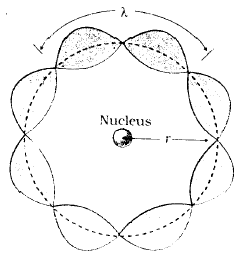
  1. Using de Broglie's hypothesis, explain with the help of a suitable diagram, Bohr's second postulate of quantization of energy levels in a hydrogen atom.
  2. The ground state energy of hydrogen atom is - 13.6 eV. What are the kinetic and potential energies of the electron in this state?
Answer

  1. $\lambda = \frac{\text{h}}{\text{p}} = \frac{\text{h}}{\text{mv}}$


$2\pi\text{r} = \text{n}\lambda$

$ =\text{n}\frac{\text{h}}{\text{mv}}$

$\Rightarrow\text{mvr} = \text{L} = \frac{\text{nh}}{2\pi}$
  1. Kinetic energy=13.6 eV
Potential energy = -27.2 eV.

Need a full question paper?

Generate a complete, print-ready paper with questions like this in minutes — across 16+ boards, with answer keys.

Start Generating Free

Similar questions

Three equal charges, $2.0 \times 10^{-6}C$ each, are held fixed at the three corners of an equilateral triangle of side 5cm. Find the Coulomb force experienced by one of the charges due to the rest two.
A long, straight wire of radius r carries a current i and is placed horizontally in a uniform magnetic field B pointing vertically upward. The current is uniformly distributed over its cross-section.
  1. At what points will the resultant magnetic field have maximum magnitude? What will be the maximum magnitude?
  2. What will be the minimum magnitude of the resultant magnetic field?
A block of mass 0.5kg hanging from a vertical spring executes simple harmonic motion of amplitude 0.1m and time period 0.314s. Find the maximum force exerted by. the spring on the block.
If mercury and glass had equal coefficient of volume expansion, could we make a mercury thermometer in a glass tube?
Is the motion of a charge across junction momentum conserving? Why or why not?
A thin conducting spherical shell of radius R has charge Q spread uniformly over its surface. Using Gauss’s law, derive an expression for an electric field at a point outside the shell.Draw a graph of electric field E(r) with distance r from the centre of the shell for $0\underline{<}\text{r}\underline{<}\infty.$
Radioactive isotopes are produced in a nuclear physics experiment at a constant rate $\frac{\text{dN}}{\text{dt}}=\text{R}.$ An inductor of inductance 100mH, a resistor of resistance $100\Omega$ and a battery are connected to form a series circuit. The circuit is switched on at the instant the production of radioactive isotope starts. It is found that $\frac{\text{i}}{\text{N}}$ remains constant in time where i is the current in the circuit at time t and N is the number of active nuclei at time t. Find the half-life of the isotope.
  1. Write the important properties of photons which are used to establish Einstein’s photoelectric equation.
  2. Use this equation to explain the concept of (i) threshold frequency and, (ii) Stopping potential.
A charge of $+2.0 \times 10^{-8}C$ is placed on the positive plate and a charge of $-1.0 \times 10^{-8}C$ on the negative plate of a parallel-plate capacitor of capacitance $1.2\times10^{-3}\mu\text{F}.$ Calculate the potential difference developed between the plates.
Give reasons for the following:
  1. The Zener diode is fabricated by heavily doping both the p and n sides of the junction.
  2. A photodiode, when used as a detector of optical signals is operated under reverse bias.
  3. The band gap of the semiconductor used for fabrication of visible LED’s must at least be 1.8eV.