Question
Explain with proper diagram, the application of a $p$ - $n$ junction diode as a halfwave rectifier.

Answer


Image
Image
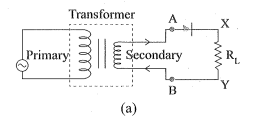
The circuit diagram for the half-wave rectifier is shown in the figure. One $p-n$ junction diode is required in the half wave rectifier circuit.
As shown in fig. (a), the primary coil of a step down transformer is connected to an A.C. source. The secondary coil of transformer is connected in series with the $p-n$ junction diode and load resistance $R_L$.
The secondary of a transformer supplies the desired ac voltage across terminals A and B. When A is positive the diode is forward biased and it conducts. So, some output voltage is obtained between two terminals of load resistance $R_L$.
When A is negative, the diode is reverse-biased and it does not conduct. The reverse saturation current of a diode is negligible and can be considered equal to zero for practical purposes.
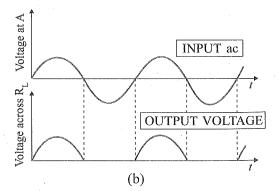
As shown in fig. (b), in the positive half cycle of ac there is a current through the load resistor $R _{ L }$ and we get an output voltage. Whereas there is no current in the negative half-cycle. In the next positive half cycle, again we get the output voltage.
Thus, the output voltage, though still varying, is restricted to only one direction and is said to be rectified. Since the rectified output of this circuit is only for half of the input ac wave so it is called the half-wave rectifier.

Need a full question paper?

Generate a complete, print-ready paper with questions like this in minutes — across 16+ boards, with answer keys.
Start Generating Free

Similar questions

For given time interval. Show the graphical representation at different angles for some $\alpha$-particle scattering.
A capacitor of unknown capacitance, a resistor of 100 $\Omega$ and an inductor of self inductance L = $( 4 /\pi^{2})$henry are connected in series to an ac source of 200V and 50 Hz. Calculate the value of the capacitance and impedance of the circuit when the current is in phase with the voltage. Calculate the power dissipated in the circuit.
Give explanation of Conductor, Semiconductor and insulator on the basis of band theory.
Explain the de-Broglie wavelength by explaining the waveform of matter.
The numerical value of ionization energy in eV equals the ionization potential in volts. Does the equality hold if these quantities are measured in some other units?
Repeat the previous exercise if the angle between each pair of springs is 120° initially.
The electric field in a region is given by $\overrightarrow{\text{E}}=\frac{3}{5}\text{E}_0\overrightarrow{\text{i}}+\frac{4}{5}\text{E}_0\overrightarrow{\text{j}}$ with $\text{E}_0=2.0\times10^3\text{NC}^{-1}.$ Find the flux of this field through a rectangular surface of area 0.2m2 parallel to the y-z plane.
A coil of resistance $100\Omega$ is connected across a battery of emf 6.0V. Assume that the heat developed in the coil is used to raise its temperature. If the heat capacity of the coil is 4.0J/K, how long will it take to raise the temperature of the coil by 15°C?
A partially plane polarised beam of light is passed through a Polaroid. Show graphically the variation of the transmitted light intensity with angle of rotation of the Polaroid.
An electromagnetic wave of wavelength $\lambda$ is incident on a photosensitive surface of negligible work function. If the photoelectrons emitted from the surface have the same de Broglie wavelength $\lambda\text{B,}$ prove that $\lambda=\Big(\frac{2\text{mc}}{\text{h}}\Big)\lambda^2_\text{B}.$