MCQ
Field lines start from$........$ charges and ends at $........$ charges.
  • A
    Negative, positive.
  • Positive, negative.
  • C
    Positive, positive.
  • D
    Negative, negative.

Answer

Correct option: B.
Positive, negative.

Need a full question paper?

Generate a complete, print-ready paper with questions like this in minutes — across 16+ boards, with answer keys.
Start Generating Free

Similar questions

A resistor and an pure inductor are connected to an ac supply of $120\,V$ and $50\,Hz$. The current in the circuit is $3\,A$. If the power consumed in the circuit is $108\,W$, then the resistance in the circuit is.....$\Omega $
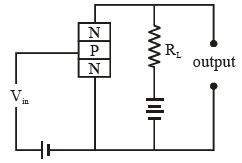
An $NPN$ transistor circuit is arranged as shown in figure. It is
A circular loop carrying a current is replaced by an equivalent magnetic dipole. A point on the loop is in:
The threshold wavelength of tungsten is $2300\, \mathring A.$ If ultraviolet light of wavelength $1800\,\mathring A$ is incident on it, then the maximum kinetic energy of photoelectrons would be about, ............ $eV$
Two resistors having equal resistances are joined in series and a current is passed through the combination. Neglect any variation in resistance as the temperature changes. In a given time interval
A physical quantity is measured and the result is expressed as nu where u is the unit used and n is the numerical value. If the result is expressed in various units then:
For a crystal system, $a = b = c, a = b = g^1\ 90^\circ$, the system is
The number of electrons to be put on a spherical conductor of radius $0.1\,m$ to produce an electric field of $0.036\, N/C$ just above its surface is
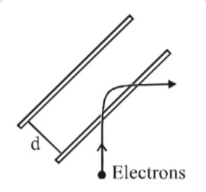
A problem of practical interest is to make a beam of electrons turn at $90^{\circ}$ corner. This can be done with the parallel plates shown in figure. An electron with kinetic energy $8.0 \times 10^{-17} J$ enters through a small hole in the bottom plate. The strength of electric field that is needed if the electron is to emerge from an exit hole 1.0 cm away from the entrance hole, traveling at right angles to its original direction is........... $\times 10^5 N / C$.
Radius of first Bohr orbit is $r$. What is the radius of $2^{nd}$ Bohr orbit $ ?$