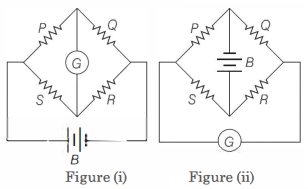
Figure $(i)$ below shows a Wheatstone's bridge in which $P, Q, R$ and $S$ are fixed resistances, $G$ is a galvanometer and $B$ is a battery. For this particular case, the galvanometer shows zero deflection. Now, only the positions of $B$ and $G$ are interchanged, as shown in figure $(ii)$. The new deflection of the galvanometer
KVPY 2010, Medium


Download our appand get started for free
Experience the future of education. Simply download our apps or reach out to us for more information. Let's shape the future of learning together!No signup needed.*
Similar Questions
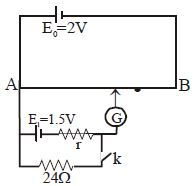
- 1For the arrangement of the potentiometer shown in the figure, the balance point is obtained at $a$ distance $75\,cm $ from $A$ when the key $k$ is open. The second balance point is obtained at $60\, cm$ from $A$ when the key $k$ is closed. Find the internal resistance (in $ \Omega$) of the battery $E_1$.View Solution
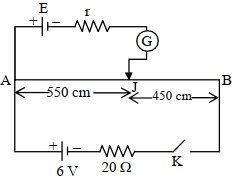
- 2In the given figure, there is a circuit of potentiometer of length $A B=10 \,{m}$. The resistance per unit length is $0.1 \,\Omega$ per ${cm}$. Across ${AB}$, a battery of emf ${E}$ and internal resistance ' ${r}^{\prime}$ is connected. The maximum value of emf measured by this potentiometer is : (In $V$)View Solution
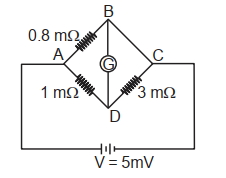
- 3To measure the temperature coefficient of resistivity $\alpha$ of a semiconductor, an electrical arrangement shown in the figure is prepared. The arm BC is made up of the semiconductor. The experiment is being conducted at $25^{\circ} \mathrm{C}$ and resistance of the semiconductor arm is $3 \mathrm{~m} \Omega$. Arm BC is cooled at a constant rate of $2^{\circ} \mathrm{C} / \mathrm{s}$. If the galvanometer $\mathrm{G}$ shows no deflection after $10 \mathrm{~s}$, then $\alpha$ is :View Solution
- 4It is preferable to measure the $e.m.f.$ of a cell by potentiometer than by a voltmeter because of the following possible reasons.View Solution
$(i)$ In case of potentiometer, no current flows through the cell.
$(ii)$ The length of the potentiometer allows greater precision.
$(iii)$ Measurement by the potentiometer is quicker.
$(iv)$ The sensitivity of the galvanometer, when using a potentiometer is not relevant.
Which of these reasons are correct? - 5Two electric bulbs have tungsten filament of same length. If one of them gives $60\ W$ and the other $100\ W$ , thenView Solution
- 6A car has a fresh battery of $e.m.f$. $12\, V$ and internal resistance of $0.05\, \Omega$. If the starter motor draws a current of $90\, A$, the terminal voltage when the starter is on will be ............... $V$View Solution
- 7In a conductor $4$ coulombs of charge flows for $2$ seconds. The value of electric current will beView Solution
- 8View SolutionWhen a current flows through a conductor its temperature
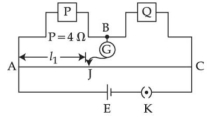
- 9Resistance are connected in a meter bridge circuit as shown in the figure. The balancing length $l_{1}$ is $40\,cm$. Now an unknown resistance $x$ is connected in series with $P$ and new balancing length is found to be $80\,cm$ measured from the same end. Then the value of $x$ will be $.......\Omega$View Solution
- 10A $500\, W$ heating unit is designed to operate from a $115\, volt$ line. If the line voltage drops to $110\, volt$, the percentage drop in heat output will be ............... $\%$View Solution