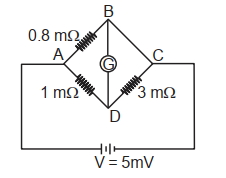
To measure the temperature coefficient of resistivity $\alpha$ of a semiconductor, an electrical arrangement shown in the figure is prepared. The arm BC is made up of the semiconductor. The experiment is being conducted at $25^{\circ} \mathrm{C}$ and resistance of the semiconductor arm is $3 \mathrm{~m} \Omega$. Arm BC is cooled at a constant rate of $2^{\circ} \mathrm{C} / \mathrm{s}$. If the galvanometer $\mathrm{G}$ shows no deflection after $10 \mathrm{~s}$, then $\alpha$ is :
JEE MAIN 2024, Diffcult
Download our app for free and get started
For no deflection $\frac{0.8}{1}=\frac{R}{3}$
$\Rightarrow \mathrm{R}=2.4 \mathrm{~m} \Omega$
Temperature fall in $10 \mathrm{~s}=20^{\circ} \mathrm{C}$
$\Delta \mathrm{R}=\mathrm{R} \alpha \Delta \mathrm{t}$
$\alpha=\frac{\Delta \mathrm{R}}{\mathrm{R} \Delta \mathrm{t}}=\frac{-0.6}{3 \times 20}$
$=-10^{-2} \mathrm{C}^{-1}$

Download our appand get started for free
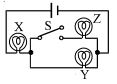
Experience the future of education. Simply download our apps or reach out to us for more information. Let's shape the future of learning together!No signup needed.*
Similar Questions
- 1View SolutionThe resistance of an incandescent lamp is
- 2Column $- I$ gives certain physical terms associated with flow of current through a metallic conductor. Column $- II$ gives some mathematical relations involving electrical quantities. Match Column $- I$ and Column $- II$ with appropriate relations.View Solution
Column $- I$ Column $- II$ $(A)$ Drift Velocity $(P)$ $\frac{m}{n e^{2} \rho}$ $(B)$ Electrical Resistivity $(Q)$ $\mathrm{ne} v_{\mathrm{d}}$ $(C)$ Relaxation Period $(R)$ $\frac{\mathrm{eE}}{\mathrm{m}} \tau$ $(D)$ Current Density $(S)$ $\frac{E}{J}$ - 3$n$ identical cells each of $e.m.f.$ $E$ and internal resistance $r$ are connected in series. An external resistance $R$ is connected in series to this combination. The current through $R$ isView Solution
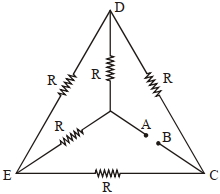
- 4Five equal resistances are connected in a network as shown in figure. The net resistance between the points $A$ and $B$ isView Solution
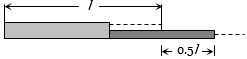
- 5In order to quadruple the resistance of a uniform wire, a part of its length was uniformly stretched till the final length of the entire wire was $1.5$ times the original length, the part of the wire was fraction equal toView Solution
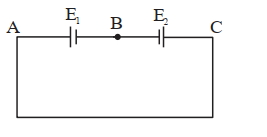
- 6Two cells are connected in opposition as shown. Cell $\mathrm{E}_1$ is of $8 \mathrm{~V}$ emf and $2 \ \Omega$ internal resistance; the cell $E_2$ is of $2 \mathrm{~V}$ emf and $4\ \Omega$ internal resistance. The terminal potential difference of cell $\mathrm{E}_2$ is:View Solution
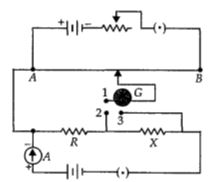
- 7A potentiometer circuit is set up as shown. The potential gradient, across the potentiometer wire, is $k$ $volt/cm$ and the ammeter, present in the circuit, reads $1.0\,\, A$ when two way key is switched off. The balance points, when the key between the terminals $(i)$ $1$ and $2$ $(ii)$ $1$ and $3,$ is plugged in, are found to be at lengths $l_1$ and $l_2$ respectively. The magnitudes, of the resistors $R$ and $X,$ in $ohms$, are then, equal, respectively, toView Solution
- 8The temperature dependence of resistances of $Cu$ and undoped $Si$ in the temperature range $300-400\ K$, is best described byView Solution
- 9A galvanometer of resistance, $G,$ is connected in a circuit. Now a resistance $R$ is connected in series of galvanometer. To keep the main current in the circuit unchanged, the resistance to be put in parallel with the series combination of $G$ and $R$ isView Solution
- 10If $X, Y$ and $Z$ in figure are identical lamps, which of the following changes to the brightnesses of the lamps occur when switch $S$ is closed?View Solution